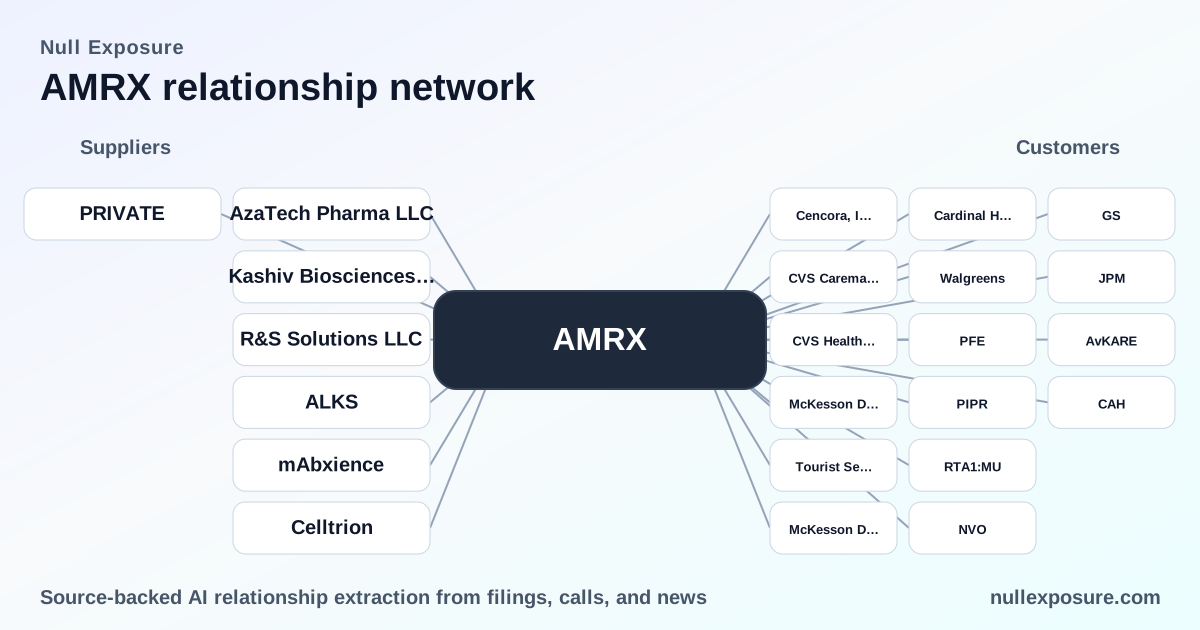
Amneal Pharmaceuticals (AMRX): Who actually buys the drugs and where the risk lives
Amneal operates and monetizes as a manufacturer and marketer of generic and specialty pharmaceuticals that sells volume through major wholesalers, retail pharmacy chains, institutional distributors and a government-focused distribution arm called AvKARE. The company generates revenue by supplying finished dosage products and specialty launches to a concentrated set of large buyers, while capturing incremental margin through specialty partnerships and government distribution services.
For a concise overview of Amneal’s data and filings, visit https://nullexposure.com/.
The investor thesis in one line
Amneal is a volume-driven generics platform with a concentrated customer base; upside depends on specialty growth and partnerships, while downside is dominated by distribution concentration and government channel complexity.
Concentration, channels and why customers matter
Amneal’s commercial model is straightforward: large-scale manufacturing of generics and select specialty products, distributed primarily through a small number of wholesalers and retail chains, plus a government-facing distribution segment (AvKARE). This structure produces strong operating leverage on volume but creates outsized counterparty risk because a handful of customers account for the bulk of revenue. According to Amneal’s FY2024 Form 10‑K, the four largest customers—Cencora, McKesson, Cardinal Health and CVS Health—collectively drove roughly 70% of net revenue in 2024. That concentration is a structural risk to earnings stability.
Explore more on company filings and relationship signals at https://nullexposure.com/.
Key operating constraints that shape the playbook
- Revenue concentration is critical. The top four customers historically account for ~70% of sales, which makes the company dependent on a few large buyers for cash flow and order predictability (FY2024 10‑K).
- Significant government exposure via AvKARE. AvKARE focuses on U.S. Department of Defense and Veterans Affairs accounts and acts as a re‑packager and distributor, adding both margin diversification and contract complexity (10‑K; GlobeNewswire FY2025–FY2026 releases).
- Large enterprise buyers dominate contracting posture. Amneal negotiates with consolidated wholesalers and retail chains that command strong commercial terms; this places pricing pressure on generics margin and increases bargaining leverage of counterparties (10‑K).
- Distribution maturity and role diversity. Amneal’s commercial footprint includes direct sales, wholesale distribution, repackaging and institutional supply—this breadth lowers single-channel risk but increases operational complexity (10‑K).
Customer-by-customer—what the public record shows
Below are the relationships identified in public filings and earnings calls. Each entry summarizes the relationship in plain English with source context.
-
Cencora, Inc.
Cencora is one of Amneal’s four largest customers and is part of the concentrated wholesaler channel that accounted for roughly 70% of Amneal’s net revenue in FY2024. According to Amneal’s FY2024 Form 10‑K, Cencora is explicitly listed among the top four customers driving the majority of sales. -
McKesson Drug Co.
McKesson is named in Amneal’s FY2024 10‑K as one of the company’s four largest customers, representing a material share of net sales and forming part of the company’s essential distribution backbone (FY2024 Form 10‑K). -
McKesson Drug Company
The filing also references McKesson under this variant of the name when describing industry alliances and distribution partnerships, reinforcing McKesson’s role in Amneal’s wholesale channel (FY2024 10‑K). -
Cardinal Health, Inc.
Cardinal Health is similarly enumerated among the four largest customers in Amneal’s FY2024 Form 10‑K and is cited as a core channel partner in the company’s distribution network. -
Cardinal Health (CAH)
A separate line in the results lists Cardinal Health with ticker CAH, reiterating its inclusion as a major wholesaler customer in the FY2024 10‑K. -
CVS Caremark
CVS Caremark is cited in Amneal’s 10‑K as an example of retailer–wholesaler alliances; the company is part of the concentrated customer set that drives a large portion of Amneal’s sales (FY2024 10‑K). -
CVS Health Corporation
The FY2024 10‑K explicitly names CVS Health Corporation as one of the four largest customers accounting for approximately 70% of net revenue, underscoring its materiality to Amneal’s topline. -
Walgreens
Walgreens is referenced in the FY2024 10‑K as an example of alliances between wholesalers and retailers; it is part of the commercial landscape Amneal sells into via large buyers and co‑operative arrangements. -
Rite Aid / RTA1:MU
Rite Aid is cited in the FY2024 10‑K as an example of the retail–wholesale alliance environment; the filing references the company alongside large wholesalers when describing distribution market structure. -
AvKARE
AvKARE is Amneal’s government‑focused distribution and repackaging segment; Amneal’s public releases (GlobeNewswire FY2025 and FY2026 financial results) and the FY2024 Form 10‑K state that revenue and gross profit from AvKARE product sales are included in the Affordable Medicines segment and that AvKARE primarily serves the U.S. Department of Defense and Veterans Affairs. AvKARE functions as a distributor and re‑packager, adding government contract exposure and a differentiated revenue stream (GlobeNewswire press releases; FY2024 Form 10‑K). -
Pfizer (PFE)
Amneal has an active collaboration with Pfizer on GLP‑1 products; per Amneal’s Q4 2025 earnings call, the companies report the collaboration is progressing well and both teams are working together on development and commercialization activities (Q4 2025 earnings call). -
PFE
The PFE ticker appears in earnings materials referencing the same Pfizer collaboration on GLP‑1s, corroborating the partnership noted on Amneal’s Q4 2025 call. -
Novo (NVO)
During Amneal’s Q3 2025 earnings call, management discussed a higher bid from Novo for Metsera, reflecting external M&A activity that could affect Amneal’s partnership dynamics and existing agreements (Q3 2025 earnings call). -
NVO
The NVO ticker appears in the Q3 2025 call transcript in the same context—market activity around Metsera and potential counterparty shifts. -
TXMD (TXMD)
A FY2024 filing by TXMD references a Paragraph IV notice relating to an ANDA submitted by Amneal, indicating intellectual property and regulatory engagement between the companies, rather than a classic buyer–seller distribution relationship (TXMD FY2024 10‑K). -
Tourist Securities
Tourist Securities is listed as a Q4 2025 earnings call participant; the reference identifies the firm as an active analyst/financial audience member engaging with management (Q4 2025 earnings call). -
JPMorgan / JPM
JPMorgan analysts participated in the Q4 2025 earnings call (Chris Schott), reflecting institutional engagement from a major investment bank in Amneal’s investor communications (Q4 2025 earnings call). -
Piper Sandler / PIPR
Piper Sandler (ticker PIPR) is recorded as a questioner on the Q4 2025 earnings call, indicating analyst coverage and market scrutiny from mid‑market research desks (Q4 2025 earnings call). -
Goldman Sachs / GS
Goldman Sachs is shown as a participant in the Q4 2025 call (Matthew Dellatorre), evidencing engagement from large sell‑side desks during Amneal’s investor updates (Q4 2025 earnings call).
What this means for investors: risk vs. runway
- Concentration is the dominant risk. The top four buyers account for the majority of revenue; any meaningful change in ordering patterns or contracting terms at those customers will directly compress Amneal’s top line and margins (FY2024 10‑K).
- Government channel is both diversification and complexity. AvKARE gives Amneal access to federal channels and mix expansion, but government contracts have unique compliance and pricing dynamics that increase operational risk (FY2024 10‑K; GlobeNewswire FY2025–FY2026).
- Partnerships can unlock specialty upside. Collaborations like the GLP‑1 work with Pfizer signal a path to higher‑margin growth, but these relationships require execution and alignment with partners’ strategic moves (Q4 2025 earnings call).
For a deeper dive into counterparties, contract risk and historical filings that drive these conclusions, visit https://nullexposure.com/.
Bold takeaway: Amneal’s business is scalable by volume and partnerships but fragile to shifts among a small set of dominant wholesalers and retailers; AvKARE provides strategic diversification into governmental channels but introduces contract and operational complexity.