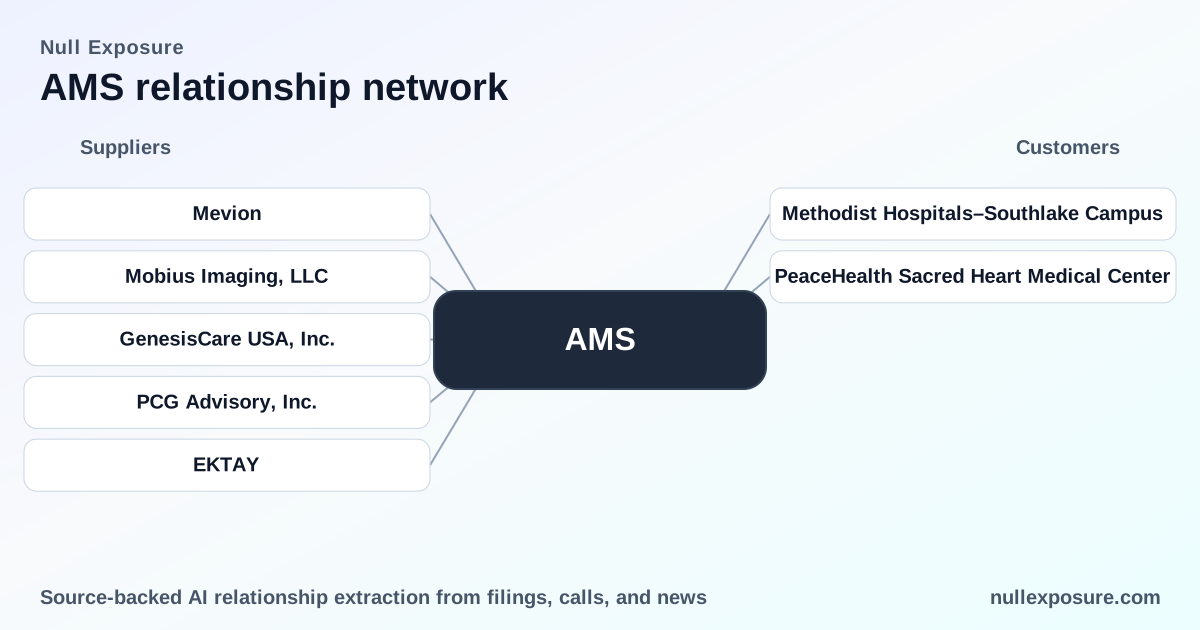
American Shared Hospital Services (AMS): Customer Relationships Drive Recurring, Procedure‑Linked Revenue
American Shared Hospital Services rents and operates radiosurgery and advanced radiation therapy systems under long‑term, fee‑for‑use and revenue‑sharing leases with hospitals and cancer centers, monetizing via recurring per‑procedure fees and, in some cases, shared patient revenue. This operating model delivers high‑margin, equipment‑anchored services but concentrates cash flow on a handful of large, capital‑intensive customers and on utilization trends among referring physicians.
For a concise institutional briefing on AMS customer exposure and contract posture, visit https://nullexposure.com/.
How AMS structures customer engagements and why that matters
AMS sells an integrated proposition: it supplies the hardware, arranges installation and site build, and runs the clinical and reimbursement support that converts expensive modalities into ongoing procedure revenue. The company’s contracts are company‑level long‑term agreements—typically ten‑year terms—and are structured as fee‑per‑use or revenue‑sharing, so revenue is both recurring and volume‑sensitive. The business serves a mix of mid‑market medical centers and large health systems, with geographic reach focused in North America and select LATAM sites.
- Contracting posture and maturity: Contracts skew long‑term with established lease economics, favoring predictable capital recovery but tying AMS to the partner’s patient volumes and physician referral patterns.
- Concentration and criticality: Historically, a very small number of customers account for a large share of revenue — a materiality signal that increases earnings volatility if utilization shifts.
- Capital intensity: Single‑room proton beam systems cost tens of millions, while Gamma Knife installations are multi‑million; this translates to high per‑customer spend and long payback periods.
For a deeper company profile and customer mapping, see https://nullexposure.com/.
On‑record customer relationships (each relationship in the results)
The following entries summarize every customer relationship surfaced in public reporting and transcripts.
Orlando Health / Orlando Health, Inc.
AMS extended a long‑standing lease for its Proton Beam Radiation Therapy system with Orlando Health through 2033, continuing a partnership that originated in 2006 and was previously amended in 2012; this is a material, long‑term PBRT lease renewal. According to company filings and press coverage reported in May 2026 by TradingView and Globe and Mail, the extension is a seven‑year amendment to the existing PBRT lease (reported May 2, 2026).
PeaceHealth Sacred Heart Medical Center (RiverBend)
AMS supplied a Gamma Knife Perfexion system to PeaceHealth Sacred Heart Medical Center at RiverBend, and physicians have begun treating patients on that system, demonstrating AMS’s role as an equipment supplier and operator for Gamma Knife installations. This deployment was noted in an ITN Online report (first reported March 9, 2026).
Methodist Hospitals – Southlake Campus (Merrillville, Indiana)
AMS contracted to supply a Gamma Knife Perfexion system to Methodist Hospitals–Southlake Campus, a classic example of AMS’s turnkey Gamma Knife offering to regional hospitals. The agreement was announced in a company release covered on GreatNews (reported March 9, 2026).
Care New England
AMS worked closely with Care New England in Rhode Island to stabilize and rebuild its radiation oncology physician team, an operational collaboration that supported higher treatment volumes and physician engagement rather than a simple equipment sale. This partnership was discussed in the company’s FY2026 earnings commentary and MarketBeat coverage (reported March 31, 2026).
Brown University Health
AMS announced a new collaboration with Brown University Health in Rhode Island that helped rebuild AMS’s physician base and improve treatment volumes, indicating AMS’s role in networked clinical partnerships as well as equipment leasing. This was described during AMS’s FY2026 disclosures and covered in MarketBeat and investing.com transcripts (reported March–May 2026).
CharterCARE Health Partners
AMS engaged CharterCARE Health Partners as part of its multi‑party Rhode Island initiative to restore radiation oncology capacity and referring‑physician engagement, highlighting AMS’s tactical partnerships with regional health systems. This engagement was referenced in company remarks on the FY2026 earnings call captured by Investing.com (reported March 31, 2026).
Prospect CharterCare
AMS cited Prospect CharterCare together with Care New England as a health system partner in ongoing efforts to drive treatment volume growth and referring physician engagement, underscoring AMS’s focus on health‑system level relationships to sustain per‑procedure revenue. This comment appeared in an earnings transcript reported on Investing.com (FY2025/Q2 and later references in 2026 reporting).
What the customer map implies for investors
The collected evidence points to a business with predictable contract tenors but utilization‑linked cash flows:
- Revenue durability with utilization exposure: Ten‑year lease economics and fee‑per‑use structures create durable contract backlogs, but earnings are directly tied to procedure volumes and the success of physician networks.
- High concentration risk: Public disclosures show two customers historically accounted for ~35% and ~27% of revenue in 2024, and one customer represented 48% in 2023, indicating single‑counterparty risk that can materially move margins and cash generation.
- Capital and execution intensity: The $30–$50 million spend profile for single‑room PBRT and $3–$4.5 million for Gamma Knife suites makes each customer win strategically important and operationally demanding, requiring project execution, reimbursement expertise, and ongoing clinical support.
- Geographic footprint: Operations are North America‑centric with selective LATAM exposure through GKF‑owned single‑unit sites, suggesting limited diversification outside key markets.
- Customer mix: The company sells to both mid‑market centers and large health systems, balancing portfolio risk but requiring different sales and service capabilities.
Investment risks and catalytic reads
- Volume sensitivity is the principal operational risk; physician referrals and system uptime directly affect cash receipts.
- Concentration raises downside; loss or nonrenewal of a major PBRT or Gamma Knife contract would have outsized impact.
- Project execution and reimbursement complexity are ongoing operating risks given the turnkey model.
- Upside levers include successful rollouts to new university and system partners (e.g., Brown University Health) and lease renewals of high‑value PBRT assets (e.g., Orlando Health).
Bottom line
AMS operates a capital‑intensive, service‑forward leasing model that converts installed hardware into recurring, per‑procedure revenue streams. The company’s strength is predictable contract tenure and embedded clinical services; its weakness is high customer concentration and utilization dependence. For institutional clients mapping customer exposure and contract terms, AMS’s public statements and earnings commentary provide clear visibility into the pipeline of long‑term, active leases and system deployments.
Explore more institutional summaries and customer intelligence at https://nullexposure.com/.