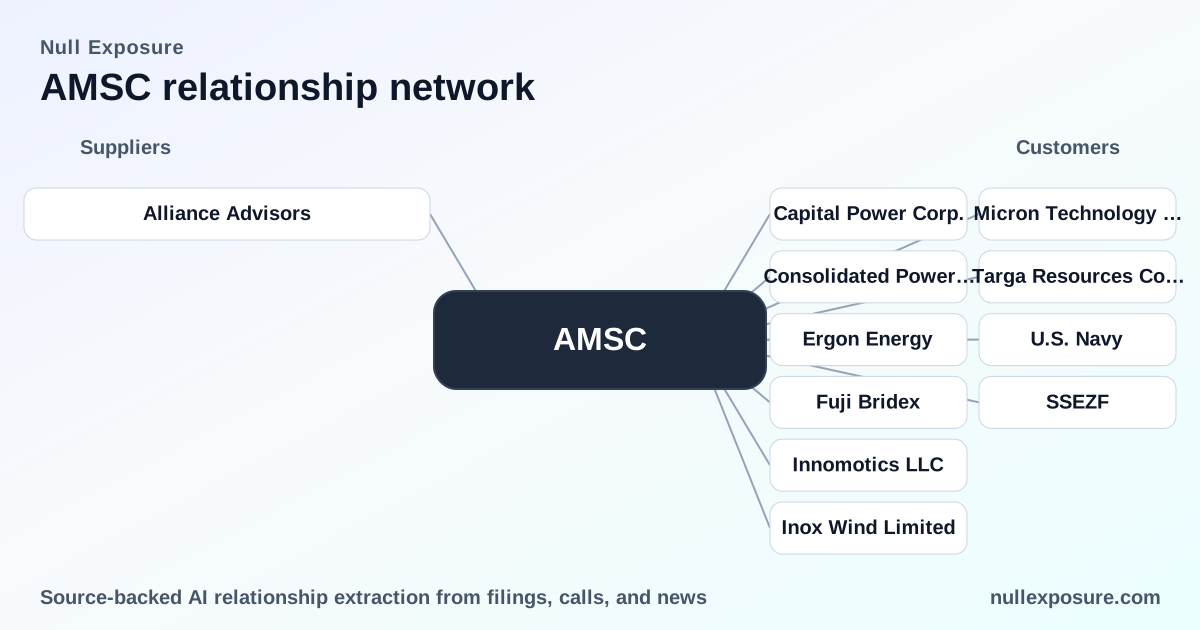
AMSC’s customer map: who pays for its power electronics, licenses and services
Thesis: American Superconductor Corporation (AMSC) monetizes through three complementary revenue streams — hardware sales of power electronics and ship protection systems, licensing of wind turbine designs with upfront or milestone fees and royalties, and recurring services including field support and turnkey installations — sold into utilities, industrial end-users and government customers globally. For investors, the commercial model is a mixture of long-term contracts and licensing revenue that creates recurring and project-driven cash flows, with a meaningful revenue concentration in wind licensing historically. Learn more at https://nullexposure.com/.
Why the customer roster matters for valuation and risk
AMSC’s customer list in its FY2025 Form 10‑K reads like a cross‑section of utilities, defense and industrial buyers. That composition drives the company’s contracting posture: a mix of long-term construction and prototype development contracts that require performance bonds, and licensing agreements that generate upfront or milestone payments and sometimes royalties. The firm also sells into government channels for ship protection systems, which elevates contracting complexity and procurement lead times.
Strategically, this customer mix produces three investment-relevant characteristics:
- Revenue heterogeneity: Product sales (Grid and Wind hardware), licensing fees and service revenue produce different margin profiles and cash timing.
- Counterparty concentration risk: One historical data point — Inox accounted for 14% of revenue in fiscal 2024 — demonstrates single-counterparty materiality in licensing. This is a company-level signal of concentration risk rather than an isolated contract effect.
- Global delivery footprint with regional exposure: AMSC reports sales across the Americas, Asia‑Pacific and EMEA and an installed base of over 18 GW that supports recurring service revenue and spare parts sales.
Customer relationships — who AMSC names and what each relationship implies
Capital Power Corp.
AMSC lists Capital Power among its grid customers, indicating the company supplies transmission, power electronics or turnkey grid solutions to North American utilities. This relationship is cited in AMSC’s 2025 Form 10‑K disclosure of served customers for the grid market (Year ended March 31, 2025).
Consolidated Power Projects (Pty) Ltd
Consolidated Power Projects (South Africa) is named as an international grid customer, reflecting AMSC’s work in EMEA and APAC target markets and its ability to serve utility projects outside North America. This mention appears in AMSC’s FY2025 Form 10‑K customer list.
Ergon Energy
Ergon Energy in Australia is included in AMSC’s list of grid customers, underscoring the company’s presence in the Asia‑Pacific utilities market and its localized sales/service posture. AMSC references Ergon Energy in its FY2025 Form 10‑K.
Fuji Bridex
Fuji Bridex (Singapore) appears as a named grid customer in AMSC’s FY2025 filing, illustrating commercial activity in Southeast Asia and the company’s engagement with distribution or system integrator partners in that region.
Innomotics LLC
Innomotics LLC is listed among AMSC’s historical grid customers, consistent with the company supplying power electronics and control systems to industrial and utility customers; this is reported in the FY2025 Form 10‑K customer enumeration.
Inox Wind Limited
Inox is identified in AMSC’s 10‑K as a licensed wind turbine partner; company disclosures show Inox represented a material revenue contributor — Inox accounted for 14% of AMSC’s total revenues in fiscal 2024, highlighting concentration in the Wind licensing business (FY2024/FY2025 disclosures in the 10‑K).
Micron Technology Inc.
Micron Technology is named as a served grid market customer in AMSC’s FY2025 Form 10‑K, signaling that the company’s power solutions extend to industrial and high‑tech facilities requiring grid resilience and advanced power electronics.
Targa Resources Corp.
Targa Resources is included in the list of grid customers in the 2025 10‑K, indicating AMSC’s participation in energy infrastructure projects serving midstream and industrial energy operators in the Americas.
U.S. Navy
The U.S. Navy is a disclosed customer for ship protection and degaussing systems; AMSC explicitly sells defense‑grade systems into government channels and references government contracts as part of its Grid business. A TradingView summary of AMSC SEC reporting and AMSC’s filings notes growth expectations driven in part by ship protection systems for the U.S. Navy (TradingView coverage referencing AMSC SEC filings, FY2026 commentary).
SSEZF
SSEZF (inferred ticker) is cited by name in AMSC’s FY2025 Form 10‑K customer list through reference to SSE plc, reflecting projects or equipment sales in the UK energy market; this supports the company’s EMEA regional revenue footprint.
SSE plc
SSE plc is explicitly listed in the FY2025 10‑K among AMSC’s grid customers, demonstrating AMSC’s commercial reach into major UK utilities and reinforcing the company’s European presence.
(Each customer above is cited from AMSC’s Form 10‑K for the year ended March 31, 2025 unless otherwise noted; the U.S. Navy reference is further discussed in contemporary SEC reporting coverage summarized by TradingView in early 2026.)
Commercial constraints and operating model signals
AMSC’s filings and disclosures reveal several firm‑level operational constraints that shape revenue reliability and project execution:
- Long‑term contracting posture: The company enters into long-term construction and prototype development contracts that often require performance bonds and use over-time revenue recognition for turnkey installations. This drives project risk and working capital needs (company 10‑K disclosures).
- Licensing business with mixed monetization mechanics: Licensing agreements provide either paid‑up upfront fees or milestone-based payments plus possible royalties; this structure yields lumpy, high‑margin cash flows that coexist with lower-margin equipment sales (10‑K licensing language).
- Government procurement channels: AMSC sells ship protection systems to the U.S. Navy and other defense customers, which increases contractual complexity and procurement lead times but raises the strategic criticality of certain product lines (10‑K evidence).
- Geographic diversification with regional concentrations: AMSC reports revenue across Americas, Asia‑Pacific and EMEA, serving markets globally via localized sales and field service — a maturity signal that supports recurring service revenues tied to an installed base of over 18 GW (10‑K regional tables and service disclosures).
- Segment mix: The business spans hardware (power electronics and systems), services (installation, commissioning, field support), and software/control systems — each with different margin profiles and capital intensity.
These constraints translate to an investor playbook of balancing licensing upside and margin expansion against project execution risk, customer concentration (notably the Inox example), and long contract timelines.
If you’d like a focused model of how these customer relationships feed revenue cadence and cash flow, visit https://nullexposure.com/ for a closer look.
Bottom line for investors
AMSC combines a capital‑equipment vendor profile with an intellectual‑property licensor and service provider. The company’s FY2025 disclosures confirm a global footprint, a meaningful installed base that supports recurring service revenue, and material licensing relationships that can dominate year‑to‑year revenue. Key financial context from public metrics: Market cap roughly $2.39B, trailing revenue ~$279M, high statutory profit margin on reported results but modest operating margin on core operations, which underscores the interplay between lumpy licensing and steady product/service sales.
For valuation and portfolio decisions, prioritize (1) monitoring licensing renewals and milestone schedules, (2) assessing execution risk on turnkey grid projects that carry performance bonds, and (3) tracking government procurement pipelines for ship protection systems — these factors determine the predictability of AMSC’s cash flows and justify the premium or discount investors assign to the shares.