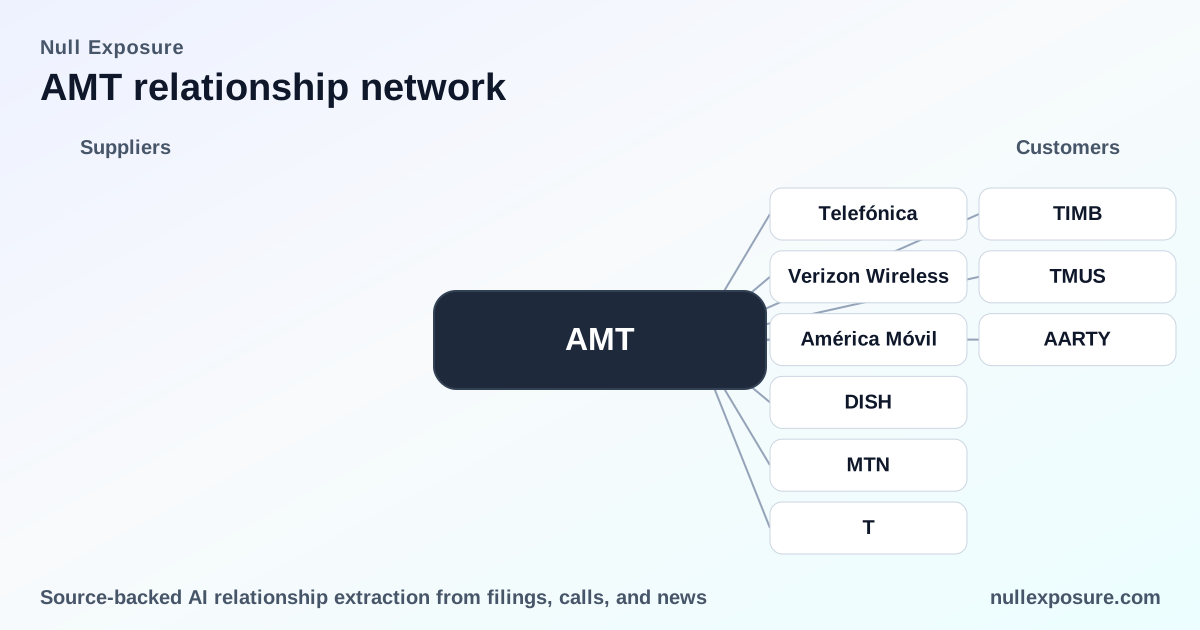
American Tower (AMT) — Customer relationships that drive cashflow and concentration risk
Thesis: American Tower monetizes an owner‑operator model by leasing rooftop and tower space to wireless carriers and related tenants under long‑dated leases and master agreements; recurring rental cashflows from a concentrated set of global carriers drive valuation, while single‑tenant disruptions — most recently DISH — create short‑term headline risk. Learn more about how customer mix shapes AMT’s revenue profile at https://nullexposure.com/.
How AMT’s customer economics work in plain terms
American Tower earns stable, contractual rent from tenants who install and operate communications equipment on AMT real estate. Leases are generally long‑term with periodic escalators and many tenants sit on master lease agreements, creating predictable cashflows and high renewal rates that underpin REIT valuation multiples. AMT’s business is globally diversified in footprint but concentrated by customer in key markets — the U.S. & Canada are heavily weighted to three national carriers, while Europe, Latin America and Africa rely on a smaller set of large regional operators.
- Long-term contracting posture: Across markets, tenant leases commonly have initial non‑cancellable terms of five to ten years with multiple renewal options and contractual escalations (AMT 2024 Form 10‑K).
- Framework agreements reduce churn: AMT uses master lease agreements that standardize terms across many sites and reduce non‑contractual churn (AMT 2024 Form 10‑K).
- Critical infrastructure role: Property operations accounted for 98% of total revenues in 2024, making tenant relationships the core business driver (AMT 2024 Form 10‑K).
If you want an investor‑grade map of AMT’s tenant exposures and narrative risk, visit https://nullexposure.com/ for deeper customer analytics.
Customer roster — the relationships investors should price into the model
Below are the customer relationships identified in AMT’s public filings and market coverage. Each short summary is tied to the original reporting.
Telefónica
Telefónica is a major European tenant that accounted for 10% of American Tower’s consolidated operating revenues in FY2024, making it one of AMT’s individually material customers in Europe. Source: AMT 2024 Form 10‑K (FY2024).
Verizon Wireless / Verizon Communications
Verizon is a top U.S. tenant — 13% of consolidated revenue in 2024 and part of an 86% aggregate concentration with AT&T and T‑Mobile in the U.S. & Canada — and is under long‑dated leases and specific multi‑year agreements with AMT. Source: AMT 2024 Form 10‑K (FY2024).
América Móvil
América Móvil is a principal Latin American tenant included in the cohort that accounted for a large share of Latin America property segment revenue for FY2024. Source: AMT 2024 Form 10‑K (FY2024).
MTN Group (MTN)
MTN is cited as a primary tenant in AMT’s Africa & APAC portfolio and forms part of an 81% aggregate concentration in that region along with Airtel. Source: AMT 2024 Form 10‑K (FY2024).
DISH / Dish Wireless / DISH Network
DISH is a near‑term negative catalyst after defaulting on strategic collocation payments; AMT removed 100% of DISH revenue from organic growth for 2026 and has initiated legal action, with analysts estimating roughly $200M of U.S. revenue exposure annually through 2035 before the reset. Sources: The Globe and Mail (Mar 2026); Tikr.com (May 2026); MarketBeat and other market coverage (Mar–May 2026).
Verizon (news coverage)
Recent market pieces reiterate Verizon’s role among AMT’s largest tenants and cite its contribution to property segment revenue and recent leasing dynamics. Source: Investing.com (May 2026).
T‑Mobile / TMUS
T‑Mobile is the single largest customer by revenue (19% in 2024) and the company disclosed elevated churn related to contractual cancellations and legacy Sprint leases under the T‑Mobile master lease agreement. This is a structurally important relationship that influences U.S. churn assumptions. Source: AMT 2024 Form 10‑K (FY2024).
AT&T / T and AT&T Mexico
AT&T accounted for 18% of consolidated revenue in 2024 and is part of the 86% U.S. & Canada concentration; AMT also disclosed ongoing arbitration with AT&T Mexico that could influence organic growth in that market. Sources: AMT 2024 Form 10‑K (FY2024); The Globe and Mail (Mar 2026).
TIM / TIM S.A. / TIMB
TIM (TIM S.A.) negotiated a strategic consolidation deal with American Tower do Brasil covering about 9,000 towers and consolidating prior contracts into a single framework through 2034, and TIM has publicly discussed capping lease growth via such tower agreements. Sources: The Globe and Mail press release (Jan 21, 2026); TIM earnings highlights coverage (Mar 2026).
AST SpaceMobile (ASTS)
ASTS appears in market reports as a partner in broader mobile‑operator ecosystems that include AMT, indicating AMT’s role in infrastructure partnerships beyond traditional carriers. Source: Sahm Capital coverage (Apr 2026).
Bharti Airtel / AARTY / Airtel
Bharti Airtel is named alongside MTN in AMT’s Africa & APAC disclosures and is a key regional tenant driving that regional revenue concentration. Source: AMT 2024 Form 10‑K (FY2024).
What the constraints tell investors about durability and risk
AMT’s constraint signals translate directly into valuation levers:
- Contracting posture: long‑term and framework‑based. The company’s leases typically feature 5–10 year initial non‑cancellable terms, multiple renewal options, and annual or index‑linked rent escalators; master lease frameworks are used to reduce churn (AMT 2024 Form 10‑K).
- Concentration is high but geographically diversified. The U.S. & Canada generate the largest share of revenue (with AT&T, T‑Mobile and Verizon comprising ~86% of U.S. & Canada property revenue), while Europe, Latin America and Africa are anchored by a smaller set of dominant regional operators; this is a concentration risk offset by global footprint (AMT 2024 Form 10‑K).
- Criticality of relationships. Property operations produced 98% of 2024 revenue, establishing tenant relationships as mission‑critical drivers of cashflow (AMT 2024 Form 10‑K).
- Maturity and renewals. Roughly half of leases extend beyond 2030 and renewal behavior is historically high because alternative sites are costly; this supports durable cashflows but can compress near‑term growth if major tenants renegotiate terms (AMT 2024 Form 10‑K).
- Country and segment diversification. AMT combines infrastructure leasing with services and a smaller data‑center portfolio in the U.S., giving multiple monetization levers even as the core tower business remains dominant (AMT 2024 Form 10‑K).
Notably, a constraint excerpt explicitly references a March 2015 multi‑year agreement with Verizon covering ~11,100 sites and averaging ~28‑year terms at inception — this is a relationship‑specific signal that underscores Verizon’s preferential long‑dated exposure to AMT (AMT 2024 Form 10‑K).
Investment implications and final read
American Tower’s cashflow quality is rooted in long leases and master agreements, but the stock requires investors to price concentration and event risk: DISH’s default is an immediate revenue reset, AT&T‑Mexico arbitration and T‑Mobile legacy churn affect near‑term organic growth, while TIM’s Brazil consolidation represents upside stability in Latin America. For valuation work, use a base case that assumes high renewal probability and contract escalators, and model a scenario that strips DISH contribution and stresses U.S. carrier churn for a conservative view.
For a structured view of how customer exposures translate to cashflow risk across scenarios, see the product at https://nullexposure.com/ — it provides curated customer relationship intelligence for investment due diligence.