AMTD IDEA Group — How its customer relationships drive brand monetization and IP control
AMTD IDEA Group operates as a diversified financial and media holding company that monetizes through brand licensing, media operations, and targeted financial services ownership. Revenues derive from a mix of content and intellectual-property licensing, distribution partnerships, and strategic acquisitions that consolidate IP and control regional rights; these relationships are executed through exclusive licenses, litigation when necessary, and distribution agreements that extend brand reach. Investors should value AMTD for its active IP monetization posture but account for concentration and enforcement costs tied to regional license transitions. Learn more about how we track these dynamics at https://nullexposure.com/.
Why customer relationships matter for valuation
AMTD’s financial profile shows a compact market capitalization and high profit margin metrics relative to scale, indicating that brand and licensing agreements can be high-margin levers. The company’s reported RevenueTTM and GrossProfitTTM are modest in absolute terms, which makes the quality and legal defensibility of customer and license relationships disproportionately important for top-line stability and margin preservation. Contracting posture here is not passive: AMTD enforces IP and reassigns licenses through acquisitions, which reduces reliance on legacy partners but raises near-term legal and integration costs.
Snapshot of operating model constraints and business signals
- Contracting posture: AMTD displays an assertive posture — it acquires brands outright and pursues legal remedies against former licensees to protect IP and reassert control. This is a company-level signal drawn from press activity and public actions, not a single-relationship attribution.
- Concentration: Revenue mix suggests concentration risk because a small number of high-profile media licenses and distribution partnerships carry outsized strategic value given the company’s scale.
- Criticality: Licensing and distribution relationships are critical to AMTD’s media monetization model; loss or disruption of regional licensees can materially affect reach and licensing revenue.
- Maturity: The business shows a mix of mature, long-standing partnerships and recent transitions (expired licenses, acquisitions) that imply active portfolio reshaping rather than passive reinvestment.
These characteristics should factor into any investor model as operational leverage that can boost margins but expose AMTD to episodic legal and regional rollout costs.
Relationship roll-call — what every listed tie tells investors
-
Modern Media Company Limited (現代傳播集團): Following AMTD’s acquisition of The Art Newspaper in 2023, the former License Agreement with Modern Media for China and Hong Kong expired on 1 October 2023, underscoring a transition from third‑party licensing to in-house control in Greater China. According to a PR Newswire release in May 2026, AMTD executed this change as part of its integration after the acquisition.
Source: PR Newswire (May 2026). -
SCHW-P-D (Charles Schwab preferred): Historical context on TD Ameritrade shows industry consolidation: Schwab acquired TD Ameritrade’s retail brokerage business, including the ThinkorSwim platform, as part of a strategic refocus away from retail trading. This transaction is relevant for investors tracking legacy customer migration and platform ownership that influence competitive dynamics in brokerage technology. The point was noted in a Finviz news item in March 2026 summarizing Schwab’s position.
Source: Finviz news (March 10, 2026). -
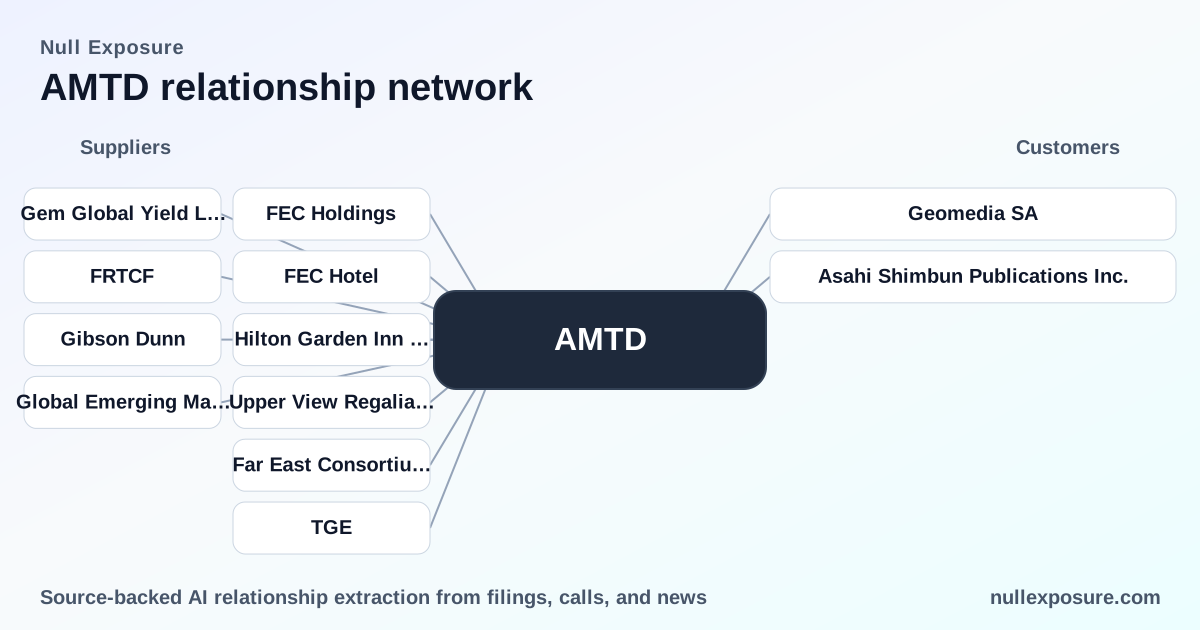
Geomedia SA: AMTD has initiated legal proceedings in Morocco against a former licensee, Geomedia SA, for improper use of the L'Officiel and AMTD intellectual property, signaling aggressive IP enforcement and zero tolerance for unauthorized exploitation of its fashion/media brands. This action demonstrates AMTD’s willingness to litigate to protect licensing value, as reported in March 2026 coverage.
Source: Finviz news (March 9, 2026). -
Asahi Shimbun Publications Inc.: AMTD’s content and distribution strategy includes regional publishing partnerships: an issue was widely distributed across Japan in partnership with Asahi Shimbun Publications, reflecting strategic alliances to scale reach in premium national markets. This collaboration was reported in March 2026 and illustrates AMTD’s use of incumbent media partners for market penetration.
Source: Taiwan News (March 9, 2026).
What these relationships collectively reveal about revenue durability
AMTD’s customer footprint portrayed by these items shows a blend of direct ownership, aggressive IP control, and selective distribution partnerships. The company is consolidating high-value media brands and reassigning regional rights rather than relying on legacy licensees; that structural shift increases long-term margin potential but raises short-term execution risk. Legal enforcement against former licensees, as with Geomedia SA, reduces dilution of brand value but generates litigation cost and potential regional pushback.
Key investment implications
- Upside: Direct ownership of premium titles and exclusive distribution deals increase long-term monetization options (subscriptions, licensing, syndication) with high incremental margins. The company’s low absolute revenue base means successful rollouts or new licensing deals can have outsized effects on financials.
- Risk: Concentration of important relationships in a few regions and the need for active legal enforcement pose operational and reputational risks; litigation outcomes can reset expected revenues and timing.
- Catalysts to watch: speed of integration for acquired brands, court outcomes in IP cases (e.g., Morocco), and the establishment of new distribution pipelines in China, Japan, and other priority markets.
Final read and practical next steps
For investors evaluating AMTD’s customer relationships, the core thesis is clear: this is a company monetizing brand equity through ownership and selective partnerships while actively policing IP to protect future cash flows. That strategy increases margin potential but concentrates execution risk into a handful of regional agreements and legal battles. Track ongoing legal developments and distribution rollouts as primary short-term signals.
If you want a structured view of AMTD’s partner transitions and litigation headlines, we compile relationship-level monitoring and context at https://nullexposure.com/. For deeper due diligence on comparable licensing strategies and how they affect valuation multiples, contact Null Exposure for tailored research.