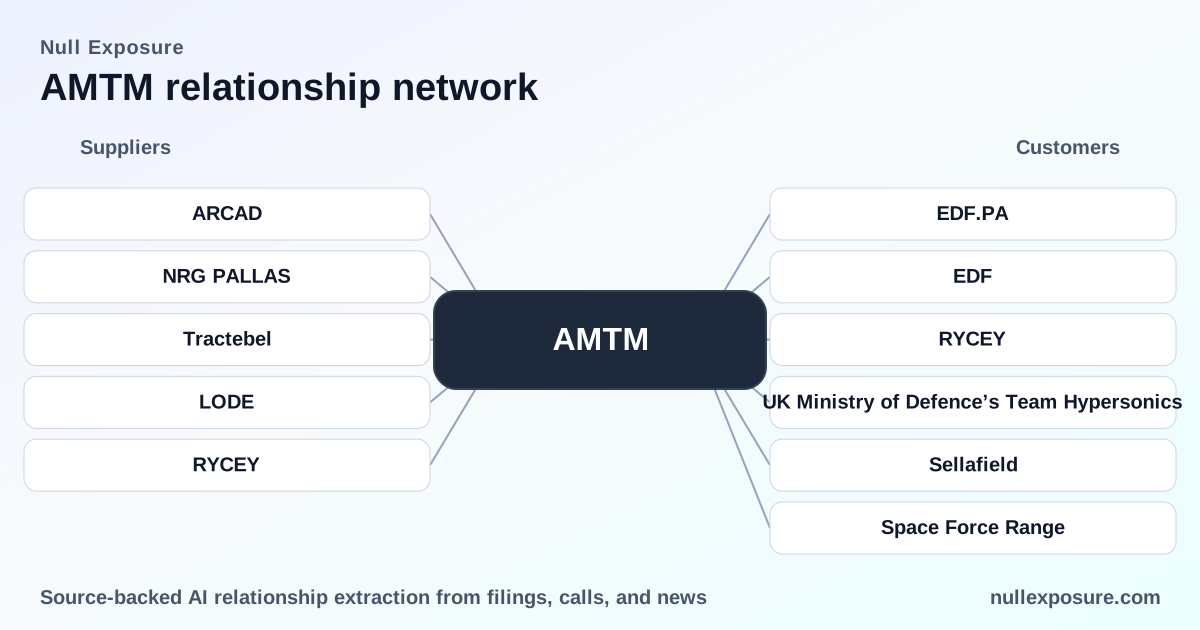
Amentum (AMTM) — Customer relationships that reprice the risk profile
Amentum is a global engineering and technology services operator that monetizes through long-duration government and commercial contracts: the company wins multi-year tasking as a prime or JV lead, executes engineering, program delivery and remediation services, and converts backlog into recurring revenue and margin improvement. Recent FY2026 awards across nuclear, space, defense and wildfire response materially increase revenue visibility and move large portions of Amentum’s backlog from bids into funded work. For a deeper look at counterparties and how they change the business risk picture, visit the Null Exposure homepage: https://nullexposure.com/.
Why these customer wins matter for investors
Amentum’s business model is contract-driven. Large framework and long-duration prime awards deliver steady revenue but also concentrate operational risk around a handful of program sinks. When Amentum secures multi-year engineering or owner’s engineer roles, it locks in utilization for cleared personnel and generates backward-loaded cashflow that supports margin expansion. Conversely, fixed-price elements and complex decommissioning exposures can compress near-term margins if ramping or scope changes are mishandled.
Customer-by-customer: the FY2026 picture
Below I catalogue every counterparty reported across recent items and summarize the commercial relationship and source.
Électricité de France (EDF / EDF.PA)
Amentum secured UK nuclear support contracts with EDF valued up to approximately $730–743 million covering reactor fleet services and contribution to the Hinkley Point C program; the award is described as a multi-year ten‑year engagement. According to Intellectia and multiple March 2026 press reports, this positions Amentum as a significant services supplier to the UK nuclear operator. (Intellectia/Finviz/TradingView news, March 2026)
Great British Energy – Nuclear
Great British Energy–Nuclear awarded Amentum-led Litmus Nuclear a long-term owner’s engineer contract worth roughly $406 million with a maximum 14‑year term to support Rolls‑Royce SMR deployment (Wylfa). That owner’s engineer role establishes a durable engineering services stream tied to SMR deployment schedules. (Investing.com / SahmCapital, May 2026)
Rolls‑Royce
Amentum was selected as program delivery partner for Rolls‑Royce’s Small Modular Reactor program in the UK and Czech Republic and will provide assurance and governance services for SMR deployments, supporting initial rollouts and local job creation. The arrangement is cited in March–May 2026 coverage and is linked directly to the Great British Energy award. (Intellectia / Investing.com, March–May 2026)
California Department of Forestry and Fire Protection (Cal Fire)
Amentum won a $425 million aerial firefighting contract to provide aircraft and operational support to Cal Fire, announced April 7, 2026; this is a material, single-state commercial/government contract that expands Amentum’s emergency response footprint in North America. (InsiderMonkey / Yahoo Finance, April 2026)
European Commission Joint Research Centre
Amentum leads a joint venture awarded a $112 million framework to decommission and manage radioactive waste across research sites in Italy, Germany, Belgium and the Netherlands; the initial term is two years with extension options. This is a continental framework win that reinforces the firm’s European decommissioning credentials. (SimplyWallSt / Investing.com / SahmCapital, March–May 2026)
NASA
Amentum provided critical ground systems operations for NASA’s Artemis II crewed mission and is cited as a key provider for space operations and recovery support — a continuation of the company’s high‑criticality contracts in civilian space programs. The relationship is referenced in April 2026 commentary on Artemis II. (InsiderMonkey / SahmCapital, April–May 2026)
U.S. Space Force
Amentum holds large-range and program work for the U.S. Space Force that are described as ramping long-duration awards; these contracts sit inside Amentum’s multi-billion backlog and are positioned as revenue-conversion drivers for FY2026 onward. (SahmCapital coverage, March–May 2026)
Space Force Range
Cited separately in coverage, the Space Force Range award is identified as one of the large, multi‑year programs that will convert backlog into higher run‑rate revenues and improve operating leverage as it ramps. (SahmCapital, March 2026)
Sellafield
Sellafield remediation work is repeatedly listed among Amentum’s large European nuclear remediation engagements and is cited as a high‑impact award that contributes to backlog conversion and operational leverage. (SahmCapital, March–May 2026)
UK Ministry of Defence’s Team Hypersonics
Amentum secured an Industry Mission Partner contract to provide missile design engineering and program management for Team Hypersonics under the AUKUS framework, broadening its defense portfolio in advanced weapons support. (SahmCapital, February–March 2026)
Lockheed Martin (LMT)
Lockheed Martin’s 2025 Form 10‑K notes a $360 million cash acquisition paid during Q2 2025 for Amentum’s Rapid Solutions business; this historical deal provides precedent for strategic asset transfers and shows prior commercial interactions between Amentum and major primes. (LMT 2025 10‑K filing, referenced 2026)
Business-model constraints and operational characteristics investors should weigh
- Contracting posture: Amentum’s revenue base is dominated by long-duration government prime contracts and framework awards; the backlog-to-revenue conversion rate controls visibility and near-term cashflow. Evidence in filings shows backlog includes unexercised option years and IDIQ tasking that only convert to revenue when task orders are issued.
- Counterparty concentration: Company filings indicate ~81% of revenue derives from U.S. federal government work, a high concentration that reduces commercial cyclicality but increases exposure to federal spending patterns and procurement cycles.
- Geographic breadth and maturity: Amentum is a global operator with mature, trusted relationships in the UK and Australia and program exposure across North America, Europe and allied nations — this supports diversification across markets while keeping program execution complexity high.
- Materiality and criticality: The company’s services are described as critical to customer priorities (nuclear services, space ground systems, defense capabilities), which elevates revenue stickiness but also increases program delivery obligations and reputational risk.
- Service orientation with infrastructure scale: Amentum functions as a service provider across infrastructure, remediation, and digital solutions; its segments include large-scale environmental and nuclear work, plus digital/intelligence offerings — a mix that drives capital-light recurring margins but requires specialist labor and cleared personnel.
- Relationship stage: Most cited engagements are active and mature or are long-term frameworks, which gives investors near-term revenue visibility but also implies concentrated execution risk during ramps.
Investment implications and risk takeaways
- Upside: The March–May 2026 awards materially increase funded backlog across nuclear (EDF, Rolls‑Royce/GBE), space (NASA, Space Force), and emergency services (Cal Fire). These awards convert a portion of the $47 billion backlog into higher run‑rate revenue and provide a path to margin improvement through scale and fixed-cost absorption.
- Downside: Execution on fixed‑price or owner’s engineer roles and rapid ramping for complex decommissioning and hypersonics programs creates operational risk that can compress near-term margins if staffing or supply chains lag. Concentration in government customers also ties valuation to public spending cycles.
For a concise monitor of Amentum’s counterparty flow and to track how new awards shift credit and operational profiles in real time, see the Null Exposure platform: https://nullexposure.com/.
Bold final takeaway: FY2026 awards recast Amentum from backlog-holder to active revenue converter — that structural shift improves visibility but intensifies execution risk concentrated in complex, government‑sponsored programs.