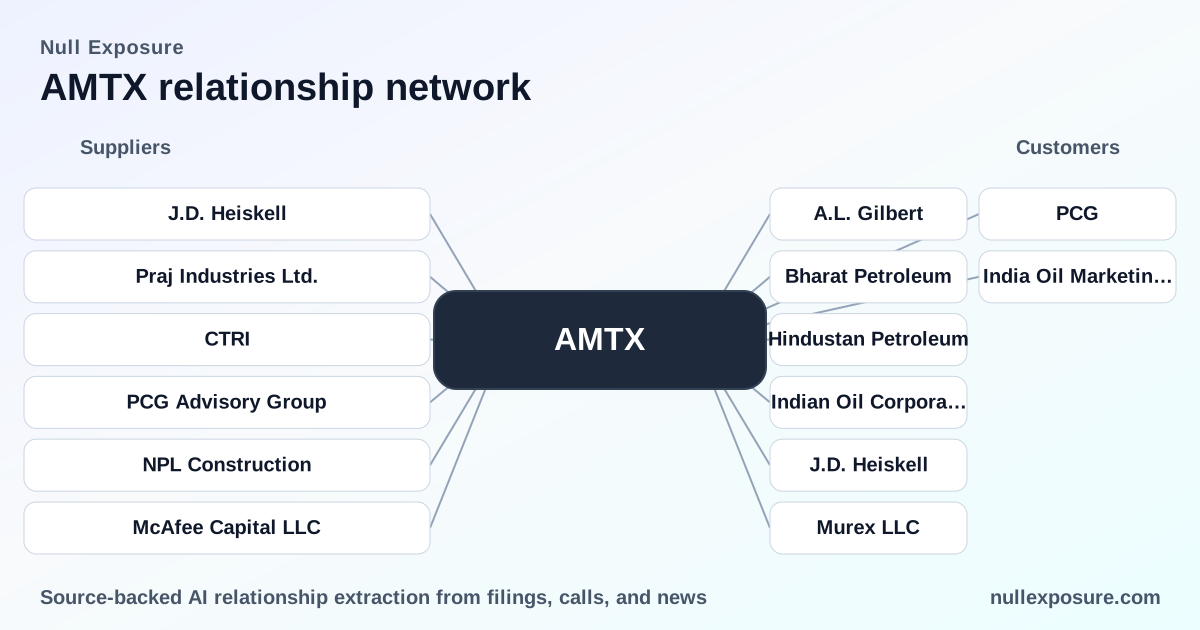
Aemetis (AMTX) — Customer Map and Commercial Risks for Investors
Aemetis operates as a vertically integrated renewable fuels and biogas producer that monetizes through product sales and contracted offtake: ethanol and related coproducts sold into California via designated fuel marketers, biodiesel sold to Indian government Oil Marketing Companies, and renewable natural gas delivered into utility pipelines. The company captures additional revenue from CO2 sales and environmental attributes, and it leverages resellers and distributors to reach end markets. For a concise investor briefing and data-driven customer intelligence, visit https://nullexposure.com/.
Quick investment thesis: channel-driven revenue, concentrated cash flows
Aemetis' commercial model relies on a small number of channel partners and government offtake in India. The benefits are stable, contract-backed revenue in some segments and rapid scale in others; the risk is high counterparty concentration and sensitivity to short-term pricing on spot-indexed contracts. Investors should value the stock with concentration and contract tenor front of mind.
How Aemetis contracts and sells — operating model signals every investor must read
- Contracting posture: Aemetis uses a mix of short-term indexed contracts and cost-plus tenders. The company notes quarterly sales contracts for California ethanol that are indexed to daily spot prices, which creates exposure to short-cycle price volatility.
- Concentration and criticality: The California ethanol business is highly concentrated with one counterparty accounting for essentially all California ethanol segment revenue, a structural revenue concentration that is a primary counterparty risk. The India biodiesel business is also materially concentrated among three customers.
- Geographic split: Commercial activity is bifurcated between North America (California ethanol, RNG/biogas into utility pipelines) and APAC (Kakinada biodiesel sales to Indian OMCs), giving investors a play on both regulated utility markets and government procurement in India.
- Relationship roles and channels: Aemetis frequently sells through resellers and distributors (fuel marketers and industrial gas companies) rather than direct retail, which reduces go-to-market complexity but increases dependency on reseller behavior and contract terms.
- Maturity and activity: Customer relationships across segments are active and revenue-generating; the company executed sales of Investment Tax Credits and recognized biodiesel revenue in 2025, indicating commercial traction.
These are company-level signals drawn from Aemetis' public disclosures and recent press activity.
Detailed customer relationships (each relationship from filings and press)
A.L. Gilbert
Aemetis has designated A.L. Gilbert, an animal feed company adjacent to the Keyes ethanol plant, to sell and distribute wet distillers grains (WDG) produced at Keyes. According to Aemetis’ 2024 Form 10‑K, A.L. Gilbert functions as the local distributor for this coproduct (FY2024 10‑K).
Bharat Petroleum
Aemetis sold biodiesel to Bharat Petroleum as part of its India OMC offtake during 2023–2024; these sales came through government tender and procurement channels. The 2024 Form 10‑K lists Bharat Petroleum among the OMC customers for biodiesel (FY2024 10‑K).
Hindustan Petroleum
Hindustan Petroleum is similarly named as an OMC buyer of Aemetis biodiesel in 2023–2024, reflecting the company’s reliance on government-sponsored OMC tenders for its India segment revenue. This is documented in Aemetis’ 2024 Form 10‑K (FY2024 10‑K).
Indian Oil Corporation
Indian Oil Corporation is also identified as a government OMC purchaser of biodiesel during 2023–2024, underscoring the India segment’s concentration in OMC channels. The detail is provided in the company’s 2024 Form 10‑K (FY2024 10‑K).
J.D. Heiskell
Aemetis sells substantially all of the ethanol, WDG, DCO and CDS produced at its California facility to J.D. Heiskell under a purchasing agreement, and J.D. Heiskell resells those products to marketers designated by Aemetis. The 2024 Form 10‑K states that sales to this single customer represented 98% and 100% of California Ethanol segment revenues for 2024 and 2023 respectively, making this relationship critically material (FY2024 10‑K).
Murex LLC
Aemetis has designated Murex LLC as the single fuel marketing company to purchase its ethanol; Murex resells into blender markets and enters quarterly indexed sales contracts with fuel blenders, so ethanol pricing is short‑term and index-linked through Murex. This arrangement and the pricing mechanism are described in Aemetis’ 2024 Form 10‑K (FY2024 10‑K).
PCG (PG&E Corp.)
A GlobeNewswire release in June 2025 described Aemetis’ Biogas Central Digester Project near Modesto delivering renewable natural gas into the PG&E utility gas pipeline, with multiple dairies tied into the project; the press release connects the project to PG&E pipeline delivery (GlobeNewswire, June 2025).
PG&E
The same June 2025 GlobeNewswire announcement references delivery of RNG into the PG&E utility gas pipeline, confirming that Aemetis’ biogas operations route gas into the utility network that PG&E operates (GlobeNewswire, June 2025).
India Oil Marketing Companies (aggregate)
Aemetis’ India biodiesel business recognized $14.5 million of revenue in Q3 2025 primarily from allocations that converted into sales to the India Oil Marketing Companies, indicating meaningful revenue generation from OMC allocations in 2025 (GlobeNewswire press release, November 6, 2025).
What these relationships imply for valuation and risk
- Single‑buyer concentration in California is the principal commercial risk. The J.D. Heiskell purchase arrangement accounts for virtually all ethanol segment revenue in California; any disruption, contract renegotiation, or operational issue at either party would meaningfully impact cash flows.
- India revenue is large but concentrated and tied to government procurement. Sales to OMCs provide scale and predictable tenders but also expose Aemetis to policy and tender timing risks; the company signals a cost‑plus contracting posture for Kakinada biodiesel.
- Short‑term indexed pricing in ethanol reduces pricing visibility. The quarterly contracts entered by Murex are indexed to spot prices, creating earnings volatility when commodity prices move.
- Channel strategy reduces distribution cost but increases counterparty dependence. Using resellers (Murex, J.D. Heiskell, A.L. Gilbert) simplifies logistics and marketing but concentrates counterparty leverage.
- RNG and CO2 sales diversify revenue streams. Delivering RNG into PG&E’s pipeline and selling CO2 to an industrial gas company broaden the revenue base beyond fuels, providing partially de‑correlated cash flows tied to utility and industrial demand.
Bottom line and investor action
- Key positives: active commercial traction across California and India, monetization of coproducts, and RNG integration into utility infrastructure.
- Key negatives: extreme revenue concentration in California with a single buyer, India exposure to OMC tender cycles, and short‑term indexed ethanol pricing that injects near‑term volatility.
For a focused view on counterparty risk and revenue concentration, review Aemetis’ 2024 Form 10‑K and the company’s 2025 press releases on biogas and India biodiesel. For further commercially actionable customer intelligence and risk scoring, visit https://nullexposure.com/ to explore our investor tools and relationship mapping.
Investors should price AMTX with concentration premiums and monitor contract renewals, India tender schedules, and ethanol spot price trends as the primary drivers of near‑term earnings variability.