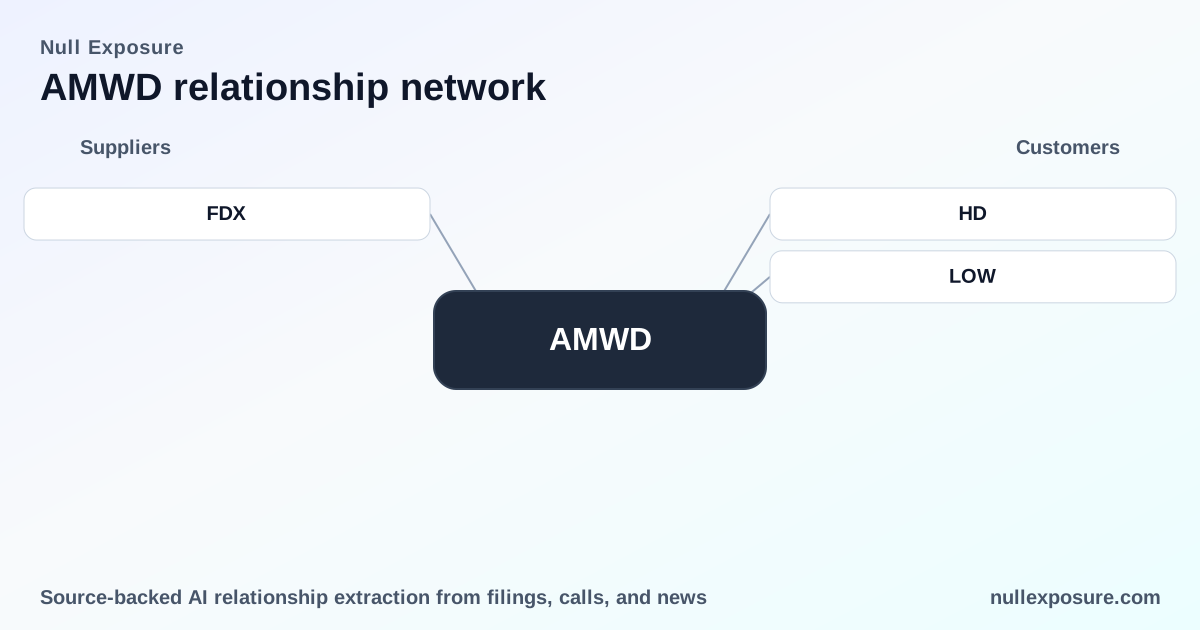
American Woodmark (AMWD): Customer Concentration and Commercial Footprint
American Woodmark manufactures and distributes cabinets and home-organization products to the U.S. remodeling and new-construction markets, monetizing through direct sales to three primary channels — home centers, builders, and independent dealers/distributors — and recognizing revenue at shipment or delivery under standard commercial terms. The company's profitability is driven by scale manufacturing, national distribution, and a small number of very large retail partners whose purchasing patterns strongly influence top-line volatility. For a concise gateway to our platform coverage, visit https://nullexposure.com/.
How AMWD operates and where the money comes from
American Woodmark sells finished cabinetry and related products nationwide through three main channels: home center retailers (big-box), builder accounts, and independent dealers/distributors. The company operates an integrated manufacturing and distribution model that captures margin through product specialization and national reach; the firm recognizes revenue when control transfers to the customer at shipment or delivery, consistent with Note A in its consolidated financial statements. According to company filings, the organization services the U.S. market from multiple manufacturing platforms and also provides turnkey installation services via eight primary service centers, supporting its direct builder relationships.
Key business model characteristics:
- Contracting posture: Predominantly spot/transactional revenue recognition at shipment or delivery, not long-term take-or-pay contracts, which produces higher sensitivity of reported revenue to channel demand (Note A of consolidated financials).
- Geographic focus: Entirely U.S.-centric distribution and sales, which concentrates macro exposure to U.S. housing starts and remodeling cycles.
- Channel mix and concentration: A small number of large home centers and builder accounts dominate revenue, increasing customer-level concentration risk.
- Relationship maturity: Top customers are long-standing; the company reports decades-long engagements with its largest partners, providing operational stability but creating dependency.
Why customer concentration matters for investors
Home centers and large builders are essential distribution levers for AMWD. In fiscal 2025, Home Depot and Lowe’s together generated roughly 40.8% of net sales, which makes their purchasing decisions critical to AMWD’s revenue trajectory and working capital management. The loss or meaningful order reduction from either customer would have a material adverse effect on the company’s financial results, as stated in the FY2025 disclosures.
The customer roster — what filings and press coverage list
Below are the relationships extracted from the public reporting and associated plain-English summaries. Each relationship listed in the reporting is covered.
HD (ticker: HD)
American Woodmark disclosed reliance on a major home-center customer identified as HD that contributes substantially to net sales; filings show that the two largest customers accounted for a combined 40.8% of FY2025 net sales. Reporting that cites AMWD’s FY2025 SEC disclosures highlights this concentration (TradingView, March 9, 2026, summarizing AMWD’s 10‑K).
Home Depot
Home Depot is explicitly named among AMWD’s largest customers and, together with Lowe’s, accounted for approximately 40.8% of fiscal 2025 net sales, making Home Depot a material revenue source whose purchasing patterns directly influence AMWD’s top line (TradingView coverage of AMWD’s FY2025 10‑K, March 9, 2026).
Lowe’s
Lowe’s is the other principal home-center customer named in the FY2025 disclosures; paired with Home Depot it represents a material concentration of demand — roughly 40.8% of FY2025 net sales — and the company states that losing either customer would have a material adverse effect (TradingView summarizing AMWD’s 10‑K, March 9, 2026).
Operational constraints and what they imply for operators and investors
The public disclosures and supporting excerpts produce a consistent signal about AMWD’s operating model and risk profile:
- Revenue recognition is transactional (spot): AMWD recognizes revenue upon shipment or delivery per Note A, indicating that the business is geared to fulfill orders and convert at transfer of control rather than through long-duration contractual revenue guarantees. This increases sensitivity to short-term demand swings.
- Customer mix spans large enterprise to local dealers: The company deliberately targets large home centers and top builders while also serving mid‑market regional distributors and over 1,500 local dealers, creating a layered go‑to‑market approach that balances concentration with breadth.
- Material concentration risk is significant: The two largest customers account for a large share of sales (combined ~40.8% in FY2025), and builders alone represented approximately 43.5% of net sales, indicating meaningful customer and channel concentration that drives revenue cyclicality.
- Criticality and maturity: AMWD has maintained 20+ year average relationships with top customers, including Home Depot and Lowe’s, which provides operational stability but locks the company into dependence on a few counterparties for a large portion of revenue.
- National U.S. exposure: The business is concentrated geographically within the United States, making AMWD a play on U.S. housing starts and remodeling activity rather than a diversified international consumer company.
- Service integration: The company operates a network of eight installation/service centers to support builder accounts, positioning it as both a manufacturer and a service provider for certain channels.
These constraints collectively indicate a company with predictable operational processes and durable partnerships but exposed to concentration, cyclical housing demand, and transactional order flow.
For further background on how we synthesize customer intelligence for investment and operational due diligence, see https://nullexposure.com/.
Investment considerations — upside and risk drivers
- Upside drivers: stable manufacturing scale, deep integration with leading home centers, and long-term builder relationships all support margin capture when housing demand is healthy.
- Key risks: customer concentration (Home Depot + Lowe’s ~40.8%), U.S.-only exposure to housing cycles, and transactional revenue recognition that translates demand shocks quickly to reported revenue and working capital swings.
- Operational monitoring priorities: tracking purchase patterns from Home Depot and Lowe’s, builder order trends and single-family starts, and inventory/fulfillment metrics tied to spot shipment recognition.
Bottom line
American Woodmark is a focused, U.S.-centric cabinetry OEM that monetizes through national distribution channels and transactional shipment-based revenue recognition. The company’s largest strength—deep relationships with major home centers and builders—is also its principal vulnerability: customer concentration and housing-cycle exposure will dictate near-term revenue volatility. Investors evaluating AMWD should prioritize forward-looking data on Home Depot and Lowe’s order cadence and U.S. single-family starts as the clearest leading indicators of performance.