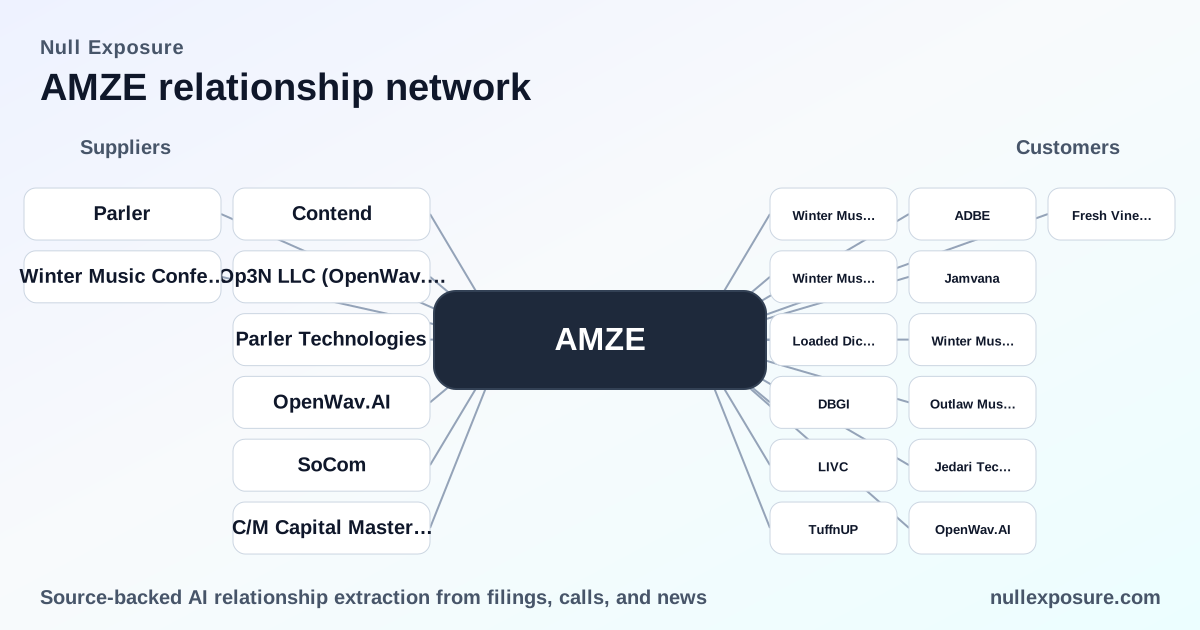
Amaze Holdings (AMZE): Customer Map and Commercial Implications for Investors
Amaze Holdings operates a creator-powered commerce and merchandising platform that monetizes via transaction and services revenues from brand partnerships, event merchandising, distribution agreements, and a growing direct-to-consumer (DTC) channel. The company earns money by powering commerce integrations for media and creator partners, selling branded merchandise at events and online, and syndicating audience segments to advertising platforms. This review focuses on the counterparty relationships disclosed in public reports and press announcements to assess commercial concentration, channel mix, and operational dependencies. For a quick platform overview and data-driven customer intelligence, visit Null Exposure.
What investors need to know in one sentence
Amaze is scaling a multi‑product commerce stack where revenue comes from branded merchandise and embedded commerce deals with legacy media, live events, and creator ecosystems—commercial success depends on a small number of large distribution partners, broad event and media tie‑ups, and growth in higher‑margin DTC sales.
How the partner ecosystem drives the business
Amaze’s partnerships fall into three functional buckets: (1) event and festival merchandising (ticketed, high‑visibility sales), (2) platform and media integrations that embed commerce into content properties, and (3) ad-tech/data syndication that monetizes audiences. These relationships are strategically complementary—events drive short-term transaction volume, media partnerships enable recurring embedded commerce, and ad‑tech partnerships convert audience signals into advertising revenue.
- Event and merchandise partnerships generate immediate cash and brand exposure but are seasonal and execution‑intensive.
- Media and platform integrations create higher lifetime value by embedding transactions into trusted content environments.
- Ad-tech syndication converts first-party signals into incremental revenue but depends on distribution partners for scale.
Explore investor-focused relationship analysis at Null Exposure.
Relationship roster — what each partnership means (concise takeaways)
Digital Brands Group (DBGI) / Digital Brands Group
A strategic integration with Digital Brands Group positions Amaze’s Teespring marketplace to expand third‑party brand offerings and apparel manufacturing reach. According to a GlobeNewswire release (Sep 9, 2025), DBGI became the first third‑party brand on Amaze’s Teespring Marketplace, signaling retail channel expansion.
Winter Music Conference 2026 (WMC 2026)
Amaze is the official branded merchandise partner for WMC 2026, providing on‑site merchandising and branded product lines for the Miami conference (March 24–26, 2026). Multiple press items (StockTitan and GlobeNewswire, Mar 2026) confirm Amaze’s role as official merchandise sponsor, delivering event‑driven sales and creator engagement.
Loaded Dice Entertainment
A partnership names Loaded Dice Entertainment as an official merchandise partner, giving Amaze access to event and artist audiences for branded product sales. The announcement appeared in company press coverage (StockTitan, Mar 2026).
The Trade Desk (TTD)
Amaze syndicates audience segments from its DSP to programmatic platforms such as The Trade Desk, enabling data‑driven ad revenue streams. GlobeNewswire (Mar 26, 2026) explains that Amaze’s DSP activates segments syndicated to The Trade Desk, creating a monetization path beyond physical merchandise.
TuffnUP
Amaze powered a limited‑edition TuffnUP collection with creator Joe Rauth, demonstrating capability to execute creator collaborations and drop commerce activations. StockTitan coverage (Feb 10, 2026 reporting) highlights this product drop as an example of creator‑led merchandising.
Outlaw Music Festival Tour 2025
Amaze served as Official Sponsor and Exclusive Branded Merchandise Partner for the Outlaw Music Festival’s 10th anniversary tour, delivering on‑tour merchandise sales and festival exposure (StockTitan, Mar 2026).
Jamvana
A strategic partnership with Jamvana links Amaze’s commerce capabilities to independent musicians and labels, integrating distribution, publishing, and promotional services into the commerce stack (StockTitan, Mar 2026).
Live Current Media (LIVC) / LIVC (Kast App)
Amaze entered an exclusive operating partnership to operate Live Current Media’s software, with initial focus on the Kast streaming app, expanding Amaze’s footprint into streaming platform commerce operations (StockTitan, Mar 2026).
OpenWav.AI
A collaboration with OpenWav.AI brings AI‑driven e‑commerce tools to musicians and creators, extending Amaze’s product offering into content‑to‑commerce tooling (StockTitan, Mar 2026).
Jedari Technology, Inc.
A joint initiative with Jedari Technology was cited as part of integrated e‑commerce and AI tool efforts for musicians and artists, supporting Amaze’s position as a creator‑focused commerce operator (StockTitan, Mar 2026).
Fresh Vine Wine
A limited‑edition premium Napa Valley red wine was developed in collaboration with Fresh Vine Wine, illustrating Amaze’s willingness to co‑brand in food & beverage categories (StockTitan, Mar 2026).
LA Times Studios, LLC
A high‑profile media integration: Amaze powers Food Channel LA, an LA Times Studios social‑commerce launch that embeds transactions into premium content, using Amaze’s operating studio model and Contend as an operating partner (Yahoo Finance and GlobeNewswire, Mar–May 2026). This is a significant distribution node given LA Times’ large monthly reach.
Adobe Express (ADBE) / Adobe
Amaze integrated its creator commerce platform into Adobe Express through an add‑on experience, embedding commerce workflows into Adobe’s creative toolset and broadening creator distribution channels (StockTitan, Mar 2026).
What the disclosure constraints tell investors about operational risk and runway
The company filings and public excerpts reveal several structural characteristics that shape commercial risk and scaling potential:
- Concentration and materiality: For the year ended December 31, 2024, 80% of wholesale revenue derived from four customers and those customers represented 25% of accounts receivable, indicating high revenue concentration and counterparty risk at the wholesale level.
- Channel mix and margin dynamics: DTC is higher‑margin and a stated strategic priority—management intends to invest to expand DTC capabilities, which signals a deliberate push to diversify away from wholesale dependency.
- Distribution dependencies: The company explicitly works with large national distributors—including Southern Glazer’s Wine & Spirits, Johnson Brothers, and RNDC—underscoring reliance on established distribution networks to reach retail endpoints.
- Geographic scale: Operations and revenue are concentrated in North America (United States and Puerto Rico), with wholesale and DTC channels both domestically focused.
- Relationship roles and stages: Public disclosures classify counterparties as distributors, buyers (individual DTC customers), and sellers (company’s proprietary products); Amaze reports active nationwide wholesale relationships and a ramping DTC strategy.
- Segment mix: The business reports revenue from both distribution (wholesale) and core product sales (proprietary varietals / merchandising), with wholesale currently material but DTC prioritized for margin improvement.
These constraints combine to produce a business model that is operationally dependent on a small set of large partners for wholesale scale, while pursuing diversification via higher‑margin media integrations and DTC expansion.
Investment implications and near‑term catalysts
- Positive drivers: Media integrations (LA Times Studios, Adobe Express) and ad‑tech syndication (The Trade Desk) create avenues for recurring embedded commerce revenue that scale beyond episodic event sales. Event and festival merchandising provides immediate cash flow and marketing value.
- Key risks: High concentration among wholesale customers and reliance on national distributors create counterparty exposure; domestic geographic concentration limits international upside.
- What to watch next: growth in DTC revenue, renewal/expansion of media integrations, and any disclosures that reduce wholesale concentration (e.g., new distributor relationships or less dependence on top four customers).
Bottom line: Amaze has assembled a pragmatic partner mix that balances event monetization with higher‑value media integrations, but current financial leverage to a few wholesale customers and domestic distribution partners is a material risk that investors should monitor closely.
For continuous monitoring of Amaze customer relationships and signal‑driven alerts, visit Null Exposure.