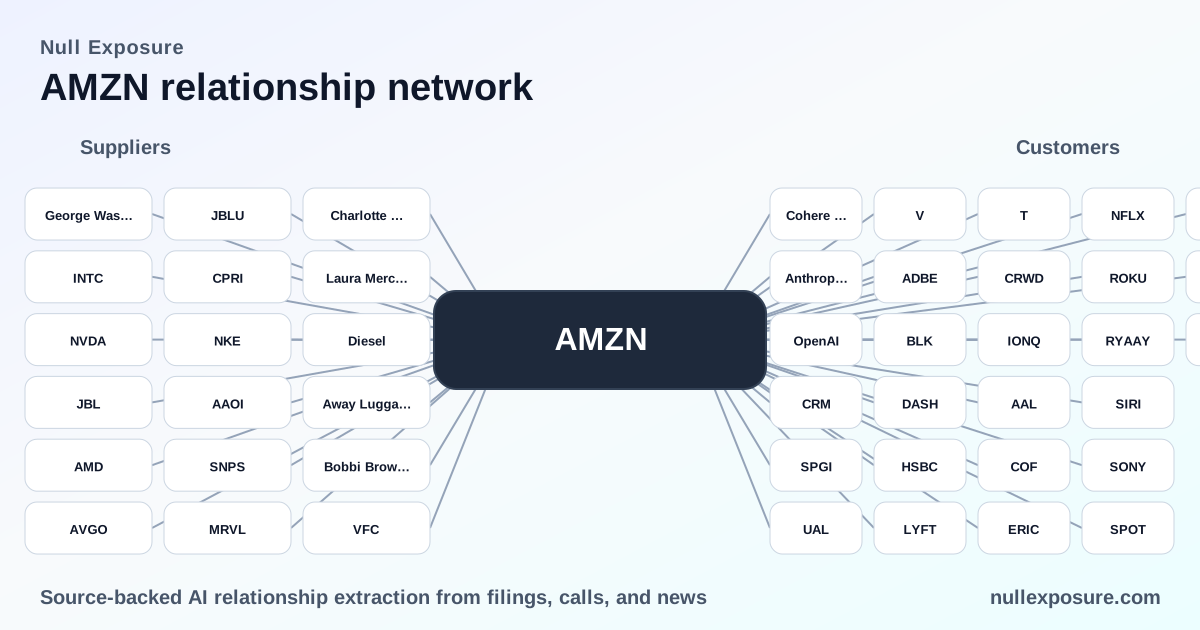
How Amazon’s customer web drives AWS scale and retail economics
Thesis: Amazon monetizes through a diversified, interlocking model — consumer retail and marketplace take-rates; recurring subscription revenue (Prime and digital services); advertising; and a high‑margin infrastructure business (AWS) that sells usage-based compute, storage and AI services to enterprises, startups, governments and developers. For investors, the critical signal is that AWS embeds long‑term, large commitments alongside on‑demand usage, producing durable contract coverage and a continuous top‑line lever to AI and cloud adoption. Learn more at https://nullexposure.com/.
What the pattern of customer mentions tells investors
Amazon’s customer relationships in the sample break into three strategic buckets: AI and platform customers (OpenAI, Anthropic, Nvidia partners), enterprise & telco customers adopting AWS for mission workloads, and a broad long tail of marketplace and advertising partners. Two business model constraints are central for valuation and operational risk:
- Contracting posture: Amazon reports large long‑term performance obligations (roughly $244 billion of commitments for contracts with original terms > 1 year as of Dec. 31, 2025) and a weighted average remaining life of ~4.1 years — a signal of material multi‑year revenue visibility at the company level.
- Revenue mix: AWS blends usage‑based billing (revenue recognized as compute/storage is consumed) with subscription and multi‑year commercial commitments; this creates asymmetric upside as AI and Trainium/Graviton demand rises, and downside concentration risk if large customers shift platforms.
- Global & cross‑segment criticality: Amazon serves consumers, enterprises and governments globally; government customers and regulated workloads increase the importance of compliance and FedRAMP/GovCloud offerings.
- Role diversity: Amazon operates as manufacturer (hardware devices), seller/marketplace operator, and large service provider (AWS and advertising) — each role has different margin and counterparty risk profiles.
These characteristics matter for premium finance and counterparty diligence: long-term commitments reduce revenue volatility, but usage-based growth amplifies upside from rising AI compute demand; global scale increases systemic exposure to outages or regulatory friction.
Quick catalog: customer mentions and the source evidence
Below I list each customer mentioned in the provided results with a one‑ or two‑sentence plain-English summary and the original source noted inline.
- Anthropic — Amazon hosts Anthropic’s Claude for non‑defense workloads and Anthropic trains models on Amazon hardware (Project Rainier / Tranium references). Source: AMZN 2025 Q3/Q4 earnings call transcripts and related market coverage (Mar 2026 earnings call; market reports FY2026).
- Cohere Health — Cohere Health is using AgentCore to deploy agents that reduce medical review times by 30–40%. Source: AMZN 2025 Q3 earnings call (transcript excerpt, Mar 2026).
- OpenAI — Amazon announced new agreements with OpenAI, reflecting commercial AI collaboration. Source: AMZN 2025 Q4 earnings call (Mar 2026).
- Avalon GloboCare (ALBT) — Avalon’s Avalon Quantum AI LLC is collaborating with AWS on an “agentic AI” video platform with AWS funding for Phase 2. Source: Globenewswire and SahmCapital press releases (Apr–May 2026).
- Safe Pro Group (SPAI) — Safe Pro’s scalable AI edge platform is built on AWS; multiple press releases cite AWS as the cloud backbone for government and commercial deployments. Source: Globenewswire, The Globe and Mail and related PR coverage (FY2026).
- Adobe (ADBE) — Adobe is listed among new agreements cited on Amazon’s earnings call, indicating product or go‑to‑market collaborations. Source: AMZN 2025 Q4 earnings call (Mar 2026).
- Digital Realty (DLR‑P‑K) — Digital Realty announced deployment of AWS Direct Connect 100Gbps capability at PlatformDIGITAL locations. Source: PR Newswire release (FY2021 item cited).
- Synopsys (SNPS) — Synopsys noted its digital twin platform can be powered by AWS infrastructure and Graviton4 processors. Source: Synopsys press release (FY2026).
- i3 Verticals (IIIV) — The company emphasizes partnerships with AWS for cloud‑native SaaS solutions. Source: TradingView summary of FY2025 filing (Mar 2026).
- BlackRock (BLK) — BlackRock appears among new agreements Amazon cited on its earnings call. Source: AMZN 2025 Q4 earnings call (Mar 2026).
- Worx (WORX) — Uses hosted solutions on AWS and Rackspace as part of its SaaS delivery model. Source: TradingView / FY2026 filing language.
- Bridgeline (BLIN) — Company filing warns of dependence on AWS for hosting and risk from disruption. Source: Bridgeline FY2025 10‑K / StockTitan report (FY2025).
- Caris Life Sciences (CAI) — Hosts data and analysis on AWS in addition to on‑premise infrastructure. Source: SEC filing summary via StockTitan (FY2026).
- CrowdStrike (CRWD) — Listed among enterprise agreements Amazon flagged on its earnings call. Source: AMZN 2025 Q4 earnings call (Mar 2026).
- Lumen Technologies (LUMN) — Announced Lumen as a partner for AWS Interconnect last‑mile delivery. Source: Lumen and AWS press coverage (FY2026).
- DoorDash (DASH) — Named as a new agreement in the earnings call; indicates advertising or cloud collaboration. Source: AMZN 2025 Q4 earnings call (Mar 2026).
- HSBC — Appears in Amazon’s list of new agreements on the earnings call. Source: AMZN 2025 Q4 earnings call (Mar 2026).
- Lyft (LYFT) — Included among AWS partners and customers cited on the earnings call; Lyft is also using Trainium/Graviton for daily rides/deliveries. Source: AMZN earnings and investor materials (Q4/Q1 2026).
- Grid Dynamics (GDYN) — Entered a multi‑year strategic collaboration with AWS to advance enterprise generative AI. Source: company press and news coverage (FY2025–FY2026).
- DXC Technology (DXC) — Completed enterprise‑wide deployment of Amazon Quick (agentic AI workspace) across 115,000 employees. Source: DXC press release (Feb 2026).
- XMax / XWIN — Launched an AI inference platform hosted on AWS. Source: Globenewswire and Yahoo Finance releases (Apr–May 2026).
- Weatherford (WFRD) — Signed an agreement to migrate and modernize platforms to AWS. Source: Investing.com / Globenewswire coverage (FY2025).
- IonQ (IONQ) — Quantum systems available through Amazon Braket on AWS. Source: IonQ announcement and industry press (FY2026).
- Gaxos.AI (GXAI) — AWS committed funding to develop its AI sales coaching platform; the announcement spurred a significant share reaction. Source: ManilaTimes / TradingView / StockTwits coverage (Mar 2026).
- Talkspace (TALK) — Launched integration with Amazon Pharmacy and other Amazon health services. Source: BH Business / company earnings (FY2025–FY2026).
- Perion (PERI) — Integrated Perion One Platform with Amazon DSP to leverage Amazon audience data. Source: Perion and Finviz coverage (FY2025–FY2026).
- Uber (UBER) — Announced as part of AWS partner roster; Uber is applying Graviton4 and Trainium3 for ride‑matching and model training. Source: Amazon Q1 2026 results and related press (FY2026).
- Delta Air Lines (DAL) — Announced as a customer for Amazon Leo‑powered inflight Wi‑Fi (starting 2028). Source: Amazon Q1 2026 results press release (May 2026).
- United Airlines (UAL) — Named among recent AWS customer agreements during Amazon’s earnings presentation. Source: AMZN 2025 Q4 earnings call and Q1 result notices (2026).
- Thomson Reuters (TRI) — Used Amazon agentic tools to transform large quantities of code and internal workflows cited on Amazon calls. Source: AMZN 2025 Q3 earnings call (2025Q3 transcript).
- Spotify / SiriusXM / Roku / Netflix / Hulu (streaming & ad partners) — Identified in earnings call as integrations or ad inventory partnerships (Amazon DSP and Amazon Audiences). Source: AMZN 2025 Q3 and Q4 earnings call transcripts.
- Numerous smaller ISVs, partners and marketplace customers (examples include: Beamr, SailPoint, Qualys, Nice, Ribbon Communications, Rockwell Automation, RedCloud, Rail Vision, V2X, Choice Hotels, AAR/AIRvoyant, Labcorp, Moodys, SailPoint, and many others) — Each cited in press releases or filings as using AWS infrastructure, listing products in AWS Marketplace, or entering strategic collaborations. Sources: multiple press releases, company filings and news items included in the results (Mar–May 2026).
(If you require a fully exhaustive, row‑level register of every single entity and URL from the source feed, we can export that as a dedicated report — see next steps below.)
What this means for investors and operators
- Upside exposure to AI: Mentions of OpenAI, Anthropic and broad enterprise adoption underscore AWS’s role as a primary supplier of AI compute, driving incremental high‑margin revenue via Trainium/Graviton demand.
- Durable multi‑year coverage vs. usage volatility: The coexistence of large long‑term commitments and usage‑based billing creates a buffer but preserves strong upside if customers scale AI workloads.
- Concentration and operational risk: AWS’s customer breadth is an advantage, but outages or regulatory restrictions to key customers (enterprise, government) would have outsized operational and reputational impacts.
- Ecosystem monetization: AWS Marketplace, co‑sell programs and device/advertising tie‑ins expand monetization beyond pure infrastructure, evidencing embedded cross‑sell opportunities.
Next steps (for underwriters and analysts)
- Download a detailed counterparty register or request a tailored exposure matrix by customer, contract type and evidence URL. Visit https://nullexposure.com/ to start a custom inquiry and obtain the full source export.
Bold takeaway: Amazon’s customer map shows durable revenue anchors through long‑term AWS commitments while preserving asymmetric upside from usage growth tied to AI — a structural driver investors should model explicitly in cloud revenue and margin scenarios.