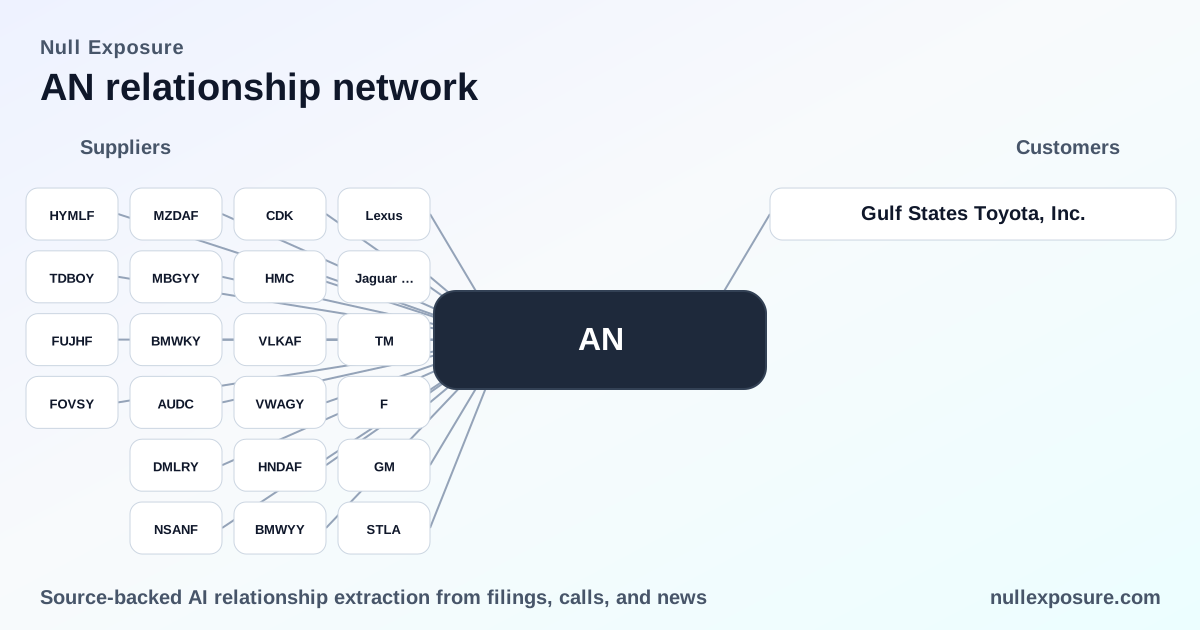
AutoNation (AN): Customer Relationships and Commercial Implications for Investors
AutoNation operates the largest auto retail platform in the United States, monetizing through vehicle sales, after‑sales parts and service, and customer finance and insurance products. The company captures margins at point of sale, then extracts recurring and higher‑margin revenue via parts, maintenance subscriptions, and captive finance. For investors, AutoNation is a vertically integrated retailer whose profitability depends as much on after‑sales capture and finance penetration as on new‑vehicle unit volumes. Explore the customer relationships and operating constraints that shape that profitability and strategic optionality. For primary source access, visit https://nullexposure.com/.
How AutoNation makes money — a concise investor thesis
AutoNation sells new and used vehicles across a broad brand footprint and drives incremental profit through three core levers: (1) after‑sales services and parts, which deliver recurring margin; (2) finance and insurance products, increasingly routed through its captive AutoNation Finance; and (3) value extraction from vehicle preparation, wholesale parts and collision services. The company’s EBITDA is sensitive to finance penetration and service utilization, while its cashflow profile benefits from long‑term consumer loan receivables and multi‑year service contracts.
Business model characteristics that matter to equity investors
- Contracting posture — longer duration exposures. AutoNation recognizes interest income over the contractual life of auto loans; the weighted average term reported in filings is 73 months, indicating a multi‑year revenue stream tied to credit performance and interest rate dynamics (10‑K, FY2025). That extends cashflow visibility but increases exposure to credit cycle swings over an extended horizon.
- Subscription-like service revenue. The company sells vehicle care programs where customers purchase a fixed number of maintenance services redeemable over a five‑year term under VCP contracts; these contracts convert one‑time buyers into repeat service customers and stabilize after‑sales revenue (10‑K, FY2025).
- Customer base concentration and geography. AutoNation is broadly national but concentrated: approximately 65% of 2025 revenue was generated in Florida, Texas and California, which amplifies regional economic and regulatory risks (10‑K, FY2025).
- Counterparty profile — retail individuals dominate. The business is predominantly retail‑facing; AutoNation Finance provides indirect financing to qualified retail customers, and the company serves over 11 million customers, underscoring a reliance on consumer spending and credit conditions (10‑K, FY2025).
- Role breadth — seller and service provider. Stores sell roughly 30 new vehicle brands while operating parts, repair and collision businesses that are essential for lifetime customer value and margin retention (10‑K, FY2025).
- Lifecycle stage — finance is ramping. Management is intentionally shifting origination economics from third‑party arrangers to its captive AutoNation Finance, expecting reductions in finance and insurance gross profit to be offset by higher profitability inside the captive as penetration rises (10‑K, FY2025). This is a structural change that will alter margin mix and capital allocation.
- Segment composition — diversified core products and services. Revenue drivers include new and used vehicle sales, after‑sales services, and customer financial services; this mix reduces volatility from unit cycles but places greater emphasis on operational execution across service centers and F&I operations.
Notable customer relationships and what they imply
AutoNation’s public disclosures and news coverage reveal customer and market interactions that illuminate competitive position and disposition of assets.
Gulf States Toyota, Inc.
AutoNation’s 2025 10‑K references Gulf States Toyota in the context of senior executive background, highlighting industry relationships with large independent distributors of Toyota vehicles and parts. According to AutoNation’s FY2025 filing, the disclosure notes an executive’s prior tenure as President and General Manager of Gulf States Toyota from 2017 to 2023, indicating executive familiarity with franchise distribution channels and supplier dynamics (10‑K, FY2025).
Tasca Automotive Group (deal for a Lincoln dealership)
A May 2026 industry report from Connecticut Business Times / CBT News details that Tasca Automotive Group acquired a Lincoln dealership in Clearwater from AutoNation, confirming AutoNation’s active portfolio management through strategic dealership dispositions. The transaction indicates ongoing optimization of franchise holdings and capital redeployment, consistent with management’s approach to rationalize locations and extract value from non‑core or underperforming assets (CBT News, May 2, 2026).
What these relationships mean for operational and credit risk
- Dealership dispositions reflect active portfolio management. The sale of a Lincoln franchise to Tasca shows AutoNation is willing to divest dealerships to better align brand mix and margin per location, which supports capital efficiency but introduces execution risk during transitions (CBT News, May 2026).
- Industry ties inform supply and parts access. The executive linkage to Gulf States Toyota signals deep industry experience that benefits negotiations and parts distribution insights, reducing supply chain friction for Toyota‑franchised outlets (10‑K, FY2025).
- Customer finance ramp changes revenue mix and capital needs. Shifting origination to AutoNation Finance trades immediate F&I dealer revenue for longer‑term interest income recognized over 73 months; investors should model a temporary compression in gross profit at point of sale with the expectation of gradual accretion in captive returns and an altered balance‑sheet credit profile (10‑K, FY2025).
Key risk and opportunity flags for investors
- Credit exposure over an extended term. The weighted average loan term of 73 months extends sensitivity to consumer credit deterioration and interest‑rate cycles — a structural risk that must be stress‑tested against rising delinquencies.
- Revenue concentration by region. With 65% of revenue concentrated in three states, macro shocks or localized regulatory changes in those markets could disproportionately affect results.
- Higher margin potential from after‑sales and captive finance. VCP contracts and the ramp of AutoNation Finance are structural levers that convert customers into recurring revenue streams, improving lifetime value and margin stability over time.
- Operational execution is critical. Success depends on service center utilization, retention of F&I penetration, and efficient integration of divested or acquired dealerships.
Investment takeaway and where to research next
AutoNation combines scale in vehicle retail with an actionable plan to convert transactional sales into recurring after‑sales and captive finance income. The investment case rests on management’s ability to grow AutoNation Finance while maintaining service capture and mitigating regional concentration risks. For a focused review of the company’s filings and the relationship evidence cited here, see https://nullexposure.com/ for primary document access and deeper relationship analytics.
Bold, data‑driven repositioning of finance origination and steady execution in after‑sales can widen margins; conversely, higher delinquencies or regional shocks present downside. Investors should prioritize scenario analysis around credit loss assumptions, service retention rates, and the pace at which captive finance contribution replaces third‑party F&I economics.