AnaptysBio (ANAB): Transitioning to a Royalty-Centric Business — How its Customer Relationships Drive Value
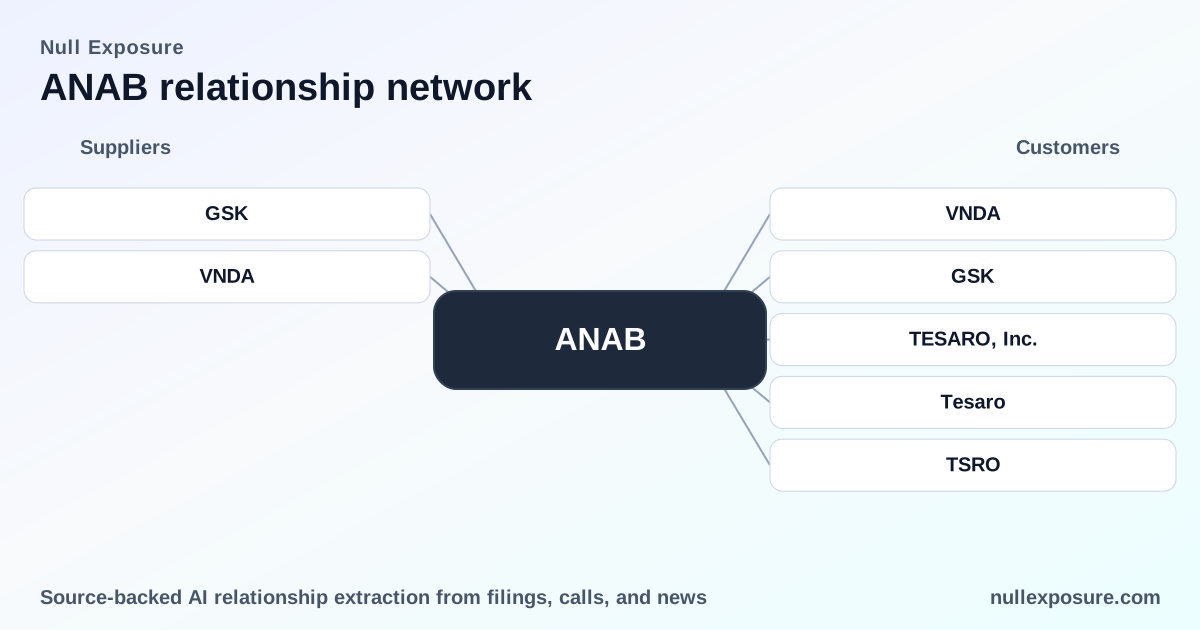
AnaptysBio has repositioned from running internal biopharma operations to a royalty- and milestone-driven model anchored on out‑licenses for two core assets: Jemperli (dostarlimab) commercialized by GSK/Tesaro and imsidolimab licensed to Vanda Pharmaceuticals. The company monetizes through tiered royalties, one‑time commercial milestones and structured royalty monetizations, while retaining selective clinical programs in a spun‑off operating subsidiary. For investors, the thesis is simple: Anaptys’s near‑term cash flows and valuation are concentrated on partner execution and legal outcomes around royalties. Learn more at https://nullexposure.com/.
What the relationships look like in plain terms
Anaptys’s customer‑facing relationships are compact but consequential. Below I lay out every counterpart named in the available coverage and how each connection translates into economics, governance touchpoints, or legal exposure.
GSK (and the Tesaro origin story) — the royalty anchor
GSK (through its acquisition of Tesaro) is the commercial partner for Jemperli and the principal royalty payer under Anaptys’s March 2014 license; the agreement delivers tiered royalties and milestone mechanics including an accrued $75 million commercial milestone when Jemperli hit $1 billion in worldwide sales in 2025 (GlobeNewswire, Mar 3, 2026). Litigation over contractual performance has escalated, making GSK/Tesaro both the largest revenue source and the focal point of legal risk (GlobeNewswire, Nov 21, 2025).
Tesaro / TESARO, Inc. / TSRO — the named licensee in the original deal
Tesaro is the named licensee under the March 2014 Collaboration and Exclusive License Agreement and is central to ongoing litigation that questions license compliance and royalty rights; Anaptys has filed suit seeking declaratory relief and Tesaro (now a GSK unit) has responded (GlobeNewswire, Nov 21, 2025; GSK press release, May 2026). The original contract specifies tiered royalty rates (8% up to $1B, then stepping to 25% above $2.5B), creating direct cash leverage to Anaptys if the license remains intact (Anaptys filing cited in GlobeNewswire, Jan 8, 2026).
Vanda Pharmaceuticals (VNDA / Vanda) — the second material royalty relationship
Vanda holds an exclusive global license for imsidolimab from Anaptys; Anaptys received upfront consideration and additional economics tied to future development/commercialization, including a $15 million license payment and subsequent regulatory milestones as Vanda advanced a BLA (PR Newswire / Finance Yahoo, Mar 10, 2026). Vanda’s regulatory progress (BLA acceptance and efficacy publications) translates into potential royalty upside for Anaptys and is explicitly referenced in investor materials (GlobeNewswire, Feb 5, 2026).
First Tracks Biotherapeutics (TRAX) — the operational spin‑out counterparty
Anaptys completed the spin‑off of First Tracks Biotherapeutics and entered a two‑year transition services agreement to separate operations while continuing to manage certain program economics; First Tracks also raised private placement capital ahead of the spin (TradingView coverage, May 2, 2026). This separation isolates Anaptys as a royalty manager while First Tracks advances the clinical programs that formerly sat inside the company (QuiverQuant / TradingView, May 2026).
EcoR1 Capital Fund Qualified — capital partner in the spin‑out financing
EcoR1 Capital Fund Qualified is listed as a counterparty in the private placement that funded First Tracks prior to the spin‑off, signaling investor demand for the clinical development franchise that Anaptys carved out (TradingView, May 2, 2026).
Constraints that define the operating model and risk profile
Anaptys’s current operating posture is shaped by long‑dated monetization deals, licensing structures, global royalty exposure and active legal disputes. Those company‑level signals change the character of revenue and counterparty risk:
-
Long‑term monetization posture. Anaptys executed multi‑year royalty monetization agreements: a 2021 Jemperli monetization with Sagard that provided $250 million up front in exchange for future Jemperli royalties, and a 2022 Zejula monetization with a DRI subsidiary for $35 million (company filings described in 10‑K excerpts). These arrangements convert future royalty streams into near‑term capital, increasing current cash visibility while transferring some upside to monetization counterparties.
-
Licensing as a primary contract type. The March 2014 Collaboration and Exclusive License Agreement with Tesaro/GSK is the canonical licensing arrangement recorded under ASC 606, making GSK a customer for accounting and cash‑flow purposes (company disclosure).
-
Global reach and materiality. Royalties and milestones are calculated on worldwide net sales, and management classifies the GSK collaboration as material given license transfers, R&D commitments and joint governance provisions — reinforcing the centrality of a single large commercial partner to Anaptys’s cash flows.
-
Active and legally contested relationships. The GSK/Tesaro relationship is active and litigated; Anaptys recognizes milestone and royalty revenue from that collaboration while pursuing declaratory relief and motions in Delaware Chancery Court (GlobeNewswire, Jan 8, 2026; GlobeNewswire, Nov 21, 2025).
Taken together, these characteristics create a business that is concentrated, contractually mature, high‑stakes and counterparty‑dependent — favorable for cash generation when partners perform, but subject to concentrated legal & execution risk.
What investors should watch next
- Litigation calendar and court rulings related to Tesaro/GSK; outcomes will materially affect royalties and upside capture (news coverage and court filings, early 2026).
- Vanda’s regulatory progress (BLA timelines and commercial launch plans) for imsidolimab, which directly affects Anaptys’s contingent economics (PR Newswire / Finance Yahoo, Mar 2026).
- Monetization amortization and remaining royalty tail after prior monetizations with Sagard and DRI, which determine how much of future upside remains with Anaptys versus third‑party monetization counterparty claims (company SEC disclosures).
For a concise, investor‑oriented breakdown of these partner dynamics and how they map into Anaptys’s cash profile, visit https://nullexposure.com/.
Final takeaways for valuation and risk
- Concentration of cash flow: Two partners (GSK/Tesaro and Vanda) drive the material near‑term economics.
- Legal outcomes are value drivers: The Tesaro dispute is not peripheral — court decisions will re‑price expected future royalties.
- Monetization reduces upside but stabilizes balance sheet: Prior sales of royalty streams provided liquidity but also transferred some future upside to monetization counterparties.
This relationship map and the embedded constraints make Anaptys a specialist royalty‑cohort play: high cash conversion potential if partners execute and courts uphold contractual terms, but concentrated counterparty and litigation risk that must be priced into any investment view.