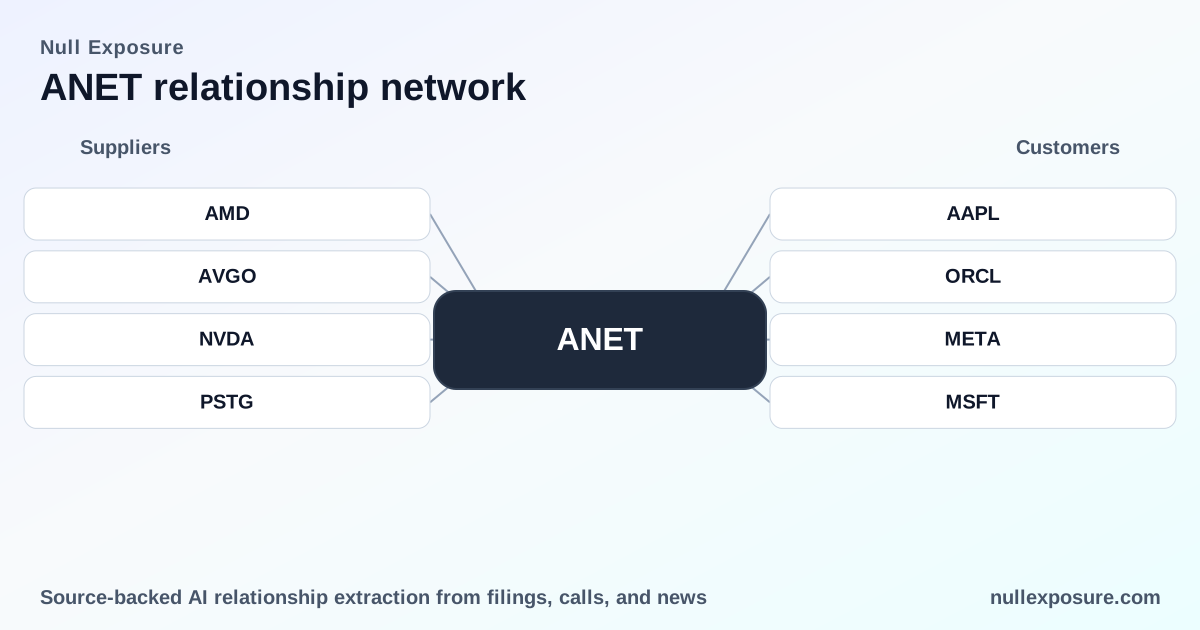
Arista Networks: Customer Relationships That Power AI — and Concentrate Risk
Arista Networks designs and sells high-performance Ethernet switches and related software for data centers and cloud infrastructure, monetizing through hardware sales, recurring software subscriptions, and renewable post-contract support. The company’s economics are driven by a dual model: one-time hardware revenues for hyperscaler capex and higher-margin, subscription-based software and services that generate predictable, deferred revenue. For a consolidated data view and signal-level sourcing, visit https://nullexposure.com/.
The investment thesis, in one line
Arista is the industrial leader supplying the back‑end networks for hyperscale AI training and cloud operations; its growth and margin profile scale with hyperscaler capex cycles, while recurring software and PCS contracts provide durable, higher‑margin revenue streams.
How Arista’s commercial construct shapes outcomes
Arista runs a hybrid go-to-market: direct sales to very large cloud and enterprise customers plus channel partners, and a product mix split across hardware, software, and services. The 2024 Form 10‑K groups revenue into Core (Data Center, Cloud and AI Networking) at roughly 65%, Cognitive Adjacencies at 18%, and Networking Software & Services at 17%, which illustrates the company’s transition toward software-driven economics while remaining materially dependent on hardware purchases from a handful of large customers.
- Contracting posture: Post‑contract support (PCS) is sold under renewable, fee‑based contracts; software and services are subscription-based, creating predictable deferred revenue (Arista reported about $3.4 billion in contract liabilities as of 12/31/2024, with ~85% expected in the next two years).
- Concentration: North America accounted for ~82% of 2024 revenue; large purchases from a limited set of customers represent a substantial portion of sales, creating cyclicality tied to hyperscaler capex.
- Criticality: Industry coverage and company commentary label Arista a “pick‑and‑shovel” supplier to AI clusters — its switches are a critical component of hyperscaler training infrastructure.
- Maturity: Relationships are largely active and operational, with ongoing multi‑year deferred revenue and renewable support contracts, alongside evaluation/pilot inventory for new use cases.
For more signal-level analysis, see https://nullexposure.com/.
Relationship roll call — who Arista sells to and why it matters
Microsoft (MSFT)
Arista’s 2024 Form 10‑K states sales to Microsoft represented 20% of total revenue in 2024 (20%, 18% and 16% across 2024–2022 trends), underscoring Microsoft’s status as an anchor customer. A Trefis note (Feb 26, 2026) and a Tikr earnings preview (May 3, 2026) highlight Microsoft as a hyperscaler whose AI infrastructure capex materially drives Arista’s near‑term hardware demand. (Source: Arista 2024 10‑K; Trefis Feb 26, 2026; Tikr May 3, 2026)
Meta Platforms (META)
Arista discloses that sales to Meta Platforms accounted for 15% of revenue in 2024 (with a multiyear trend showing higher prior percentages), confirming Meta as the other anchor hyperscaler customer. Market commentary (Heygotrade, May 2026) places Meta among the Cloud & AI Titans that together made up roughly 48% of Arista’s 2025 revenue, highlighting Meta’s centrality to Arista’s revenue base. (Source: Arista 2024 10‑K; Heygotrade May 2, 2026)
Oracle (ORCL)
Arista management grouped Oracle into its “AI and specialty providers” category that “performed strongly at 20%” during 2025 Q4 commentary, indicating Oracle is part of the expanding cohort of AI customers beyond the two anchors. External coverage also lists Oracle among the hyperscaler ecosystem Arista serves. (Source: Arista 2025 Q4 earnings call, Mar 7, 2026; Heygotrade May 2, 2026)
Apple (AAPL)
Arista’s 2025 Q4 earnings call placed Apple in the same bucket as AI and specialty providers — a named customer class that delivered strong performance in the period — signaling that Apple is a meaningful enterprise/hyperscaler‑adjacent buyer for select Arista products. (Source: Arista 2025 Q4 earnings call, Mar 7, 2026)
Note on duplicates in public commentary: multiple news outlets and analyst notes repeat the same core relationship facts (Microsoft and Meta as anchors; Oracle and Apple within an expanding AI and specialty cohort), reinforcing consistency across filings and market coverage (Trefis, Heygotrade, Tikr, Arista 10‑K and earnings call).
Constraints and operating model signals investors must weigh
- Subscription and renewables: Arista explicitly offers subscription‑based software and renewable PCS contracts; this raises revenue visibility but also introduces multi‑year performance obligations (evidence: subscription and PCS language in company filings).
- Customer concentration is material: The 10‑K and market commentary repeatedly confirm that a small number of customers account for a substantial portion of revenue. Concentration amplifies upside in hyperscaler capex cycles and downside in any single large customer slowdown.
- Geographic concentration: Americas represented ~82% of 2024 revenue, with EMEA ~10% and APAC ~8%, indicating regional concentration risk tied to U.S. hyperscaler spending patterns.
- Role and product mix: Arista operates primarily as the seller of hardware and software and a provider of support services; product segmentation shows continued reliance on hardware (Core) alongside growing services/software revenue.
- Relationship stage: Most relationships are active and revenue‑generating, supported by significant deferred revenue balances and renewable support contracts; pilots and evaluation inventory persist for new product rollouts.
Investment implications: upside and risk in plain language
- Upside: Direct exposure to AI infrastructure demand and a shift toward higher‑margin recurring software and PCS revenue support longer‑term margin expansion and revenue durability.
- Risk: High concentration in two anchor hyperscalers creates cyclicality—strong AI capex accelerates growth, but a slowdown or competitive displacement at either Microsoft or Meta would reduce demand sharply, as highlighted in market commentary (Trefis, Feb 26, 2026).
- Operational levers: Success hinges on expanding share beyond the two anchors into Oracle, Apple and other cloud/AI customers while accelerating software attach rates to smooth hardware cyclicality.
Bottom line
Arista’s position as a core supplier to AI and cloud networks is a powerful growth engine, but investors must price in concentration risk and hyperscaler capex cyclicality. Its subscription and PCS revenue profiles deliver tangible deferred revenue visibility, while geographic and customer concentration create asymmetric scenario outcomes. For signal‑level tracking and relationship provenance, visit https://nullexposure.com/ to inspect sources and filings referenced here.