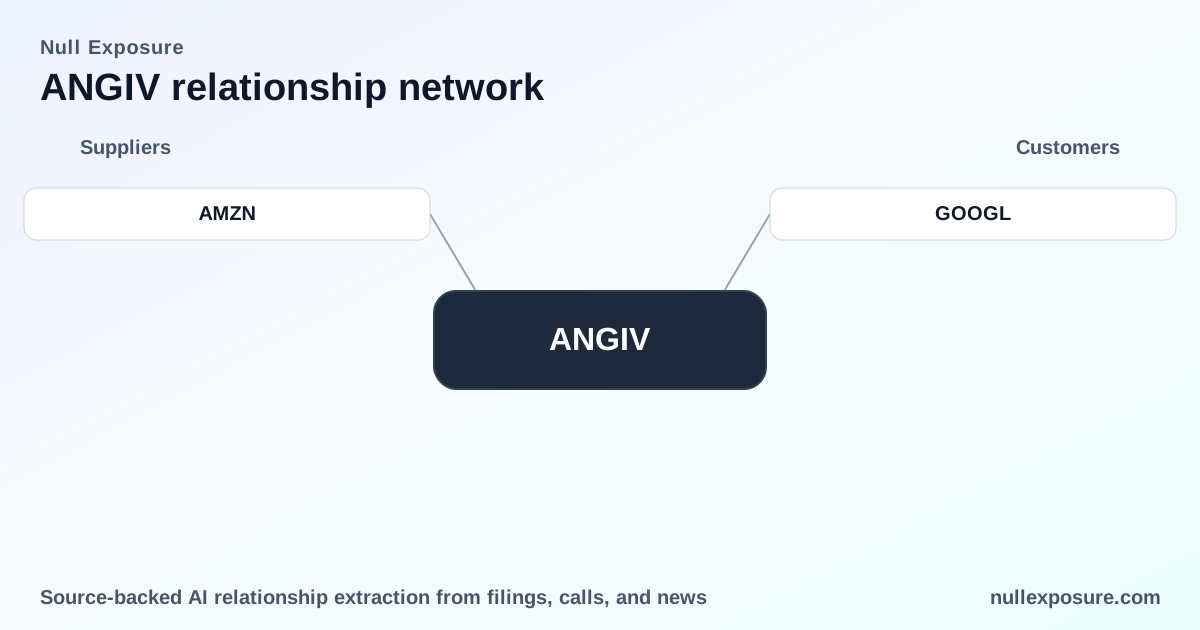
Angi Inc. (ANGIV) — Customer Relationship Spotlight: Google
Thesis: Angi operates a digital marketplace that connects homeowners with service professionals and monetizes through lead generation, advertising and subscription services for service providers; its strategic value depends on distribution partnerships and the quality of its lead network, which Google publicly cites as valuable for search and emerging LLM-driven use cases. For deeper relationship intelligence on Angi and platform partners visit https://nullexposure.com/.
Business model in plain language Angi is a marketplace that converts homeowner demand into monetizable supply-side products: premium leads, subscription programs for service professionals, and advertising placements. Revenue derives from capturing the delta between homeowner acquisition and monetized provider engagement; the company’s competitive advantage is the scale and quality of its contractor network and the data that powers matching and conversion. Distribution partnerships and search-platform visibility are therefore core commercial levers—any change in those channels directly influences top-line performance and CAC dynamics.
How Angi’s commercial relationships translate into financial sensitivity
- Distribution dependence: Partnerships with major platforms drive volume and lower customer acquisition cost.
- Lead quality criticality: High-quality leads sustain provider renewals and justify premium pricing.
- Technology embed risk/reward: Integration into search and LLM-driven surfaces can amplify demand quickly, but also exposes the company to platform policy and algorithm changes.
Relationship map — every customer link reported Angi’s publicly reported customer references in the provided results point to a single major partner listed twice; below are both entries captured from the same earnings-call source, each summarized separately per the source records.
-
GOOGL (inferred symbol GOOGL) — Angi’s network is explicitly described as valuable to Google and positioned as relevant for large language model applications. According to a Q4 2025 earnings call transcript published March 9, 2026, Angi management stated that it has “built a network, a deep, broad, and skilled network which Google still finds very valuable as a partner to serve its customers, and we believe the LLMs will as well.” (InsiderMonkey, Q4 2025 / published 2026-03-09).
Implication: Angi’s lead network is recognized by a major search platform as a distinct commercial asset that can be surfaced across traditional search and next‑generation AI interfaces. -
Google (company name listed separately in results) — The same earnings-call excerpt reiterates that Angi’s contractor network is a strategic input for Google’s customer-facing products and anticipated LLM integrations, highlighting a transactional and possibly technology-enabled commercial relationship. According to the same Q4 2025 transcript, management underscored the network’s continued utility to Google and to LLM-driven features. (InsiderMonkey, Q4 2025 / published 2026-03-09).
Implication: The dual listing underscores how Angi’s go-to-market is anchored to platform partnerships that encompass both search distribution and emerging AI channels.
Operating model characteristics and company-level signals Because no explicit contractual terms are provided in the source material, evaluate Angi’s operating posture using the observable commercial signals:
- Contracting posture: Angi operates as a supply‑side aggregator that sells leads and services to contractors while leveraging third-party distribution; its posture is commercial and transactional rather than vertically integrated. This structure favors flexible, performance-based contracts with providers and platform partners.
- Concentration: The public acknowledgement of Google as a partner signals material exposure to platform distribution, creating a concentration vector—Angi’s growth and acquisition economics are sensitive to the health of that channel.
- Criticality: Google’s valuation of Angi’s network for both search and LLM experiences elevates the partnership from peripheral to strategically critical for reach and discoverability.
- Maturity: The wording used—“still finds very valuable”—positions Angi’s network as an established asset with sustained commercial traction rather than an early‑stage experiment.
Constraints and disclosure note There are no explicit contractual constraints or third‑party limitations provided in the extracted results. That absence is itself a company‑level signal: public commentary emphasizes strategic partnership value without disclosing commercial terms or concentration thresholds, limiting outside visibility into revenue dependence and contractual protections.
Risk factors investors should prioritize
- Platform dependence risk: A meaningful share of referral traffic concentrated in a single platform exposes Angi to algorithmic shifts, commercial repricing, or preferential treatment for competitors.
- Monetization cadence: Recognition by a platform is not equivalent to favorable commercial terms; conversion and pricing remain the drivers of revenue.
- AI-driven disintermediation risk: While LLMs expand surfaces for discovery, they can also centralize matching logic within platform providers, which could reduce margins if Angi cannot secure favorable placements or integrated revenue shares.
Why the Google relationship matters for valuation A named partner like Google functions as a validation of Angi’s core asset—the contractor network—and as a distribution multiplier. If referral volumes and placements through Google materially improve conversion economics, Angi’s lifetime value per customer and gross margin profile can expand rapidly. Conversely, loss or unfavorable repricing of that channel compresses revenue and raises CAC. The relationship therefore shifts Angi’s valuation sensitivity toward platform metrics rather than purely domestic marketing efficiency.
Actionable takeaways for investors and operators
- For investors: Track referral share and any disclosure of distribution-based revenue or traffic contributions, since platform exposure is a principal driver of upside and downside risk.
- For operators: Prioritize contractual protections, diversification of acquisition channels, and product differentiation that retain providers even if third‑party placement quality fluctuates.
Further reading and intelligence For a concise compilation of Angi’s partner references and relationship signals, visit https://nullexposure.com/ for curated coverage and ongoing monitoring.
Conclusion Angi’s public commentary confirms a commercially meaningful relationship with Google that strengthens its distribution capabilities and signals relevance to the next wave of AI-driven discovery. This relationship is a double-edged sword: it scales reach and improves monetization potential, but it also concentrates execution risk around external platform policy and economics. Investors should weigh platform exposure against Angi’s ability to capture and retain premium lead economics when assessing growth and downside protection.