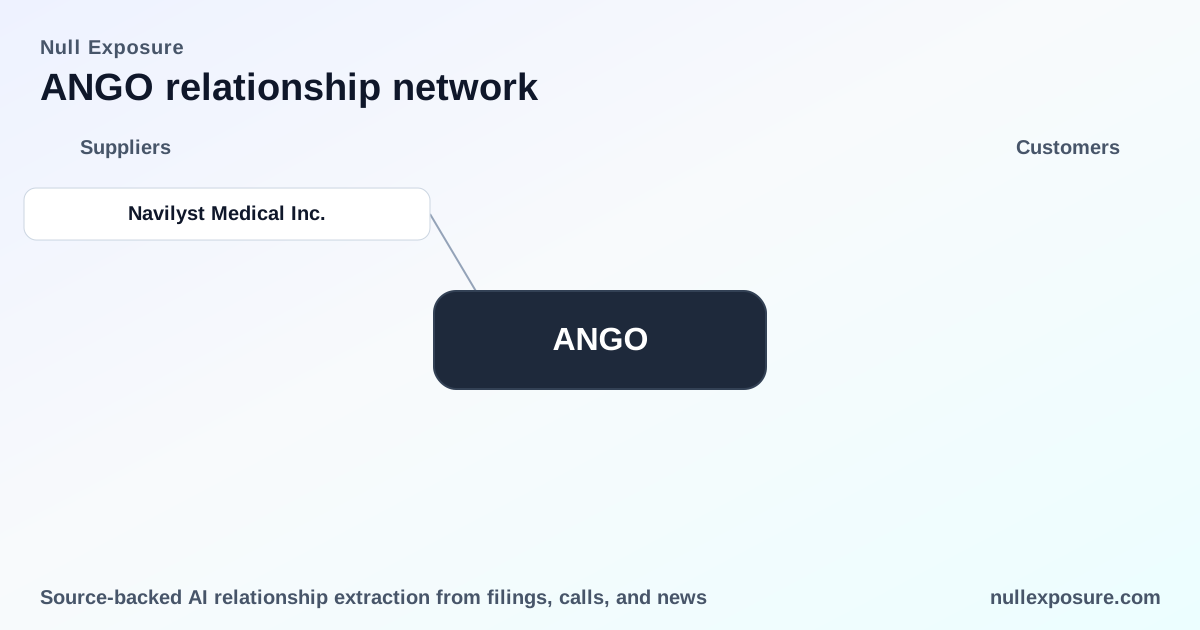
AngioDynamics (ANGO): Customer Relationships, Recent Divestitures, and Commercial Constraints
Thesis — AngioDynamics designs, manufactures and sells vascular and oncology devices and monetizes through point-of-sale device sales in the U.S. and distributor-driven international channels, supplemented by occasional strategic divestitures of product lines; revenue recognition is transaction-based and cash conversion is driven by standard 30–90 day payment terms. For investors, the story is a company with a mid-single-digit revenue base (~$314M TTM), negative operating leverage in the latest periods, and an operational model that favors short-term, shipment-driven commercial relationships rather than long multi-year supply contracts. For more context on commercial exposures and relationship analytics, see https://nullexposure.com/.
What the customer map implies for investors and operators
AngioDynamics runs a classic medical-instruments commercial model with several structural characteristics that drive both resilience and risk:
- Contracting posture: predominantly spot and short-term. The company recognizes revenue at a point in time (upon shipment or delivery) and uses standard payment terms of 30–90 days, signaling limited customer financing and quick revenue-to-cash conversion. This is a company-level signal drawn from AngioDynamics’ filings in recent fiscal periods.
- Usage arrangements exist but are limited. The company places evaluation/placement units at customer sites while retaining title; disposables consumption underpins ongoing revenue in those relationships, creating usage-linked recurring revenue for specific product lines.
- Geographic concentration in North America. The business sells primarily in the U.S. through a direct sales force; international channels rely on third-party distributors, which accounted for approximately 74% of international revenue in the fiscal year ended May 31, 2025.
- Role mix: seller-first with distributor amplification overseas. AngioDynamics is primarily a vendor selling devices to hospitals and distributors; it also functions as a service provider where placement units are used to seed consumable sales.
- Commercial maturity and concentration. The relationship set is mature and transactional, not contractualized into long-term supply agreements at scale; this creates cash predictability but leaves revenue exposed to product-line migrations and one-off M&A transfers.
These characteristics produce a predictable near-term cash profile but expose top-line growth to product portfolio changes and distributor performance overseas.
Recent customer/partner moves you need on your radar
Merit Medical — sale of dialysis catheter assets
Merit Medical paid $100 million in cash to acquire dialysis catheters and a sealant system from AngioDynamics in a deal announced in early May 2026. This transaction transfers a set of dialysis catheter assets out of AngioDynamics’ product portfolio and represents a material one-off monetization of product lines. According to MedTech Dive (May 2, 2026), Merit completed the acquisition as part of a broader catheter expansion strategy: https://www.medtechdive.com/news/MMSI-Merit-Medical-dialysis-catheters-acquisition/652616/.
Spectrum — divestiture of PICC and Midline business
AngioDynamics disclosed that it sold its PICC and Midline business to Spectrum; management referenced Spectrum directly on the company’s FY2026 earnings call transcript. The PICC/Midline sale removes a recurring consumables/line-extension set from AngioDynamics’ direct-selling portfolio and reallocates the clinical distribution pathway for those products. This was noted in an earnings-call transcript published on InsiderMonkey (May 2026): https://www.insidermonkey.com/blog/angiodynamics-inc-nasdaqango-q3-2026-earnings-call-transcript-1731695/.
How these relationships change the commercial picture
The two disclosed transactions are not routine distributor orders; they are strategic divestitures and asset transfers that reshape AngioDynamics’ addressable consumables base:
- Immediate cash and margin impact: The Merit transaction delivers a significant one-time cash infusion ($100M) and reduces direct exposure to dialysis-catheter manufacturing and ongoing R&D for that line.
- Recurring revenue trade-off: Selling PICC/Midline to Spectrum likely reduces steady consumable volume sold through Angio’s direct force, pushing future revenue for those clinical pathways to the buyer.
- Channel rebalancing: With the PICC/Midline sale and the Merit transfer, AngioDynamics’ U.S. direct sales force will need to refocus on remaining core franchises; international distributor dynamics remain unchanged and still account for the majority of non‑U.S. revenue.
Key takeaway: divestitures generate liquidity and simplify the portfolio, but they reduce the installed-base consumable stream that underpins usage-linked revenues.
Contracting and operational constraints that matter
Company filings and management commentary provide actionable signals about how AngioDynamics runs its commercial engine:
- Point-in-time revenue recognition and 30–90 day standard terms mean cash conversion is relatively quick and customer credit exposure is limited; this supports working-capital stability.
- Placement units retained by AngioDynamics create a hybrid service-provider relationship in selected clinical settings, enabling recurring disposables sales without transferring equipment ownership.
- Distributor reliance internationally creates an execution dependency: international growth depends on third-party partners (country or regional distributors) rather than expanding direct field coverage.
- No material customer financing: the company’s standard terms indicate it does not provide significant financing to customers, reinforcing a seller-first posture.
These constraints should be read as company-level operational signals that affect all customer relationships; they are not specific to Merit or Spectrum unless otherwise disclosed.
Investment implications and risks for operators
- Strategic divestitures convert product-line complexity into liquidity but lower recurring consumable cashflows; investors should model earnings without those revenue streams going forward unless replaced by new franchises.
- Geographic concentration in the U.S. creates domestic demand sensitivity; international growth requires distributor effectiveness and carries execution risk in key markets such as China, Japan and parts of Europe.
- Short-term contracts and spot shipments limit long-term revenue visibility; this increases the importance of product innovation and surgeon/interventional adoption to sustain growth.
- High institutional ownership (~95% institutions as reported) implies active coverage and limited retail float, which can compress volatility but increase sensitivity to analyst guidance and M&A signaling.
Bottom line
AngioDynamics is a transactionally oriented medical-device company that sells primarily into U.S. clinical channels while relying on distributors overseas. Recent asset sales to Merit Medical and Spectrum accelerate portfolio simplification and provide cash but reduce some recurring consumable streams, shifting the growth imperative back to core franchises and new product introductions. For investors and operators evaluating customer exposure, the principal issues are how quickly remaining franchises can replace lost consumable revenue and how effectively international distributors execute.
For deeper relationship analytics and commercial exposure mapping for AngioDynamics, visit https://nullexposure.com/.