ANIK: Revenue concentrated, licensed products, and an OEM partnership that defines risk and runway
Anika Therapeutics develops and manufactures hyaluronic-acid (HA) based joint-preservation products and adjacent regenerative solutions and monetizes through a hybrid model: direct commercial sales and distributor channels, OEM manufacturing contracts, and long-term licensing/royalty arrangements with large partners. The company’s economics are governed by a handful of long-duration agreements—most prominently with Johnson & Johnson’s MedTech unit—which together account for the majority of product revenue and therefore shape growth prospects, margin variability, and investor risk-reward.
If you want a concise reference on ANIK’s customer posture and partnership dynamics, visit NullExposure for structured relationship intelligence: https://nullexposure.com/.
How Anika operates: contracts, channels and commercial reality
Anika’s operating model is a mix of product manufacturing and licensing. The company manufactures proprietary OA (osteoarthritis) HA therapies—Monovisc and Orthovisc—and sells them through three commercial pathways:
- Licensed OEM partnerships where Anika manufactures product for larger partners who control marketing, pricing and end-user sales (the largest of these partners is J&J MedTech).
- Direct commercial channel where Anika sells to clinicians, ASC/hospital customers and distributors and controls pricing and go-to-market.
- International distributor network that resells Anika products outside the United States.
From a contracting posture perspective, Anika is committed to long-term relationships: licensing and OEM agreements extend across multi-year terms and include renewal options that shape mid-term revenue visibility. The company’s revenue concentration—J&J MedTech accounted for 57% of revenue in FY2024—creates a structural dependency that is both a growth engine and a single-counterparty risk. These are company-level characteristics supported by public filings and earnings commentary.
- Contract maturity and licensing: Anika’s filings document decade-plus licensing relationships for Monovisc and Orthovisc, including multiple extensions; this translates to durable but partner-controlled U.S. commercialization for key products.
- Concentration and criticality: Large-enterprise partners dominate OEM revenue, making partner retention and pricing negotiations material to ANIK’s P&L.
- Geographic footprint: The business is global, but the U.S. remains the primary market (roughly 69% of revenue in 2024).
All relationships cited in ANIK public documents and press (each item from the dataset)
The following short notes cover every relationship entry captured in the provided results with a concise source mention.
-
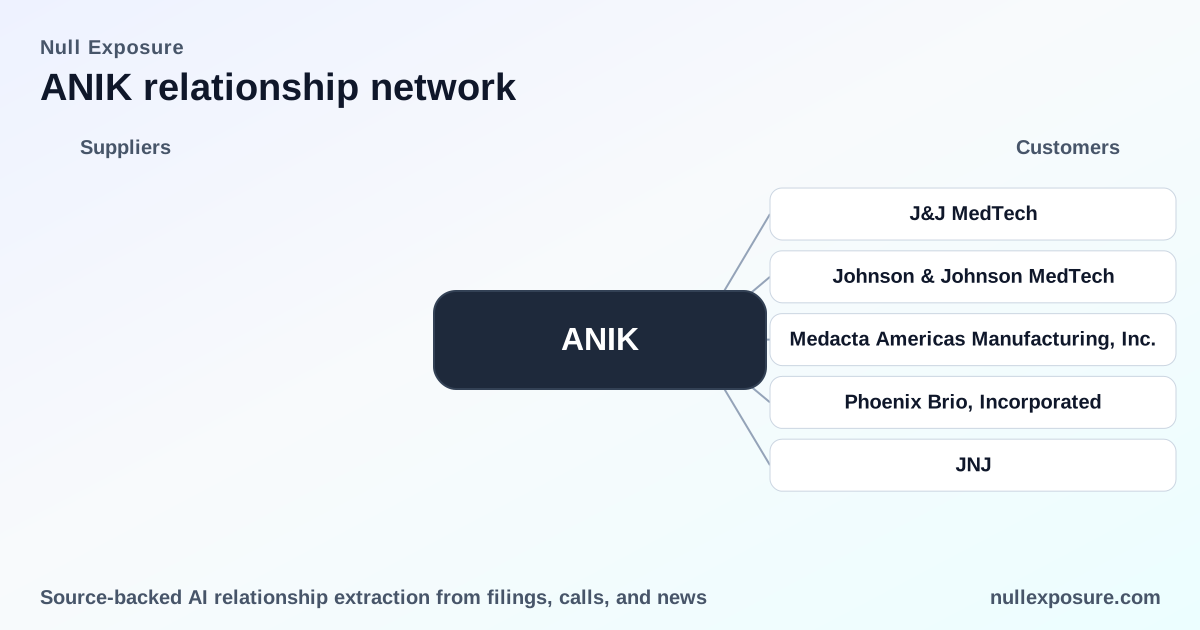
J&J MedTech — Anika’s 2024 Form 10‑K reports J&J MedTech accounted for 57% of revenue in FY2024, down from 62% the prior year; declines in OEM channel revenue are explicitly linked to lower J&J MedTech sales. Source: Anika 2024 10‑K (FY2024).
-
Johnson & Johnson MedTech — Anika discloses that Monovisc and Orthovisc are marketed exclusively in the U.S. by J&J MedTech, reflecting a license/distribution arrangement for its core OA products. Source: Anika 2024 10‑K (FY2024).
-
Medacta Americas Manufacturing, Inc. — Anika completed the sale of Parcus Medical, LLC to Medacta Americas Manufacturing, Inc., representing a divestiture of a non-core business. Source: Anika 2024 10‑K (FY2024).
-
Phoenix Brio, Incorporated — Anika completed the sale of Arthrosurface to Phoenix Brio, Incorporated, another strategic divestiture that refocused the company on joint-preservation core assets. Source: Anika 2024 10‑K (FY2024).
-
Phoenix Brio (press) — The sale of the Arthrosurface business closed on October 31, 2024, per Anika’s press release, confirming transaction timing and cash/strategic impact. Source: GlobeNewswire press release (Oct 31, 2024).
-
JNJ (earnings call Q3 2025) — In the Q3 2025 earnings call Anika reported that Johnson & Johnson exercised its option to extend the Monovisc license and supply agreement for another five years through December 2031, reinforcing the long-term nature of the partnership. Source: ANIK Q3 2025 earnings call transcript (2025Q3).
-
J&J MedTech (news / Q1 2026) — Anika said OEM channel grew 14% year-over-year in Q1 2026 due to favorable order timing for U.S. OA products sold through its partnership with J&J MedTech, highlighting demand and timing volatility. Source: InsiderMonkey Q1 2026 earnings call coverage (FY2026).
-
Johnson & Johnson (earnings call Q3 2025) — Management commentary reiterates that J&J is working to stabilize pricing in the U.S. OA pain-management business, which directly affects Anika’s OEM channel revenue. Source: ANIK Q3 2025 earnings call transcript (2025Q3).
-
JNJ (news / Q4 2025) — Anika’s Q4 2025 remarks emphasize manufacturing productivity and capacity improvements that support growth in the OEM partnership with J&J, enabling double-digit growth in Monovisc unit shipments. Source: InsiderMonkey Q4 2025 earnings call coverage (FY2026).
-
J&J Medtech (TradersUnion coverage FY2026) — Reported that Anika formed a U.S. distribution partnership with J&J Medtech for Orthovisc and Monovisc, underlining an expanded commercialization posture in the U.S. Source: TradersUnion FY2026 article.
-
J&J Medtech (second TradersUnion mention FY2026) — Coverage repeated that Anika entered a distribution partnership with J&J Medtech for HA-based OA therapies in the U.S., confirming market rollout detail reported elsewhere. Source: TradersUnion FY2026 article.
-
JNJ (TradersUnion mention FY2026) — TradersUnion reiterates that Anika’s commercial tie with J&J supports U.S. distribution of its OA products, consistent with company commentary. Source: TradersUnion FY2026 article.
-
J&J MedTech (Q3 2025 earnings call note) — The company again noted J&J exercised its extension option for Monovisc through December 2031, confirming renewal mechanics and contract duration. Source: ANIK Q3 2025 earnings call (2025Q3).
-
JNJ (press release Nov 5, 2025) — Anika’s third-quarter 2025 results disclosed that OEM channel decline in that period was driven by lower U.S. pricing for Monovisc and Orthovisc, products sold via J&J MedTech, highlighting pricing risk. Source: GlobeNewswire press release (Nov 5, 2025).
-
JNJ (Q4 2025 earnings call) — Management reiterated that manufacturing improvements directly support growth in the OEM partnership and Monovisc unit shipment gains, tying operations to partner growth. Source: ANIK Q4 2025 earnings call transcript (2025Q4).
-
J&J MedTech (Q4 2025 earnings call) — A near-identical note underscores the OEM partnership’s contribution to volume growth and the role of improved manufacturing capacity, per Q4 remarks. Source: ANIK Q4 2025 earnings call transcript (2025Q4).
-
Medacta Group (news / 2025) — Reuters/TradingView reported that Anika completed the planned divestiture of its Parcus Medical business to Medacta Group, confirming the buyer group and transaction close. Source: Reuters/TradingView news (2025).
-
JNJ (OrthospineNews FY2025) — OrthospineNews coverage of FY2025 results cited that declines were driven by lower pricing for Monovisc and Orthovisc sold by J&J MedTech, echoing company press. Source: OrthospineNews (Jul 30, 2025).
-
J&J MedTech (OrthospineNews FY2025) — OrthospineNews likewise referenced the commercial partnership with J&J MedTech as the proximate cause of pricing-driven OEM revenue decline in FY2025 coverage. Source: OrthospineNews (Jul 30, 2025).
What this means for investors: upside drivers and concentrated risk
-
Growth lever: partner-supported volume and manufacturing scale. Anika’s manufacturing productivity investments and capacity increases are directly tied to unit shipment growth for Monovisc sold through J&J, which creates a scalable volume upside without proportional SG&A expansion.
-
Primary risk: revenue concentration and pricing control. With J&J MedTech responsible for over half of revenue, Anika’s near-term cash flows and margin recovery are materially linked to partner pricing and contract renewals—even as J&J exercises extension rights that lengthen visibility.
-
Strategic clarity via divestitures. The sales of Arthrosurface (to Phoenix Brio) and Parcus (to Medacta) demonstrate management’s focus on core OA products and margins, reducing peripheral complexity but also narrowing potential diversification.
-
Contract maturity is a two-edged sword. Long-term licensing delivers revenue visibility, but where the partner controls pricing and end-user sales, Anika’s upside depends on partner execution, order timing and negotiated terms.
If you want a compact relationship map and supporting documents for capital allocation or counterparty due diligence, see NullExposure’s summary: https://nullexposure.com/.
Bottom line
Anika is a small-cap manufacturer/licensor whose financial trajectory is defined by a dominant OEM partner and long-duration licensing arrangements. For investors, the calculus is straightforward: operational improvements and higher Monovisc volumes through J&J enable scalable growth, but revenue concentration and partner-controlled pricing are the primary downside hazards. Evaluate ANIK through the lens of counterparty exposure and the probability of sustained partner volume and pricing discipline.