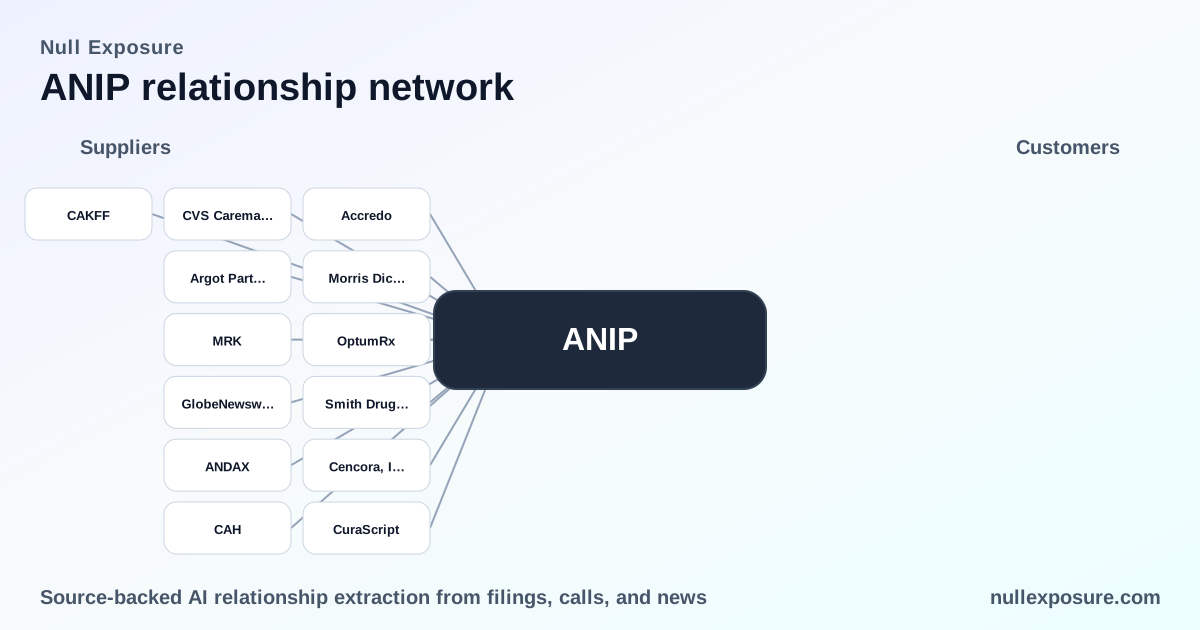
ANIP: Customer Relationships, Concentration Risks, and Commercial Posture
ANI Pharmaceuticals operates as a specialty pharmaceutical developer, manufacturer, and marketer of branded and generic prescription drugs in North America, monetizing through direct product sales to wholesalers, retail chains, hospitals and physician groups, and through contract manufacturing and royalties. Revenue is heavily channel-driven and concentrated: the company sells high-volume generics through major distributors and supports specialty brands through hospital and clinic channels, while contract manufacturing provides supplementary revenue. For an executive summary and deeper commercial mapping, visit https://nullexposure.com/.
How ANI actually sells — channels, contracts, and where the cash comes from
ANI’s commercial model is straightforward: manufacture and sell finished pharmaceuticals across two principal segments — generics and brands — and supplement margins with contract manufacturing and royalties. Sales flow predominantly through wholesale distributors, retail chains, and institutional buyers (hospitals, clinics, physician offices) and revenue is recognized when control transfers to those customers. Company disclosures for year‑end 2024 show the business is operationally focused on the U.S. market, while also maintaining international sales channels.
Key operating characteristics that drive investor analysis:
- Short payment cycles. ANI discloses payment terms for many sales are fewer than two months, which sets a fast working‑capital cadence but leaves limited buffer for extended receivables.
- High concentration of large counterparties. Four customers represented roughly 64% of net revenues in 2024 and accounted for approximately 70% of accounts receivable, underlining material counterparty concentration among large enterprise distributors and chains.
- Distribution-first posture. The company conducts business with the three major wholesalers and major retail chains in the U.S., signaling a reseller/distributor-driven go‑to‑market model.
- Manufacturing at core. Generics, contract manufacturing and royalties are central — production capacity and quality control are critical to revenue continuity.
These points come directly from ANI’s public disclosures for the period ending December 31, 2024.
Named customer relationships discovered in public sources
The following summarizes every counterparty found in the supplied results.
- Teva Pharmaceuticals USA, Inc. — A news article references Teva as the licensee for a testosterone gel product; the article does not document a direct ANI-to-Teva sales relationship. Source: Yahoo News article originally posted Oct 4, 2012 (indexed May 2, 2026) that references a licensing arrangement involving BioSante and Teva Pharmaceuticals USA, Inc. (FY2026 index). https://www.yahoo.com/2012-10-04-biosante-pharmaceuticals-and-ani-pharmaceuticals-a.html
(That is the only named counterparty surfaced in the reviewed results. No additional direct ANI customer names were provided in the input data.)
What the constraints tell investors about ANI’s commercial risk profile
Use the constraint excerpts as company‑level signals that describe how ANI contracts and where its commercial power lies.
- Contracting posture: short‑term cash conversion. Payment terms “generally fewer than two months” mean ANI operates with quick receivable turnaround, which helps cash flow but magnifies the impact of any delayed payments or extended negotiations.
- Counterparty scale: large enterprise counterparties. Disclosures identify ANI’s customers as wholesale distributors, chain drug stores, GPOs, pharmaceutical companies, hospitals and healthcare providers, with top customers concentrated among a small set of large buyers — a negotiating environment where a few large counterparties can significantly influence pricing and payment terms.
- Geographic footprint: North America‑centric with selective international reach. Revenue tables show the U.S. as the dominant market by revenue dollars in 2024 ($604,989k U.S. vs $9,387k international in that year), while the company also states it “markets, sells, and distributes” internationally.
- Materiality and concentration: critical dependency on top customers. Four customers accounted for 64% of net revenues in 2024 and around 70% of accounts receivable, making customer relationships critical to liquidity and working capital.
- Commercial roles and stages: active, distributor/reseller orientation. ANI’s disclosures explicitly list wholesaler and retail channels and confirm active contractual business with major wholesalers and retail chains; the company also sells directly to hospitals and clinics for its specialty brands.
- Segmental maturity: manufacturing and core generics drive revenues. The “Generics and Other” segment — development, manufacturing, marketing of generics, and contract manufacturing — comprises over 100 product families and is a primary revenue engine.
These constraints collectively describe a company that is commercially mature in manufacturing and wholesale distribution, highly dependent on a few large buyers, and exposed to counterparty negotiation pressure and working‑capital volatility.
Investor implications — concentration, working capital sensitivity, and operational levers
- Customer concentration is the single largest commercial risk. With four customers representing the majority of sales and accounts receivable, any adverse renegotiation or payment disruption from a top counterparty would materially pressure revenues and liquidity. Company filings for 2024 quantify that concentration and its effect on receivables and contract negotiation leverage.
- Short receivable cycles reduce interest‑rate and financing cost exposure but raise roll‑forward risk. Faster payment terms lower financing needs under normal conditions, but they also increase sensitivity to sudden disruptions (e.g., payer disputes, wholesaler inventory corrections).
- Distribution channel power compresses margin upside. Reliance on major wholesalers and retail chains gives buyers leverage over pricing and promotional terms; that dynamic is fundamental to margin and EBITDA variability. ANI’s reported EBITDA (2025 trailing numbers in company overview) is solid, but channel economics will determine sustainable margin capture.
- Operational risk is strategic. Manufacturing interruptions at any facility could disrupt delivery and have a material adverse effect on results given the concentration and distributor-dependent fulfillment model.
Risk and opportunity checklist
- Risks:
- Top-4 customer concentration (64% of net revenue in 2024; ~70% of AR).
- Distributor bargaining power compressing realized prices and payment timing.
- U.S.-centric revenue base exposes ANI to domestic reimbursement, supply chain, and regulatory dynamics.
- Production continuity is mission critical; manufacturing interruptions directly affect sales.
- Opportunities:
- Established manufacturing platform supports contract manufacturing revenue and product portfolio scale.
- Near-term growth vector from existing branded products and generics expansion if distributor terms can be stabilized.
Bottom line and recommended monitoring
ANI’s customer profile is dominated by large distributors and a small group of high‑impact buyers; that structure delivers volume economics but concentrates counterparty risk. For investors, the most important items to watch are top‑customer identities and share, accounts‑receivable aging and concentration trends, and any changes to negotiated payment terms with major wholesalers or retail chains. For ongoing monitoring and a mapped view of counterparty exposure, see https://nullexposure.com/.
Key monitoring triggers: quarterly disclosure of top customers, AR aging schedules, major contract renewals with wholesalers or retail chains, and any operational updates from manufacturing sites that could affect supply continuity.