AleAnna (ANNA): Customer Map, Concentration Risk, and Commercial Lines for Investors
AleAnna, Inc. (ANNA) is a development-stage natural gas and renewable natural gas (RNG) company that monetizes its assets primarily by selling electricity and gas products produced from onshore conventional fields and upgraded biomethane facilities in Italy. Revenue to date has been generated through direct sales to a state-owned utility and through contractual arrangements with energy marketing counterparties; the company’s commercial model therefore depends on a small set of counterparties, short payment cycles, and the successful transition from development to steady production. For a deeper look at primary disclosures, see NullExposure’s analysis hub: https://nullexposure.com/.
The headline commercial thesis investors should hold
AleAnna operates as a seller of energy commodities with high customer concentration, operational exposure to Italy/EMEA, and mostly short-term commercial arrangements. Management has taken steps to secure an offtake path—an exclusive Gas Sale Agreement (GSA) with Shell Energy Europe Limited—yet future revenue under that contract is explicitly contingent on the commencement of production, preserving project execution risk. Meanwhile, historical electricity sales were concentrated with a state-owned buyer, producing a single-source revenue profile for 2024. These characteristics together make AleAnna a play on project delivery and offtake execution rather than a diversified merchant energy business.
How AleAnna contracts and collects (what the constraints tell investors)
AleAnna’s disclosures describe a short-term contracting posture: no long-term contracts with quantity or volume guarantees and typical payment terms of two months after invoice, which limits revenue visibility but speeds cash collection when production occurs. The company’s revenue history for the year ended December 31, 2024 shows all revenue derived from one customer (the local state-owned electrical utility), signaling critical concentration in the near term. Geography is concentrated in Italy and the southern EU, which anchors regulatory and market risk to EMEA dynamics.
- Payment and contract profile: short-term contracts with standard two-month payment terms—this reduces contract rigidity but increases earnings volatility until production stabilizes.
- Counterparty mix: disclosures identify both government (state-owned utility) and commercial counterparties, including Shell, as key buyers or prospective buyers.
- Materiality: historical revenue concentration makes the single customer relationship critical to reported results; a receivable of $1.2 million related to electricity sales confirms mid-single-digit millions of exposure on the receivable ledger.
For operational detail and primary filing references consult NullExposure’s document portal: https://nullexposure.com/.
Disclosed customer relationships (each relationship from the 10‑K)
Below are every customer/vendor mention drawn from AleAnna’s FY2024 Form 10‑K disclosures; each entry is summarized in plain English with the filing cited.
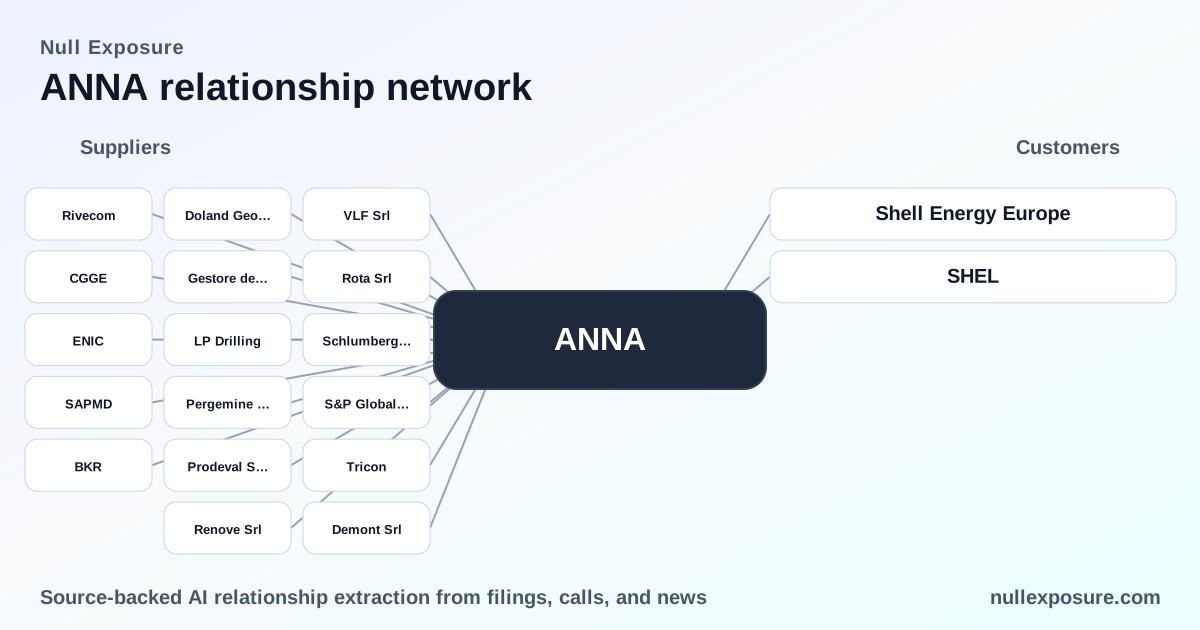
Shell Energy Europe
AleAnna’s filings list Shell Energy Europe among marketing groups engaged by the company and, more importantly, AleAnna entered a Gas Sale Agreement (GSA) with Shell Energy Europe Limited on October 29, 2024 making SEEL the exclusive buyer of the company’s share of gas produced from the Longanesi field, though future sales under the GSA are contingent on commencement of production. This GSA establishes a clear commercial path to market once production begins (AleAnna FY2024 Form 10‑K, anna‑2024‑12‑31).
SHEL (SHEL)
The 10‑K explicitly anticipates that Shell (ticker SHEL) will be a principal customer alongside industrial, power generation and residential customers across Italy and southern Europe; management frames Shell as a central commercial counterparty in the company’s go‑to‑market plans. This is documented in AleAnna’s FY2024 Form 10‑K commentary on customer composition (AleAnna FY2024 Form 10‑K, anna‑2024‑12‑31).
Shell
The filing repeats that Shell will be a primary customer for AleAnna’s output in Italy and southern EU markets, reinforcing the company’s dependence on large energy marketing counterparties as central offtake outlets. The 10‑K language on anticipated customers reaffirms Shell’s role in AleAnna’s commercialization strategy (AleAnna FY2024 Form 10‑K, anna‑2024‑12‑31).
What those relationships mean for valuation and risk
Investors should calibrate valuation to project execution and counterparty performance rather than diversified sales growth. Key implications:
- Concentration risk is high. The company reported all 2024 revenue from a single state-owned utility; until production scales and the Shell GSA is realized, revenue volatility and counterparty-default sensitivity are elevated.
- Contracting structure limits visibility. Short-term contracts and absence of long-term quantity guarantees create low structural revenue protection; the Shell GSA provides offseason offtake clarity but is production‑contingent.
- Geographic concentration concentrates regulatory risk. Primary activities and assets are in Italy, linking cash flow to Italian/EMEA energy regulation and market dynamics.
- Financial scale is modest but nontrivial. AleAnna reported $25.0 million in TTM revenue and disclosable receivables of $1.2 million tied to electricity sales, placing most individual customer exposures in the $1–10 million spend band.
- Role profile is seller and developer. Disclosures emphasize AleAnna as the seller of produced electricity and gas and as a developer of RNG facilities; the company’s economic outcome depends on moving from development to consistent commodity production and sale.
Tactical items for asset managers and operators
- Track milestones that de‑risk the Shell GSA: first gas production, delivery confirmations, and any amendments to exclusivity clauses.
- Monitor receivables and payment timing from the state utility (GSE) given the 2024 single-customer revenue history.
- Stress test valuation models for scenario outcomes where Shell offtake is delayed versus on‑time production ramp.
Bottom line
AleAnna’s near‑term commercial profile is defined by single‑customer revenue history, an exclusive but production‑contingent offtake with Shell Energy Europe, short-term contracting and Italy-centric operations. For investors, the path to de‑risking is operational delivery and conversion of the Shell GSA into recurring cash flows; absent that delivery, the company’s exposure to concentration and production timing will dominate returns. For access to the primary filings and a searchable view of these relationship disclosures, visit NullExposure’s analysis center: https://nullexposure.com/.