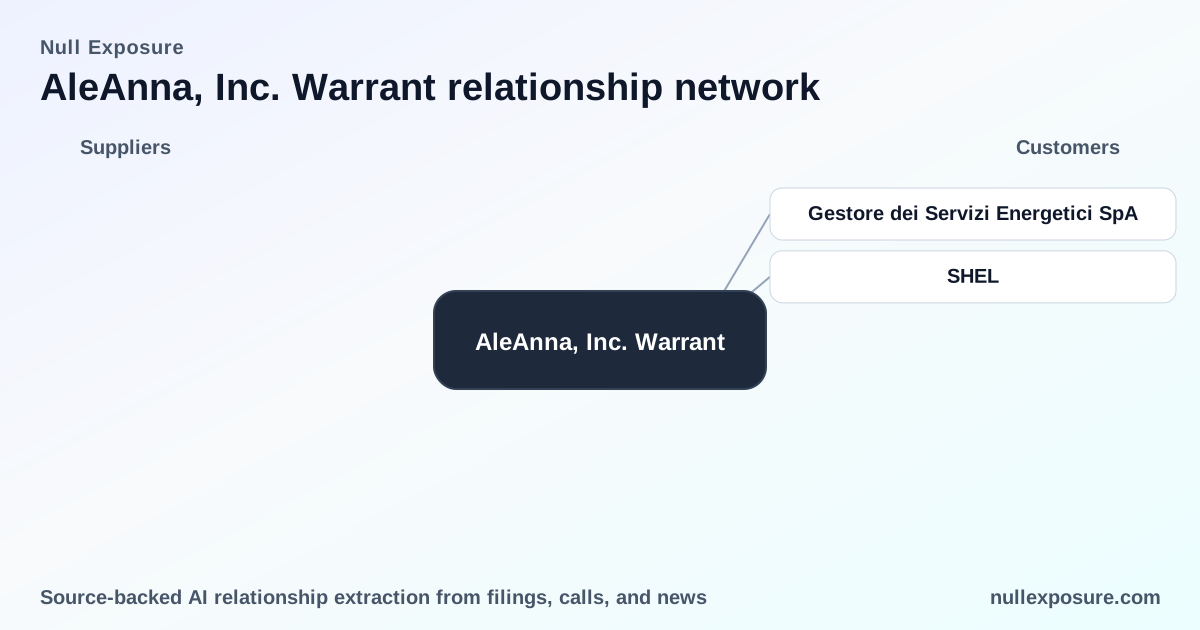
ANNAW: Customer Relationships and Commercial Dynamics — GSE and Shell in Focus
AleAnna’s filings make the company’s near‑term monetization clear: revenue in 2024 was driven by electricity generated from converted biomethane sold into Italy’s regulated channels, and the company has secured an exclusive gas sale agreement with Shell Energy Europe for future natural gas production. Investors should evaluate cash‑flow sensitivity to regulated tariffs, customer concentration, and the readiness of the Longanesi field to move from contract to paid production. For more background on how we surface and track these commercial links, visit https://nullexposure.com/.
The bottom line for investors: concentrated, tariff‑driven sales with a dealer‑style gas contract
AleAnna’s commercial profile in FY2024 is defined by customer concentration and tariff exposure. During the year ended December 31, 2024, the company reported that all revenue was derived from a single source (electricity sales) and a single customer—the local state‑owned utility (GSE), according to the company’s FY2024 10‑K. That revenue base is priced on an “on‑the‑spot” and usage‑based tariff regime (the statutory small producer tariff of €280/MWh is cited), so near‑term cash flows are a function of actual output and prevailing regulated rates rather than long‑term fixed contracts.
At the same time, AleAnna has transitioned into an upstream commercial posture for natural gas: on October 29, 2024 the company executed a gas sale agreement (GSA) with Shell Energy Europe Limited to be the exclusive buyer of AleAnna’s share of production from the Longanesi field, with future sales contingent on commencement of production (FY2024 10‑K).
Key commercial implications:
- High customer concentration: a single public utility accounted for 100% of 2024 revenues, increasing short‑term cash‑flow risk if production or statutory purchase terms change.
- Tariff and output sensitivity: revenues for electricity are usage‑based and spot‑priced under a statutory regime, tying topline directly to generation volume and regulated rates.
- Commercial readiness is contingent on production: the Shell GSA converts potential hydrocarbons into an offtake pathway, but realized revenue requires successful start of gas flow from Longanesi.
Operating posture and business model constraints investors should know
AleAnna’s FY2024 disclosures communicate several operational characteristics that shape investor risk and upside:
- Contracting posture: short‑term, spot and usage‑based monetization. The company states revenues are based on actual output and “on‑the‑spot” predetermined prices, and cites Italy’s small‑producer tariff (€280/MWh) as the pricing reference (FY2024 10‑K). These are company‑level signals about how the firm monetizes generation.
- Concentration and criticality: single‑customer dependence. The FY2024 filing confirms that one customer generated all 2024 electricity revenue, a meaningful concentration risk for valuation and liquidity planning.
- Geographic concentration: EMEA, centered in Italy. AleAnna’s primary activities and assets remain located in Italy with customer outreach into the southern EU, so regulatory and market dynamics in Italy drive commercial outcomes.
- Relationship maturity: active but production‑contingent offtake. The Shell GSA exposes the company to a major energy counterparty as buyer; however, future sales under the GSA are contingent on commencement of gas production, which makes the revenue relationship conditional rather than immediate.
These are company‑level constraints unless a contract excerpt explicitly identifies the counterparty, in which case the name is attributed below.
Relationship profiles: GSE, SHEL, and Shell — what the filings say
Gestore dei Servizi Energetici SpA (GSE)
AleAnna’s FY2024 10‑K states that Casalino and Campopiano derive revenues from the sale of electricity to the local state‑owned electrical utility, Gestore dei Servizi Energetici SpA (GSE); the filing also reports that all 2024 revenue came from that single customer. (Source: AleAnna FY2024 10‑K, filed for the year ended December 31, 2024.)
SHEL (inferred symbol)
The company explicitly projects that its customer base will largely consist of Shell as well as industrial, power generation and residential customers throughout Italy and the southern EU, signaling an intended commercial mix that combines major corporate buyers with distributed off‑takers. (Source: AleAnna FY2024 10‑K, customer discussion, FY2024.)
Shell (Shell Energy Europe Limited; inferred symbol SHEL)
On October 29, 2024 AleAnna entered a Gas Sale Agreement (GSA) with Shell Energy Europe Limited under which Shell became the exclusive buyer of AleAnna’s share of gas produced from the Longanesi field, net of certain allocations and costs; the agreement is conditioned on the commencement of gas production. (Source: AleAnna FY2024 10‑K, GSA disclosure, FY2024.)
Note: the FY2024 10‑K contains both a corporate aspiration to serve Shell‑type buyers and an executed offtake agreement with Shell Energy Europe Limited; both facts are material to revenue trajectory and counterparty risk.
Investment implications and risk checklist
AleAnna’s customer signals create a straightforward risk/reward frame for investors and operators evaluating ANNAW exposure:
- Upside lever: production and offtake conversion. The Shell GSA provides a credible commercial path for monetizing Longanesi output once production begins; successful field ramp‑up will diversify revenue beyond GSE electricity sales and convert contingency into contracted cash flow (subject to GSA terms).
- Downside lever: concentration and regulatory exposure. With 100% of 2024 revenue from the state utility and pricing tied to statutory small‑producer tariffs, a drop in generation volumes or an unfavorable revision to tariff rules would compress margins quickly.
- Operational cadence: short payment terms but short‑term contracts. Payment terms are typically two months after invoice; however, the company reports no long‑term quantity commitments—this creates predictable near‑term collections but limited long‑term revenue visibility.
What to watch next (data points that move the thesis)
- Evidence of sustained generation volumes from biomethane conversion and any change to the €280/MWh tariff framework.
- Progress milestones from the Longanesi field (drilling, testing, start‑up) that convert the Shell GSA from conditional to active deliveries.
- Any diversification of customers beyond GSE into industrial or corporate buyers that would reduce concentration risk.
For investors and operators who track counterparty exposures and commercial maturity, AleAnna’s FY2024 disclosure is clear: today’s cash flow is tariff‑driven and concentrated; tomorrow’s upside depends on field delivery and conversion of the Shell offtake into paid production. For a deeper mapping of counterparty relationships and ongoing extraction of filings, visit https://nullexposure.com/.