ANPA: How a small Hong Kong corporate-services player is monetizing ESG-adjacent work
Rich Sparkle Holdings Limited (ANPA) runs financial printing and corporate services out of Hong Kong and earns cash through fee-for-service engagements—regulatory filings, investor communications and compliance reporting. The company monetizes through recurring client work and one-off institutional engagements; its move into ESG reporting and partnerships tied to sustainable finance creates a new service line that can be upsold to existing corporate clients. For investors, the question is whether a thin revenue base and concentrated ownership can be leveraged into durable margins as ANPA expands into impact-oriented services. Learn more at https://nullexposure.com/.
Why a single partnership changes the conversation for a micro-cap services firm
ANPA is a small-cap specialist whose enterprise value and valuation multiples reflect speculative upside rather than scale. With FY‑TTM revenue of roughly $5.83 million and an EBITDA run‑rate under $1 million, the company operates at a scale where individual contracts and partnerships materially move the P&L. The Animoca Brands / Open Campus collaboration elevates ANPA from traditional financial-printing vendor to a participant in structured ESG and sustainable-finance initiatives, creating a higher-margin advisory/ESG reporting stream that can be cross-sold.
This is important because ANPA’s market metrics—market capitalization ~$89 million, price-to-sales ~12.0, and trailing P/E ~589.5—imply investor expectations for either rapid revenue acceleration or margin expansion. Given the company’s current gross profit of $2.61 million on modest revenue, converting partnerships into recurring ESG revenue is the most credible path to justify those multiples.
The Open Campus relationship and what it concretely means
ANPA will provide ESG reporting and compliance services to Open Campus and will collaborate to build an ecosystem for sustainable financing that channels capital toward education and inclusion initiatives. According to an Animoca Brands announcement dated March 9, 2026, ANPA is explicitly named as the Nasdaq‑listed partner for a US$50 million edu‑token strategy and will support compliance and ESG reporting in that structure (Animoca Brands press release, March 9, 2026: https://www.animocabrands.com/announcement/open-campus-and-animoca-brands-partner-with-nasdaq-listed-anpa-for-us50-million-edu-token-strategy).
- ANPA’s role is ESG reporting and compliance for the Open Campus initiative, positioning the company as the service provider that ensures regulatory and disclosure integrity for tokenized education finance. (Animoca Brands announcement, March 2026.)
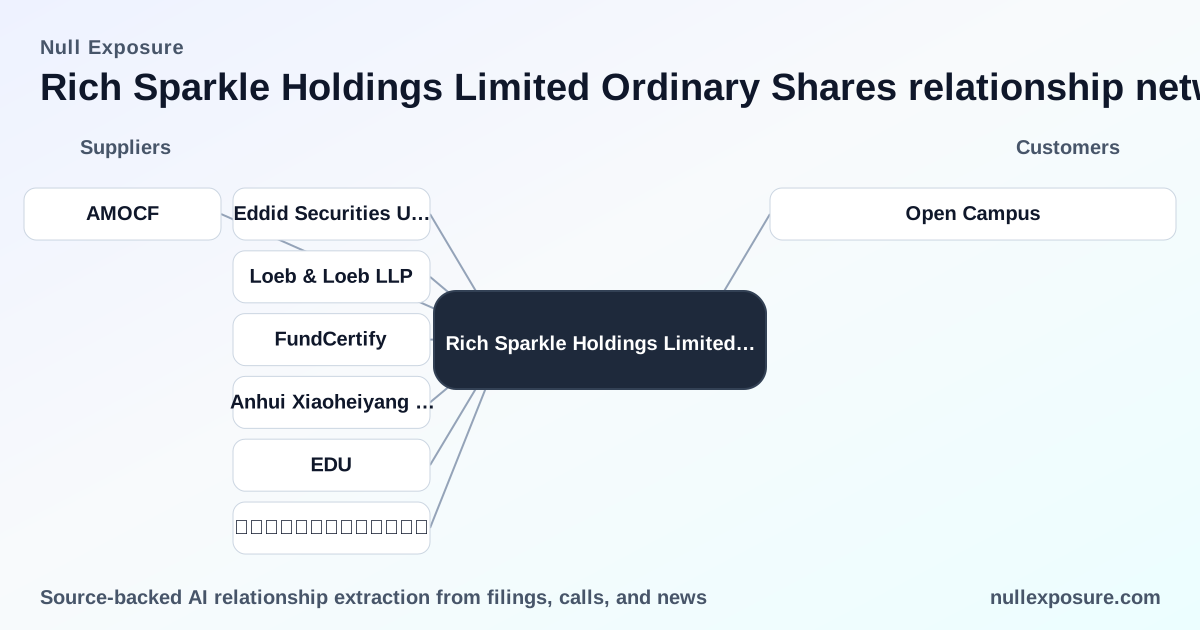
This relationship is the only customer partnership surfaced in the current review and it directly connects ANPA’s core service capability to a capital‑channeling program run by a prominent Web3/education sponsor. The functional upgrade—moving from printing and classic corporate services to ESG compliance tied to financing instruments—changes the sales narrative for institutional buyers.
Company-level constraints and operating signals investors should track
With no explicit constraint records returned, the publicly reported operating metrics provide the clearest signals on ANPA’s posture:
- Concentrated ownership and small free float: Insiders own roughly 70.9% of shares while float is about 3.636 million shares versus 15.1018 million outstanding, indicating founder/insider control and limited institutional participation (institutions ~0.2%). This produces a contracting posture where deals and capital allocation decisions are effectively controlled by insiders.
- Revenue concentration and scale sensitivity: Revenue TTM is $5.83 million with gross profit of $2.61 million and an EBITDA of $832,320. Individual partnerships can swing margins materially, so customer wins or losses are high-impact events for headline profitability.
- Valuation premium vs. operating results: EV/Revenue ~15.2 and EV/EBITDA ~113.3 show the market is pricing growth or strategic optionality, not current operating leverage. Expect volatility if partnerships fail to deliver scaled revenue.
- Profitability signals are mixed: Reported profit and operating margins are effectively nil on an absolute basis although reported ROE (~37.3%) and ROA (~9.9%) suggest returns on a small equity base; interpret these as early-stage efficiency rather than evidence of sustainable scale.
- Market and product maturity: ANPA’s primary services are established (financial printing, corporate services), but the shift into ESG compliance and tokenized financing structures is an adjacent, less mature revenue stream that requires new capabilities and potentially new regulatory oversight.
These company-level signals imply a conservative operating posture: contracting decisions are centralized, revenue is concentrated, and strategic moves such as the Open Campus tie directly to the company’s ability to de‑risk valuation multiples.
How the Open Campus tie-in affects commercial and execution risk
The Open Campus arrangement is strategically valuable because it converts one-off printing/compliance invoices into a narrative about sustainable-finance enablement. That said, execution risk is front and center:
- Commercial upside: If ANPA scales ESG reporting for tokenized capital programs, it gains a higher‑margin advisory profile and enhanced client stickiness.
- Execution risk: The company must operationalize ESG assurance processes and technical compliance for tokenized instruments—capabilities that differ from traditional financial printing.
- Regulatory risk: Tokenized financing and edu‑tokens attract scrutiny; failure to meet compliance deliverables could harm reputation and revenue.
Monitor contract terms, revenue recognition from the Open Campus program, and any regulatory filings that disclose scope or fees tied to the partnership.
Key takeaways for investors and operators
- This is a strategic pivot from printing to ESG/compliance services; the Open Campus relationship institutionalizes that pivot and creates a pathway to higher-margin work.
- Valuation reflects expectations, not scale; multiples are aggressive relative to operating cash flow and demand visible contract wins to justify them.
- Concentrated insider ownership simplifies decision‑making but elevates governance risk; limited institutional presence reduces liquidity and increases event-driven volatility.
- Watch for execution metrics: revenue contribution from Open Campus, recurring vs. one‑time fees, and disclosure of service-level responsibilities will determine whether this partnership de‑risks the stock or simply repositions the narrative.
For operators evaluating ANPA as a prospective vendor or partner, the company’s strength is in regulatory‑grade reporting and investor communications coupled with a willingness to enter ESG and tokenized financing work. For investors, the stock is a small‑cap play on successful execution of a higher‑value service transition.
Explore more company relationship intelligence and structured signals at https://nullexposure.com/.
Closing investment action
Focus your diligence on contract economics and early revenue recognition tied to the Open Campus deal, insider lock‑up timelines and any subsequent customer wins that demonstrate repeatable ESG revenue. If ANPA documents recurring fees for ESG compliance and standardizes those deliverables across multiple issuers, re‑rating to justify current multiples is a realistic outcome.