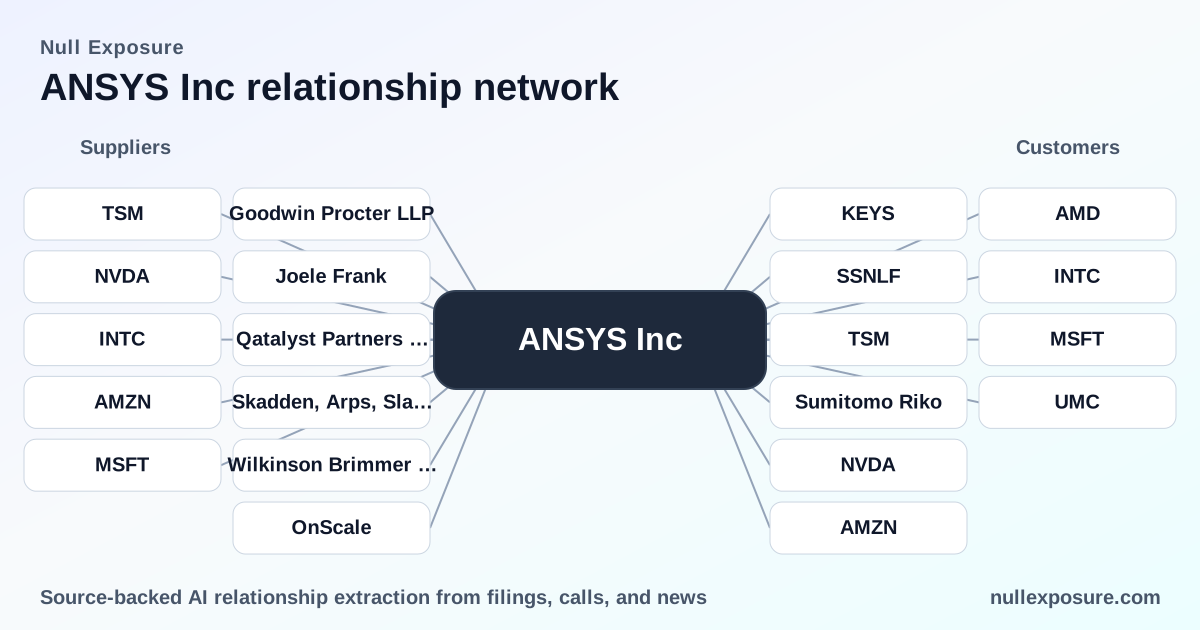
Ansys (ANSS) — Customer Relationships and Strategic Footprint
Ansys builds and sells multiphysics engineering simulation software used to design, test and optimize products across industries; it monetizes through enterprise licenses, recurring maintenance/subscription and professional services sold to aerospace, defense, semiconductor foundries, hyperscalers and industrial OEMs. For investors, the customer map reveals a high-value, mission‑critical revenue base concentrated among advanced semiconductor players, defense primes and hyperscalers — a profile that supports premium margins and sticky renewals but links growth to capital intensity in semiconductors and cloud compute.
Explore full signal coverage at https://nullexposure.com/.
Why customers define Ansys’ commercial economics
Ansys’ revenue model is enterprise‑oriented and recurring: license and subscription fees plus service contracts create long-lived customer relationships. The company’s reported metrics — high gross margin and large institutional ownership — reflect a mature, software-driven business that sells into complex product cycles. Customer relationships are highly strategic and technically critical for users: simulation often sits upstream of manufacturing and product qualification, which generates high switching costs and predictable maintenance revenue. At the same time, a substantial portion of addressable growth ties to the semiconductor cycle and hyperscaler investments in custom silicon and photonics.
- Contracting posture: enterprise sales with multi‑year engagements and technical onboarding.
- Concentration: customers include top foundries, chip designers, defense primes and hyperscalers; revenues lean on large accounts even as the product set spans many industries.
- Criticality: simulation is mission‑critical for chip signoff, aerospace validation and optical systems — customer dependence supports durable margins.
- Maturity: Ansys is established and profitable with recurring revenue characteristics; growth now benefits from adjacent markets such as photonics, quantum and AI‑accelerated design.
For a consolidated lens on Ansys coverage, visit https://nullexposure.com/.
Customer relationship catalog — every result in the feed
Keysight Technologies (KEYS) — (Synopsys press release, Mar 2026)
Ansys entered into a definitive agreement to sell its PowerArtist business to Keysight Technologies, positioning Keysight to own a power‑analysis product while Ansys and Synopsys rearrange portfolio assets. According to a Synopsys investor release (March 2026), the transaction reallocates a specific toolset to Keysight as part of broader consolidation.
Source: Synopsys investor press release, March 2026.
Samsung Electronics (SSNLF) — (EE Times Asia, FY2022 / reported 2026)
Samsung uses Ansys’ Totem‑SC IR signoff and says the tool delivers high‑fidelity power‑noise results that accelerate sensor optimization on standard hardware, underscoring Ansys’ role in advanced CMOS image‑sensor development. EE Times Asia reported Samsung’s endorsement of the platform (article referenced in 2026 summarizing FY2022 usage).
Source: EE Times Asia coverage of Ansys Totem‑SC, cited 2026.
Keysight Technologies (duplicate entry) — (Synopsys press release, Mar 2026)
See the prior Keysight entry; the Synopsys announcement appears multiple times in the feed documenting the PowerArtist sale to Keysight.
Source: Synopsys investor press release, March 2026.
Samsung Electronics (duplicate entry) — (EE Times Asia, FY2022)
Duplicate feed item reiterating Samsung’s use of Totem‑SC for high‑resolution sensor IR signoff.
Source: EE Times Asia, cited 2026.
Northrop Grumman (NOC) — (Northrop Grumman news, May 2026)
Northrop Grumman named Ansys among recipients of its Supplier Mission Excellence Award, signaling Ansys’ supplier status and strategic importance to defense supply chains. The company’s inclusion reflects recognition by a major defense prime for industrial innovation in FY2026.
Source: Northrop Grumman news release, May 2026.
TSM (TSM) — (EE Times Asia / iConnect007, FY2024)
Ansys collaborates with TSMC on multiphysics software for the COUPE silicon‑photonic and co‑packaged optics platform, accelerating chip‑to‑chip optical integration and reducing coupling losses. Industry coverage documents an ongoing technical partnership aimed at production‑scale photonics workflows (reported across 2024–2026 press items).
Source: EE Times Asia and iConnect007 articles on Ansys–TSMC collaboration, reported 2024–2026.
Sumitomo Riko — (PR Newswire, FY2024 / cited 2026)
Sumitomo Riko is reported to be implementing Ansys technology, with the press release context tied into broader corporate announcements; the mention highlights adoption by a materials/automotive supplier group using simulation to accelerate time‑to‑solution.
Source: PR Newswire release (company announcement mentioning Ansys), cited 2026.
Taiwan Semiconductor Manufacturing Co. Ltd. (TSMC) — (EE Times Asia, FY2024)
TSMC and Ansys expanded collaboration to integrate multiphysics into silicon‑photonics and 3D‑IC design workflows, a strategic partnership that targets next‑generation manufacturing nodes and co‑packaged optics. This is material because TSMC is a primary foundry customer for advanced chip signoff tooling.
Source: EE Times Asia and iConnect007 reporting on Ansys–TSMC, 2024–2026.
Amazon (AMZN) — (Markets / FinancialContent commentary, Jan 2026)
Market commentary around the Synopsys–Ansys consolidation framed Amazon as a beneficiary: hyperscalers designing custom silicon can leverage an integrated toolchain, suggesting Amazon is a relevant end‑user of the combined solutions.
Source: Markets/FinancialContent analysis piece, January 2026.
AMD (AMD) — (Markets / FinancialContent commentary, Jan 2026)
Analysts noted that AMD stands to benefit from integrated design and verification toolchains following consolidation in the EDA/simulation space, reflecting Ansys’ relevance to high‑performance silicon designers.
Source: Markets/FinancialContent analysis, January 2026.
Intel (INTC) — (Markets / FinancialContent commentary, Jan 2026)
Coverage emphasized expectation that Ansys capabilities will assist foundries and integrated device manufacturers like Intel to bring advanced nodes to high yield, underlining Ansys’ strategic role in node maturity.
Source: Markets/FinancialContent analysis, January 2026.
Microsoft (MSFT) — (Markets / FinancialContent commentary, Jan 2026)
Reports positioned Microsoft among hyperscalers that benefit from vertically integrated toolchains, highlighting cloud and AI infrastructure customers’ demand for optimized hardware designs using Ansys technology.
Source: Markets/FinancialContent analysis, January 2026.
Nvidia (NVDA / NVDA duplicate entries) — (Markets / FinancialContent commentary, Jan 2026)
Nvidia is named repeatedly in market commentary as a major beneficiary of consolidated simulation and EDA capabilities, reflecting the company’s role as a leading designer of AI accelerators that rely on advanced simulation.
Source: Markets/FinancialContent and FranklinCredit coverage, January 2026.
IONQ (IONQ‑WS) — (Optica / OPN, Nov 2024)
IonQ plans to use Ansys’ multiphysics tools — structural, optical, photonic and electromagnetic simulation — to design and optimize components for scalable quantum computers, demonstrating Ansys’ reach into emerging quantum hardware design.
Source: Optica/OPN industry coverage, November 2024.
Altera — (PR Newswire, Synopsys Ansys 2026 R1)
Altera (Intel FPGA lineage) publicly cited Ansys metamodeling as transforming power‑grid design, indicating adoption by silicon design teams for power optimization workflows in FY2026 product updates.
Source: PR Newswire, Synopsys launch announcement, May 2026.
Innomotics — (PR Newswire, Synopsys Ansys 2026 R1)
Innomotics highlighted Ansys’ reduced‑order modeling techniques as essential for building a digital twin, signaling industrial OEM use for control and power electronics design.
Source: PR Newswire Synopsys product launch, May 2026.
Synopsys (SNPS) — (TradingView analysis / Synopsys press coverage, FY2026)
Industry notes and Synopsys communications show Ansys products being integrated into a broader Design Automation segment under Synopsys after the strategic transaction, indicating organizational and GTM integration for EDA and simulation.
Source: TradingView analysis and Synopsys news releases, 2026.
Synopsys & NASA collaboration — (Synopsys investor release, 2026)
Under planned work, Synopsys and partners will use Ansys Charge Plus for physics‑based analysis to support NASA’s Artemis spacesuit and communications systems, demonstrating Ansys tools’ applicability to space‑grade engineering.
Source: Synopsys investor press release, 2026.
United Microelectronics Corporation (UMC / UMC duplicate) — (SAHM Capital, FY2023)
UMC certified Ansys multiphysics solutions for its 3D‑IC WoW stacked technology, which directly supports edge AI and wireless systems validation — a commercial validation by a global foundry.
Source: SAHM Capital report on Ansys–UMC certification, October 2023 (reported in 2026 feed).
Investment implications and risk profile
- Upside: The customer roster includes top foundries (TSMC, UMC), hyperscalers (Amazon, Microsoft), chip designers (Nvidia, AMD, Intel) and defense primes (Northrop Grumman), which supports durable, high‑value recurring revenue and potential cross‑sell into photonics, quantum and AI hardware workflows.
- Risk: Revenue exposure tracks the semiconductor capex cycle and hyperscaler demand for custom silicon; consolidation (Synopsys acquisition activity) reshapes competitive dynamics and could compress product bundles or repricing leverage.
- Operational posture: Enterprise contracts, technical onboarding and recognition by major primes establish high switching costs and renewal visibility, consistent with Ansys’ mature software economics.
Bottom line and next steps
Ansys’ customer map confirms a premium enterprise software profile: mission‑critical relationships with foundries, hyperscalers, defense primes and advanced OEMs underpin both margin durability and growth optionality in photonics and quantum. Investors should weigh secular opportunity in AI and photonics against cyclical semiconductor spending and integration effects from strategic transactions.
For ongoing signal tracking and structured relationship intelligence, see https://nullexposure.com/.