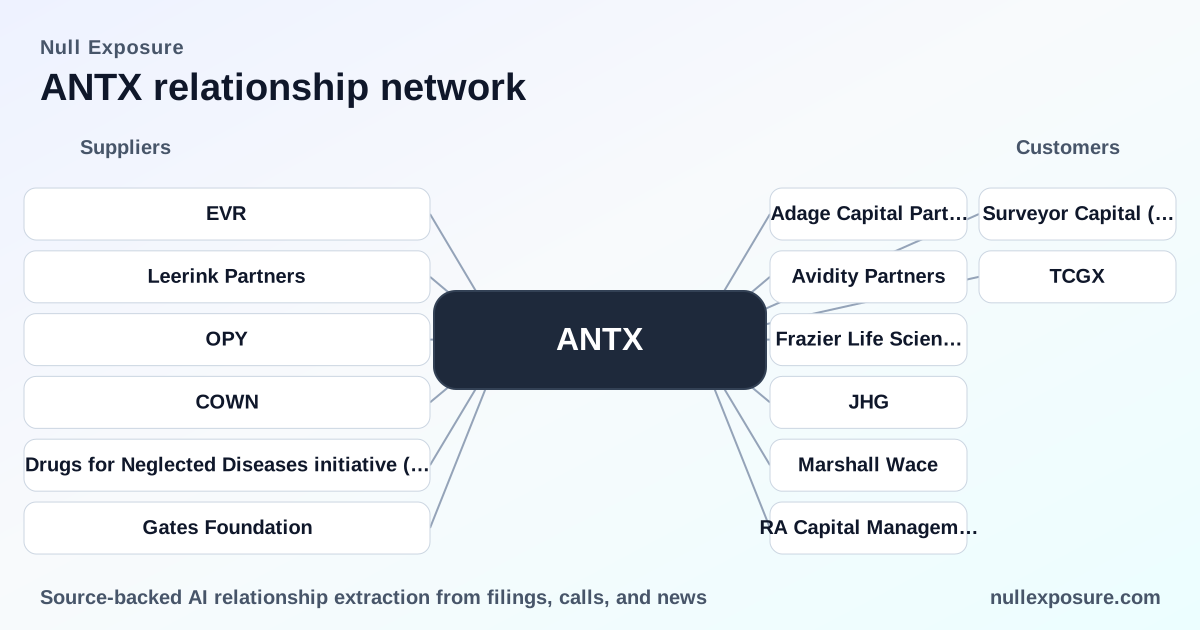
AN2 Therapeutics (ANTX) — Who’s Financing and Partnering with the Company, and What It Means for Investors
AN2 Therapeutics is a clinical-stage biotechnology company developing novel therapies and advancing them through licensing and capital markets to fund R&D. The company monetizes primarily through equity financing and strategic licensing arrangements that create milestone and potential royalty upside, while it builds toward commercial capabilities in North America and relies on regional partners for APAC commercialization. For investor due diligence, the combination of active institutional backers and a named strategic collaboration frames both the funding runway and go‑to‑market segmentation.
For more situational intelligence on counterparties and deal flow, visit https://nullexposure.com/.
High-level read: funding-first, licensing-enabled commercial strategy
AN2 is operating as a pre-revenue, R&D-centric biotech: zero reported revenue and negative EPS in its latest filings, so capital raises and partner milestones are the primary near-term value drivers. The company uses a mix of underwritten offerings, private placements, and regional license contracts to fund operations and de-risk clinical programs. That contracting posture—frequent equity raises plus selective licensing—creates dependency on institutional investors for liquidity and on regional licensees for market access in APAC.
The financing wave in 2026: institutional investors backstop cash needs
AN2 priced a material underwritten offering that included a slate of institutional healthcare and multi‑strategy investors; a separate private placement and an at‑the‑market program extended access to capital in 2026. These transactions indicate strong institutional interest but continued reliance on equity markets to fund operations.
- A March 2026 underwritten offering listed multiple investors that agreed to purchase shares, reflecting a coordinated institutional placement (StockTitan press release, March 2026: https://www.stocktitan.net/news/ANTX/an2-therapeutics-announces-pricing-of-70-0-million-underwritten-m38icucc1plc.html).
- Subsequent May 2026 reports show participation in a private placement and an at‑the‑market agreement that drew new and existing healthcare funds (Bitget and Investing.com coverage, May 2026).
Who’s on the cap table and why each relationship matters
Below are the counterparties named in the public articles covering AN2 financings and collaborations. Each entry is summarized in plain English with the cited source.
RA Capital Management
RA Capital was listed among institutional investors that agreed to buy shares in AN2’s underwritten offering in March 2026, signaling traditional biotech venture investor interest (StockTitan, March 2026: https://www.stocktitan.net/news/ANTX/an2-therapeutics-announces-pricing-of-70-0-million-underwritten-m38icucc1plc.html).
TCGX
TCGX was named as a participating investor in the same March 2026 underwritten placement, indicating participation from diverse institutional backers (StockTitan, March 2026: https://www.stocktitan.net/news/ANTX/an2-therapeutics-announces-pricing-of-70-0-million-underwritten-m38icucc1plc.html).
Frazier Life Sciences
Frazier Life Sciences also participated in the underwritten offering, representing sector-focused life sciences capital committed to the round (StockTitan, March 2026: https://www.stocktitan.net/news/ANTX/an2-therapeutics-announces-pricing-of-70-0-million-underwritten-m38icucc1plc.html).
Marshall Wace
Marshall Wace was listed among investors in the March 2026 offering, providing multi‑strategy hedge fund participation to the financing mix (StockTitan, March 2026: https://www.stocktitan.net/news/ANTX/an2-therapeutics-announces-pricing-of-70-0-million-underwritten-m38icucc1plc.html).
Adage Capital Partners LP
Adage Capital Partners joined the March 2026 placement, contributing further institutional depth to the transaction (StockTitan, March 2026: https://www.stocktitan.net/news/ANTX/an2-therapeutics-announces-pricing-of-70-0-million-underwritten-m38icucc1plc.html).
Avidity Partners
Avidity Partners was a named investor in the underwritten offering, reinforcing sector-focused hedge and asset manager interest (StockTitan, March 2026: https://www.stocktitan.net/news/ANTX/an2-therapeutics-announces-pricing-of-70-0-million-underwritten-m38icucc1plc.html).
Janus Henderson Investors (JHG)
Janus Henderson Investors (ticker JHG) participated in the March 2026 offering as an institutional purchaser, bringing long‑only asset manager exposure to the cap table (StockTitan, March 2026: https://www.stocktitan.net/news/ANTX/an2-therapeutics-announces-pricing-of-70-0-million-underwritten-m38icucc1plc.html).
Surveyor Capital (a Citadel company)
Surveyor Capital, a Citadel affiliate, was also listed among investors in the underwritten round, signaling macro/multi‑strategy support alongside biotech specialists (StockTitan, March 2026: https://www.stocktitan.net/news/ANTX/an2-therapeutics-announces-pricing-of-70-0-million-underwritten-m38icucc1plc.html).
Coastlands Capital
Coastlands Capital is reported as a participant in 2026 financing activity, specifically cited in May 2026 articles describing both the private placement and broader institutional support (Bitget, May 2026: https://www.bitget.com/amp/news/detail/12560605250469; Investing.com, May 2026: https://m.uk.investing.com/news/sec-filings/an2-therapeutics-enters-80-million-atthemarket-sales-agreement-with-jefferies-93CH-4601531?ampMode=1).
Commodore Capital
Commodore Capital was identified as a private placement investor in May 2026, listed among funds that provided $40 million through a private placement and related transactions (Bitget and Investing.com reporting, May 2026).
Vivo Capital
Vivo Capital was named among healthcare-focused funds participating in the 2026 offerings, indicating specialist healthcare fund support (Bitget, May 2026: https://www.bitget.com/amp/news/detail/12560605250469).
GSK
AN2 entered a collaboration agreement with GSK to develop new tuberculosis therapies, representing a strategic R&D partner with potential commercialization reach (Investing.com AU coverage, May 2026: https://au.investing.com/news/insider-trading-news/eizen-an2-therapeutics-coo-sells-25k-in-antx-stock-93CH-4196394).
What the constraints say about AN2’s operating model (company-level signals)
- APAC licensing is a deliberate part of AN2’s commercialization strategy. A November 2019 license granted Brii Biosciences Limited exclusive development and commercialization rights in China, Hong Kong, Taiwan and Macau; AN2 received no upfront payment on that deal but is eligible for up to $15 million in development/regulatory milestones and up to $150 million in commercial milestones, per company disclosures. This is a direct signal that AN2 uses licensing to transfer regional commercialization risk while retaining milestone upside (company filing, license disclosure, Nov 2019).
- North America commercialization is intended to be in‑house. Public statements indicate AN2 plans to build a U.S. commercial organization and recruit experienced sales and marketing professionals for markets where regulatory approvals are achieved, positioning NA as a market where AN2 expects to internalize revenue capture.
- Regulatory fragmentation across EMEA/Japan/APAC affects partner selection. The company has highlighted differing regulatory regimes across jurisdictions; this explains its selective regional licensing and partnership approach.
- These constraints collectively indicate a contracting posture that blends licensing (to reduce regional go‑to‑market cost) with continued reliance on equity markets for funding.
Key investment implications
- Capital dependence: AN2 is pre‑revenue and continues to rely on institutional financings; the presence of well‑known funds and multi‑strategy investors is a positive signal for access to capital but not a substitute for commercial revenue.
- Risk transfer via licensing: The 2019 Brii license transfers APAC commercialization risk to a local partner while preserving milestone upside for AN2, which reduces near‑term cash pressure but caps regional upside until milestones are achieved.
- Strategic R&D anchor: A collaboration with GSK for TB programs provides scientific validation and potential scale, increasing the value of AN2’s pipeline if programs advance.
If you want a focused cap‑table and counterparty risk brief tailored to fundraising windows or partnership diligence, visit https://nullexposure.com/ for deeper counterparty profiles and deal timelines.
Conclusion: AN2’s investor and partner roster in 2026 combines specialist healthcare funds and multi‑strategy institutions that have provided the financing runway, while licensing and a GSK collaboration structure AN2’s regional commercialization strategy. Investors should weigh the benefits of strong institutional support and strategic partners against the core reality that AN2 is pre‑revenue and dependent on future milestone accruals and successful clinical progress.