Sphere 3D (ANY): Bitcoin-mining services, concentrated customers, short-term contracts
Sphere 3D operates as a service provider to Bitcoin mining pool operators, monetizing by selling hash calculation capacity on short-duration, renewable spot contracts; revenue is recorded when the service starts (daily at midnight UTC) and is generated in the United States. The business shows material customer concentration and low contract stickiness, with financials reflecting modest scale — Revenue TTM $11.18M and a market capitalization near $5.63M — while profitability remains negative (Diluted EPS -6.77, EBITDA -$5.98M as reported through the latest quarter ending 2025-12-31). For a consolidated view of customer exposures and contract constraints, visit https://nullexposure.com/.
How Sphere 3D sells hash calculation as a commodity service
Sphere 3D’s performance obligation is narrowly defined: the company provides a single service — performing hash calculations for mining pool operators. The company sells that service on sub-24-hour contracts that continuously renew, with both parties free to terminate at any time without compensation, and Sphere 3D’s enforceable right to compensation only beginning when it starts providing the service at midnight UTC. These contract mechanics make the revenue cadence a sequence of daily spot transactions rather than multi-month or fixed-term agreements.
This operating posture produces several characteristic business-model signals:
- Low contract duration and low customer lock-in. The spot, terminable contracts create limited revenue visibility and high churn potential.
- Service orientation rather than product sales. The company’s segment is services: delivering compute for mining pools rather than selling hardware or long-term capacity contracts.
- Geographic concentration of activity. The company’s Bitcoin mining revenue is generated in the United States, concentrating regulatory, energy, and operational risk regionally.
- Material customer concentration. The company discloses that some customers individually represent 10% or more of revenue, indicating high revenue concentration risk at the corporate level.
A second look at Sphere 3D’s investor metrics underscores the structural profile: Price-to-Sales ~0.50, Price-to-Book ~0.26, and a high beta (3.61) point to market pricing that already reflects elevated operational and equity volatility.
What the contracts imply for predictability and capital allocation
Short-term, renewable spot contracts simplify capacity scheduling but force management to operate with nimble cost structures. Because compensation is enforceable only when service delivery begins (daily at UTC midnight), Sphere 3D must match energy, compute, and operational costs to a highly variable revenue stream. The combination of material customer concentration and short-duration contracts creates a binary dynamic: retention of key customers drives meaningful revenue swings, while loss or migration of a major customer could compress top-line and drive underutilization of fixed assets.
From a capital-allocation standpoint, investors should treat Sphere 3D as a variable-cost, high-throughput services provider whose economics are tied to mining pool demand and the competitive supply of hash power. Management’s ability to flex costs and secure multi-customer utilization will determine margin trajectory more than product differentiation.
Customer roster: primary relationship disclosed
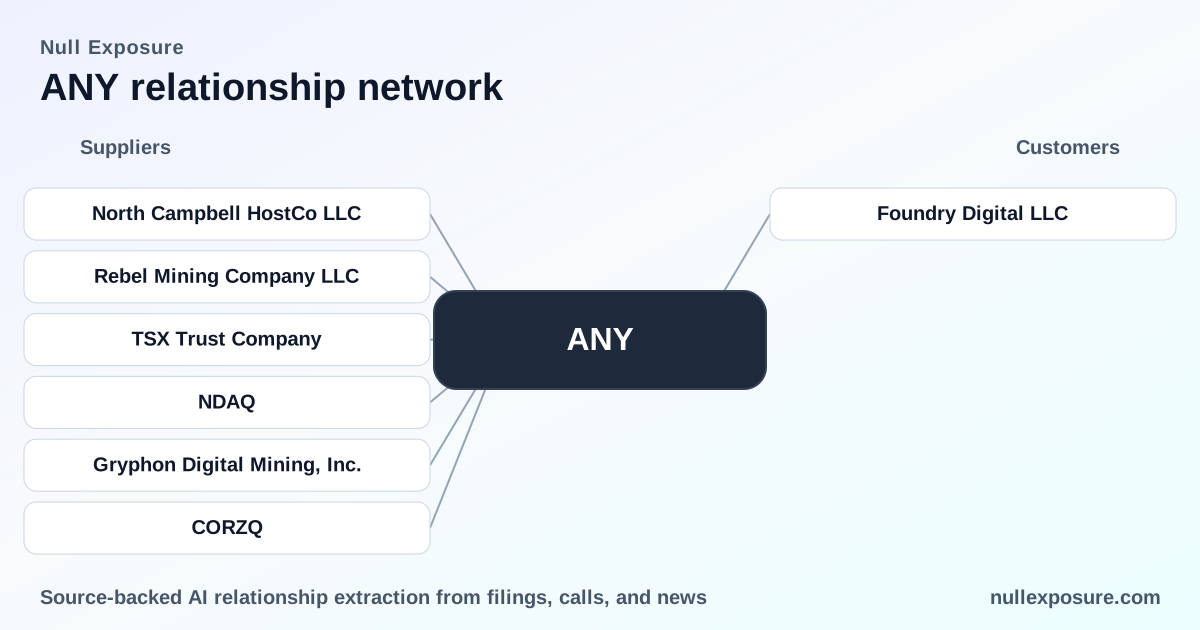
Foundry Digital LLC — Sphere 3D engages with Bitcoin mining pool operators, primarily Foundry Digital LLC, to provide hash calculation services as described in the company’s FY2025 disclosures. This supplier–customer relationship is cited in a TradingView news summary referencing the company’s SEC reporting in March 2026. (TradingView report summarizing Sphere 3D’s FY2025 10-Q, March 9, 2026: https://www.tradingview.com/news/tradingview:7a2b6ece4a1d3:0-sphere-3d-corp-sec-10-q-report/)
Constraints and company-level signals investors must price in
The company’s disclosures produce a compact set of constraints that shape operational risk and valuation:
- Contract type — short-term and spot. Contracts are less than 24 hours, continuously renew, and are terminable at any time; Sphere 3D’s right to compensation begins only when service delivery begins at midnight UTC. This is a company-level contract design that lowers revenue predictability.
- Role and segment. Sphere 3D functions as a service provider and treats mining pool operators as customers (buyers); the company’s only stated performance obligation is the hash calculation service.
- Geography. Bitcoin mining revenue is generated in the United States, concentrating exposure to U.S. energy markets and regulatory regimes.
- Materiality. The company reports that certain customers individually represented 10% or more of revenue, indicating notable concentration risk at the corporate level.
These constraints are drawn from the company’s FY2025 SEC disclosures and summarized in external reporting in early 2026.
Investment implications and risk/reward framing
- Upside levers: If Sphere 3D sustains high utilization by Foundry Digital and similar operators, modest revenue growth can flow quickly to gross profit because the company sells a service with limited additional product-development or R&D drag. The analyst target price of $30 (documented in company metadata) signals outsized upside relative to current market cap, but that gap reflects significant execution risk.
- Downside vectors: Customer concentration and spot contracting are primary shortfalls: loss of a top customer or a drop in pool demand can create abrupt top-line compression. Operational leverage to energy and compute costs, combined with negative profitability (Diluted EPS -6.77; EBITDA -$5.98M), increases the risk that underutilized capacity will meaningfully erode margins.
- Governance and ownership: Insider and institutional holdings are modest (insiders ~0.76%, institutions ~0.99%), which influences liquidity and the market’s ability to absorb material news without outsized price swings.
Tactical takeaways for investors and operators
- Monitor customer retention metrics and daily utilization rates as leading indicators of near-term revenue. With the company’s contract model, daily utilization directly maps to revenue recognition.
- Track any shift from spot contracts toward longer commitments; even partial migration to multi-day or fixed-term contracts would materially improve revenue visibility and firm valuation.
- For operators or counterparties evaluating Sphere 3D as a vendor, the company’s service-first, spot-based posture offers flexibility but requires close operational alignment around start-of-day provisioning at UTC midnight.
For a structured, comparative view of Sphere 3D’s customer relationships and contract constraints across peers, visit https://nullexposure.com/ for in-depth customer-centric exposure analysis.
Bold takeaways summary: Sphere 3D sells hash calculation services on short-term, spot, daily-renewing contracts, demonstrates material customer concentration, and operates with limited revenue predictability; investors should treat the stock as a high-volatility, execution-sensitive exposure to Bitcoin mining demand.