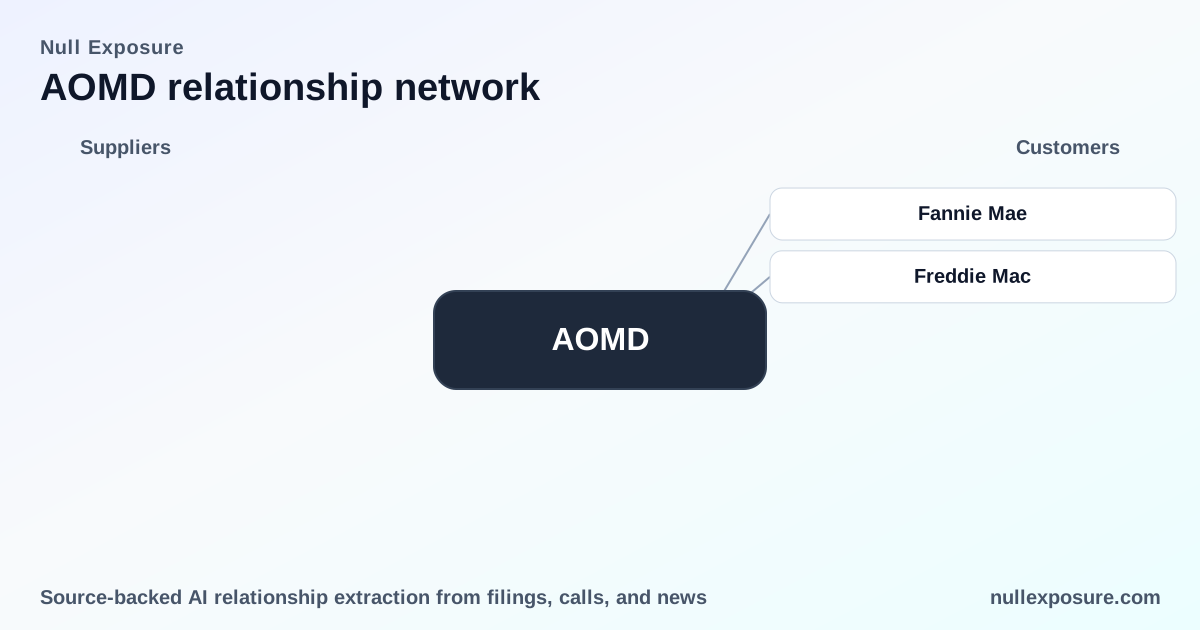
AOMD’s Customer Landscape: How Fannie and Freddie Anchor Liquidity for a Non‑QM Specialist
Angel Oak Mortgage REIT (AOMD) runs a concentrated, yield‑oriented business that acquires and manages mortgage loans secured by residential and commercial properties, with a strategic tilt toward first‑lien, non‑qualified mortgage (non‑QM) assets in the United States. The company monetizes through net interest spread on held mortgage assets and through disciplined capital allocation that funds a high cash dividend (reported dividend yield 7.54%), while positioning itself to benefit from dislocations between mortgage asset yields and funding costs. For investors assessing counterparty and customer risks, the most important signal from AOMD’s disclosures is how broad market liquidity providers—specifically Fannie Mae and Freddie Mac—shape pricing and access to funding in the U.S. mortgage markets. For a concise map of AOMD’s customer relationships and how they affect risk, see NullExposure’s coverage at https://nullexposure.com/.
Market context and operating model
- AOMD operates inside the U.S. residential mortgage market and focuses on first‑lien non‑QM loans, a niche with higher yield and differentiated credit underwriting relative to agency product. This geographic and product concentration is an explicit company‑level signal: the firm’s addressable market and underwriting playbook are U.S.‑centric and specialized.
- Liquidity and pricing for mortgage assets are governed at scale by government‑sponsored enterprises (GSEs). AOMD’s filings call out Fannie Mae and Freddie Mac as “the primary sources of liquidity” for residential mortgages because they purchase loans and guarantee mortgage‑backed securities (MBS). That structural feature of the market shapes funding availability and spreads across agency and non‑agency pockets.
- From a contracting and counterparty perspective, AOMD operates in a market with a mix of standardized agency frameworks and bespoke non‑QM transactions. This produces a dual posture: standardized mechanics for agency‑linked activity and idiosyncratic negotiation for non‑QM acquisitions.
Customer relationships: what AOMD discloses AOMD’s customer relationship references in its FY2024 10‑K identify the two GSEs as market‑level liquidity providers rather than bespoke clients delivering recurring fee revenue. The firm names both Fannie Mae and Freddie Mac in the same disclosure; the following covers each relationship documented in the filing.
Fannie Mae
AOMD’s FY2024 10‑K states that Fannie Mae acts as a primary source of liquidity in the residential mortgage market by purchasing mortgage loans and guaranteeing MBS, a function that underpins market pricing and access to capital. According to the FY2024 10‑K filing, this role by Fannie Mae is central to market liquidity dynamics that influence AOMD’s sourcing and exit options for mortgage assets.
Freddie Mac
The FY2024 10‑K also identifies Freddie Mac as a primary purchaser and guarantor in the residential mortgage market, providing the same liquidity functions as Fannie Mae that set the broad backdrop for mortgage spreads and securitization markets. AOMD’s disclosure treats Freddie Mac as a symmetric market counterparty to Fannie Mae in determining industry liquidity conditions (FY2024 10‑K).
Operating constraints and company‑level signals
- Geographic concentration: AOMD explicitly focuses on the U.S. mortgage market and first‑lien non‑QM assets, which increases sensitivity to U.S. housing, mortgage policy, and interest rate dynamics (company disclosure excerpt).
- Product concentration: A strategic emphasis on non‑QM loans positions the company in a higher‑yield niche that demands rigorous underwriting and active credit monitoring; this specialization generates return potential but reduces diversification.
- Liquidity dependence: Because the filing highlights the role of the GSEs, AOMD’s operating effectiveness is intrinsically linked to market‑wide liquidity provided by large public buyers and guarantors, not to a diversified roster of contractually dependent customers.
- Maturity and counterparty structure: The commercial mechanics of residential mortgage markets are mature—standardized for agency product and bespoke for private‑label/non‑QM product—creating asymmetric contract terms across AOMD’s book.
Why the GSE mentions matter for investors
- Market liquidity benchmark: Fannie Mae and Freddie Mac set the benchmark for mortgage yields and provide the primary price discovery mechanism. When AOMD sources or exits loans, the presence or absence of active GSE purchasing influences realized yields and bid‑ask liquidity.
- Not a direct customer dependence: The 10‑K frames the GSEs as market liquidity providers, not as direct contractual customers that buy AOMD’s loan inventory on a guaranteed timetable. This difference matters for assessing the predictability of asset dispositions and funding.
- Idiosyncratic risk remains: Despite reliance on broad market liquidity, AOMD’s non‑QM focus introduces idiosyncratic credit risk and underwriting execution risk that are not absorbed by agency programs.
Key takeaways for investors
- AOMD is a U.S.‑focused, non‑QM mortgage specialist whose economics are governed by the interaction between higher private‑label yields and broad market liquidity provided by the GSEs. The FY2024 10‑K explicitly identifies Fannie Mae and Freddie Mac as the primary liquidity engines for residential mortgage markets.
- Liquidity is a market‑level dependency, not a single‑counterparty dependency. AOMD’s disclosure frames the GSEs as systemic liquidity providers; investors must track GSE buying activity because it compresses or widens spreads that drive AOMD’s return on assets.
- Concentration risk is real and measurable. Geographic and product concentration into U.S. non‑QM assets accelerates sensitivity to domestic housing and mortgage policy cycles and to the execution of non‑QM underwriting and servicing.
- Income profile is explicit. AOMD distributes cash income and reports a 7.54% dividend yield, a signal that investors are buying yield funded by mortgage asset cash flows rather than fee diversification.
Actionable monitoring checklist
- Track monthly and quarterly GSE activity and announcements that influence agency purchasing and MBS guarantee behavior; changes will reprice agency/non‑agency spreads.
- Monitor AOMD’s disclosures for the split between agency‑eligible and non‑agency holdings and for any changes in funding sources.
- Watch dividend coverage and book valuation disclosures for stress in non‑QM credit performance.
For an expanded map of AOMD’s counterparties and customer signals, visit NullExposure’s research hub at https://nullexposure.com/ — our coverage aggregates the filing evidence and market context that institutional investors need to make informed allocation decisions.
Sources: AOMD FY2024 10‑K filing (company disclosure noting that “Fannie Mae and Freddie Mac currently act as the primary sources of liquidity in the residential mortgage markets, both by purchasing mortgage loans for their own portfolios and by guaranteeing mortgage‑backed securities”).