Ampco‑Pittsburgh (AP): Customer Map and Commercial Bearings for Investors
Ampco‑Pittsburgh manufactures engineered specialty metal products and custom equipment, selling through two operating segments (Forged and Cast Engineered Products — FCEP — and Air and Liquid Processing — ALP) to industrial and commercial buyers worldwide. The company monetizes via product sales and short‑duration custom contracts, with revenue driven by equipment orders, aftermarket parts and project bookings from large industrial and defense customers. For a compact, investor‑grade view of AP’s customer relationships and how they shape risk and opportunity, read on. — If you want direct access to the source hub for this analysis, visit https://nullexposure.com/.
How AP’s customer profile defines its commercial posture
Ampco‑Pittsburgh runs a manufacturing‑led business with short production cycles: its contracts are short‑term, with the elapsed time from production start to shipment typically measured in months, not years. That operating cadence supports working‑capital intensity but limits long‑tail revenue visibility compared with longer‑duration capital projects (constraint evidence: contract_type short_term).
AP sells both regionally and globally. The company reports the majority of sales in North America while also serving sophisticated buyers worldwide, which gives the firm geographic diversification but continued U.S. revenue concentration (constraints: geography_region — NA and global). Commercial counterparties are often large enterprises and OEMs, consistent with supplying industrial and nuclear markets (constraint evidence references Air & Liquid Systems Corporation). Organizationally, AP acts primarily as manufacturer and seller of engineered parts and systems, across manufacturing segments FCEP and ALP (constraints: relationship_role; segment).
Concentration and materiality are nuanced: the FCEP segment had a single customer accounting for ~11% of net sales in both 2023 and 2024 — a meaningful concentration risk to monitor — while ALP reported no customer >10%, implying a more diversified buyer base for that segment. Related‑party and minor sales exist but are immaterial to consolidated revenue (related‑party sales and small spend bands reported).
Customer relationships — line‑by‑line
Below are every customer relationship captured in the available records, with concise takeaways and source references.
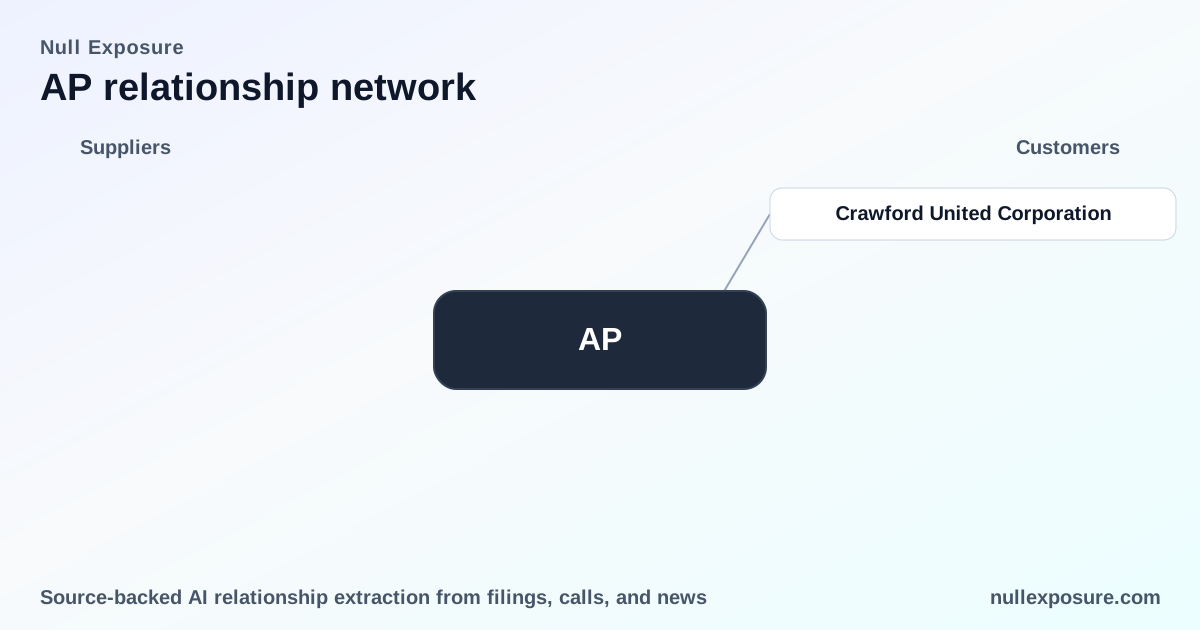
Crawford United Corporation
Ampco reported a small, ordinary‑course sale (~$4,082) during 2023 to a wholly owned subsidiary of Crawford United Corporation, indicating an isolated, immaterial transaction with a related party or industrial counterparty. This detail is disclosed in Ampco‑Pittsburgh’s Form 10‑K for the fiscal year ended 2024. (Source: Ampco‑Pittsburgh 2024 Form 10‑K filing.)
ACCS (Access Newswire / press distribution mention)
A comparative blog on press distribution noted that AP content is included among channels used for press release dissemination (listing “AP, Yahoo Finance, Reuters, Business Insider, USA Today”), which signals Ampco’s utilization of broad media distribution for corporate communications rather than a commercial purchasing relationship. The mention is in a 2026 AccessNewsWire blog post comparing platform pricing and reach. (Source: AccessNewsWire blog, May 2026.)
If you want a compact feed of Ampco’s public disclosures and media signals, see https://nullexposure.com/ for index and linking.
U.S. Navy
Ampco’s ALP business supplies pump systems and related equipment for naval applications, and management reported bookings in early 2026 for the U.S. Navy exceeding $9 million, explicitly replacing about $7.1 million lost from the termination of the Constellation‑class frigate program — a near‑term revenue recovery for defense work. A press report also described ALP supplying critical pump systems for U.S. Navy vessels and expanding capacity via Navy‑funded equipment programs, underlining defense as a durable demand channel for ALP. (Sources: Q4 2025 earnings call transcript reported on Investing.com, May 2026; Globe and Mail press release, May 2026.)
Westinghouse
Management confirmed historical supply relationships with Westinghouse, stating that Ampco "has supplied to Westinghouse in the past" and supplied specific products for product lines under that buyer. These comments appeared in Q4 2025 earnings call coverage and investor‑transcript reporting, marking Westinghouse as a past or intermittent customer in nuclear or heavy‑industry product lines rather than evidence of a current large backlog. (Sources: Q4 2025 earnings call transcript reported on Investing.com and InsiderMonkey, May 2026.)
What the relationships say about revenue durability and risk
- Short contract duration creates revenue visibility limits: AP’s short‑term production cycles mean bookings and quarterly results can swing with order timing; the company relies on steady replacement demand and periodic project bookings (constraint: short_term contracts).
- Defense work increases durability but is program‑dependent: Navy bookings and Navy‑funded capital programs provide a stronger revenue floor for ALP, yet individual program terminations (e.g., Constellation‑class) can create discrete revenue gaps that must be replaced via new bookings or aftermarket work.
- Customer concentration is asymmetric across segments: FCEP carries a measurable concentration risk (single ~11% customer), while ALP’s customer mix appears more diversified, reducing single‑counterparty downside for that segment.
- Commercial counterparties skew large and sophisticated: The business routinely works with OEMs, major industrial customers and nuclear suppliers, which elevates product specification complexity, payment discipline and bargaining dynamics (constraint: counterparty_type large_enterprise).
Financial and strategic implications for investors
Ampco’s operating model is manufacturing‑intensive and order‑driven; that supports margin upside on engineered equipment but leaves earnings vulnerable to order timing and customer program shifts. The recent Navy bookings indicate a near‑term revenue cushion for ALP and validate capital investments in capacity, while the FCEP customer concentration requires monitoring — loss of an 11% customer would materially affect that segment.
Operationally, the prevalence of short‑term contracts keeps working capital and execution focus central to performance; investors should zero in on backlog composition, defense program awards, and any shifts in single‑customer exposure disclosed in subsequent filings.
Key takeaways
- Ampco monetizes through short‑cycle, engineered product sales to large industrial and defense buyers; defense bookings provide a durable revenue channel.
- FCEP concentration (~11% from one customer) is the principal counterparty risk; ALP is more diversified and benefits from Navy‑funded expansion.
- Related‑party and one‑off sales exist but are immaterial to consolidated revenue.
For continuous updates on Ampco‑Pittsburgh customer signals and filings, the company’s filings and recent earnings transcripts are primary sources; for a consolidated index of those signals, visit https://nullexposure.com/.