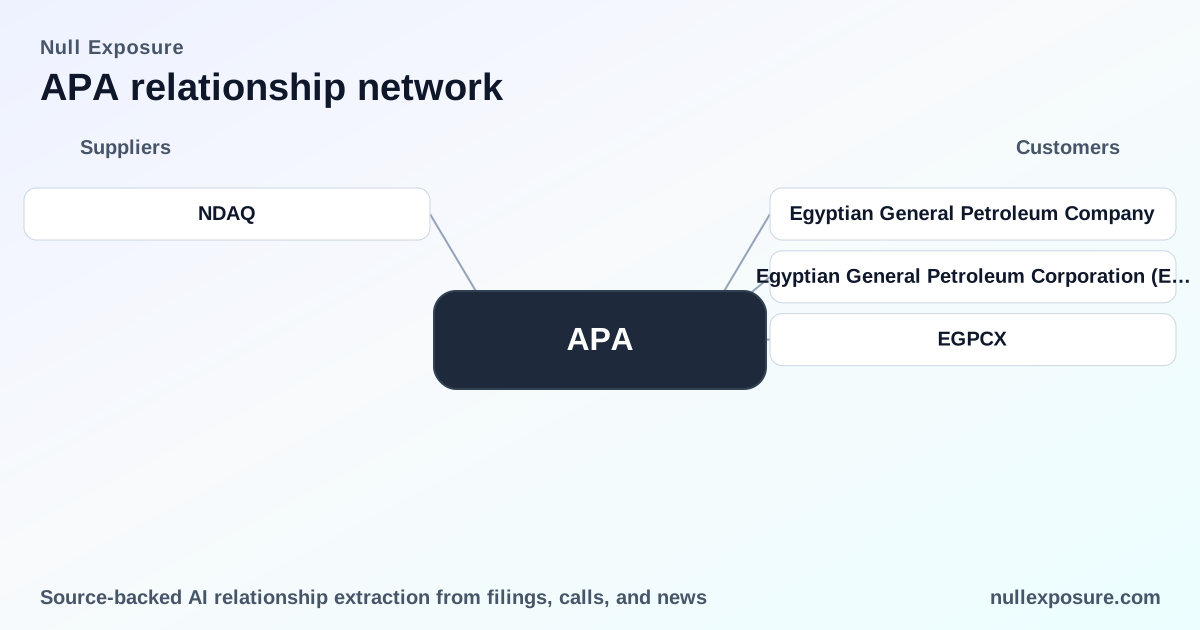
APA Corporation: customer relationships that drive cash flow and country risk
Thesis — APA Corporation is an upstream oil & gas operator that monetizes produced hydrocarbons through a mix of spot, index-linked and longer-dated sales contracts across the U.S., Egypt and the U.K.; cash generation is driven by production volumes sold under short-term market pricing, while a handful of long‑dated delivery commitments and a concentrated Egyptian counterparty exposure create differentiated operational and credit risk for investors.
For a quick operational snapshot and customer-tracking tools, visit our homepage: https://nullexposure.com/.
How APA sells product and where the money comes from
APA’s business model converts barrels and gas molecules into near-term cash through predominantly short-term, index‑based contracts that are settled on delivery. According to APA’s 2024 Form 10‑K, typical sales are structured as 30‑day evergreen or daily/monthly index contracts with payment terms that settle within a year after physical delivery, which allocates variable market prices to each performance obligation. At the same time, APA carries explicit multi-year delivery obligations for natural gas and crude oil that lock in volumes (for example, large gas delivery commitments spanning 2025–2037), creating a dual posture of spot commercialization with embedded long-term commitments (APA 2024 10‑K, FY2024).
Key operating characteristics:
- Contracting posture: Primarily short‑term receipt of cash on delivery, with important long‑dated delivery commitments for gas and some oil volumes.
- Revenue driver: Core product sales (crude oil, natural gas, NGLs) recognized at point of transfer to customer.
- Geographic footprint: Concentrated across North America, Egypt and the U.K., with exploration interests elsewhere.
- Concentration risk: A single Egyptian counterparty accounts for a material share of sales revenues in recent years.
Customer-by-customer: what the record shows
Below are concise, investor‑oriented summaries of every relationship captured in the source results.
Egyptian General Petroleum Corporation (EGPC) — FY2024 (10‑K)
APA reports that deterioration of economic conditions in Egypt could cause payment delays or non‑payment, while Egyptian operations contributed 22% of 2024 production and 12% of year‑end proved reserves, representing a material portion of APA’s cash flows. According to APA’s 2024 Form 10‑K, EGPC exposure therefore carries both production importance and payment risk (APA 2024 10‑K, FY2024).
Egyptian General Petroleum Company — FY2024 (10‑K)
APA states it is the largest acreage holder in Egypt’s Western Desert and at year‑end 2024 held 5.3 million gross acres under a merged concession agreement (MCA) ratified with the Government of Egypt and EGPC, establishing long‑running commercial terms for operations there (APA 2024 10‑K, FY2024).
TBN / APA Group pipeline activity — FY2026 (Proactive Investors)
A Proactive Investors piece in March 2026 reported APA Group completed construction of the Sturt Plateau Pipeline (SPP), connecting the Sturt Plateau Compression Facility to the Amadeus Gas Pipeline, underpinning midstream access for joint‑venture gas production in Australia (Proactive Investors, Mar 2026).
Permian Resources Corporation (PR) — FY2026 (SimplyWall / market news)
Permian Resources agreed to acquire 13,320 net acres, 8,700 net royalty acres and ~12,000 Boe/d from APA for $608 million, reflecting a divestiture of U.S. acreage and production that reallocates APA capital and alters its U.S. customer/volume profile (SimplyWall market report, May 2026).
TBN / Beetaloo Joint Venture commercial agreements — FY2025 (Proactive Investors)
A September‑quarter report noted the Beetaloo Joint Venture sanctioned a pilot project following execution of key commercial documents with APA Group, the SPCF Trust and other commercial counterparties, indicating APA’s role as a commercial anchor for Beetaloo infrastructure and offtake arrangements (Proactive Investors, FY2025).
EGPC (EGPCX notation) — FY2024 (10‑K)
APA disclosed that sales to EGPC accounted for approximately 17% of worldwide crude oil, natural gas and NGLs revenues in 2024, and that natural gas production in Egypt is sold to EGPC under an industry‑pricing formula—a material revenue relationship with explicit pricing mechanics (APA 2024 10‑K, FY2024).
Contracting, concentration and criticality — investor implications
APA’s disclosures create a coherent picture of how customer relationships affect cash flow and risk:
- Short-term cash cycle dominates: Revenue recognition and payment are typically tied to physical delivery and settlement within one year, which yields predictable, near‑term cash conversion for index‑linked sales. This short-term billing posture reduces long-dated credit exposure for most volumes but increases sensitivity to spot price volatility.
- Long-term delivery obligations create committed volume risk: APA has multi-year delivery commitments (explicit averages for 2025–2029 and 2030–2037), which require sustained production levels and create operational delivery risk if production underperforms or logistics fail.
- Material country/counterparty concentration: EGPC was responsible for roughly 17% of APA’s 2024 hydrocarbon revenues, a material concentration that elevates sovereign and counterparty credit risk—the 10‑K specifically warns about potential payment delays or deferrals tied to Egypt’s economic conditions (this materiality signal is specific to the EGPC relationship as stated in APA’s filing).
- Market mix: spot plus term: APA’s U.S. and North Sea sales combine daily/monthly index pricing and spot contracts with term arrangements; this mix supports margin capture on strong prices but leaves revenue exposed when markets weaken.
- Buyer profile: APA sells primarily to large integrated majors, marketers and utilities in North America, which supports liquidity and market access, while some North Sea and Egyptian sales are routed to national or regional counterparties with different payment profiles.
- Business maturity: The company’s relationships are operationally active, revenue‑generating, and central to APA’s core product segment; management treats these customer contracts as core to the oil & gas revenue model and recognizes revenue at point of transfer.
What this means for investors
- Positive: The short cash conversion cycle and diversified sales mechanisms (index, spot and term) produce resilient EBITDA when commodity prices are favorable; APA’s strong returns on equity and operating margins in recent filings reflect that operational leverage.
- Watch list: Egypt/EGPC concentration is the single biggest counterparty risk—EGPC accounted for a material share of 2024 revenues and is explicitly called out in APA’s 10‑K with payment delay risk. Additionally, APA’s long‑dated delivery commitments require sustained production and reliable midstream capacity.
- Portfolio action: For income or value investors, APA’s dividend and low forward PE profile reflect current cash flow strength, but allocate due diligence resources to sovereign/counterparty credit analysis in Egypt and the effect of recent U.S. asset sales (e.g., the Permian transaction) on near‑term production and cash generation.
For a structured view of counterparty holdings and materiality overlays, see our homepage: https://nullexposure.com/.
Final takeaway
APA converts production into near‑term cash via largely short‑term, index‑priced sales while retaining meaningful long‑term delivery obligations and a material economic link to EGPC in Egypt. Investors must balance the company’s cash‑generative profile against concentrated sovereign exposure and committed volume obligations when sizing position and assessing downside risk.