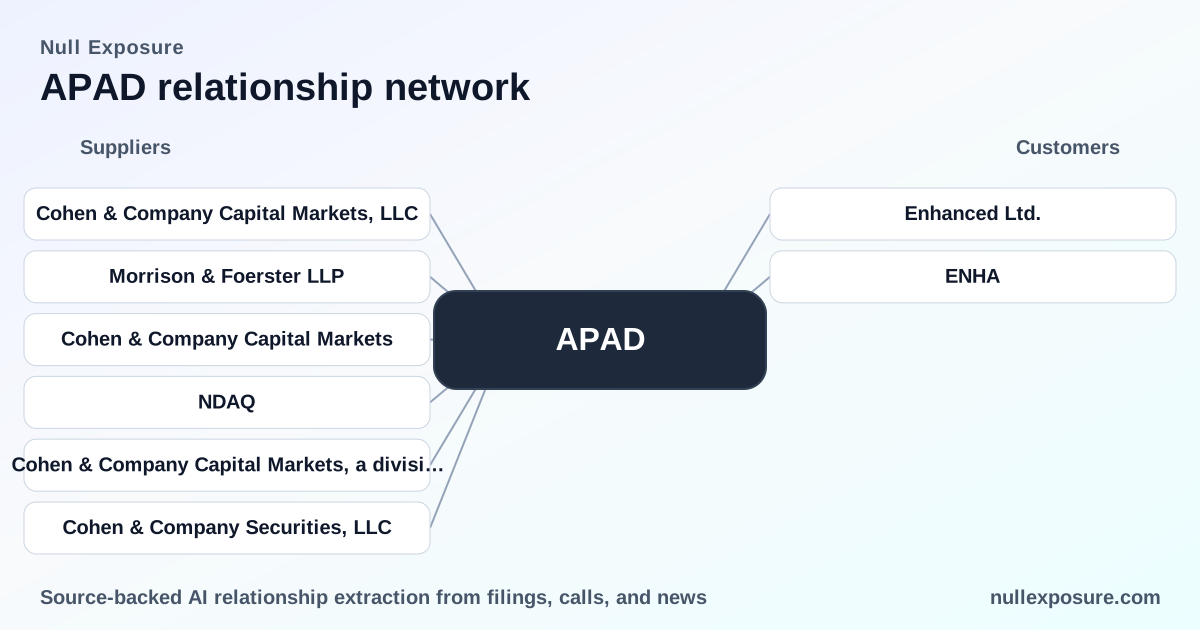
APAD: SPAC capital deployment and the Enhanced Ltd. relationship
A Paradise Acquisition Corp. (APAD) is a NASDAQ-listed SPAC that monetizes through the classic SPAC playbook: raise sponsor and public capital via an IPO and private placement, then convert that capital into value by completing a business combination and capturing sponsor economics and post-merger upside. APAD’s financial profile shows a focused shell company posture—modest market cap, minimal operating revenue, and concentrated capitalization—so the company’s value realization depends on deal execution and the terms of capital deployments. For a quick reference to the platform that produced this analysis, visit https://nullexposure.com/.
How APAD operates and where it earns returns
APAD is a Special Purpose Acquisition Company that raised cash from public and sponsor investors to identify and merge with a target company. The company’s balance-sheet attributes underline its SPAC nature: zero reported revenue TTM, a 2025 market capitalization near $304 million, and a trailing P/E of 65.59 driven by a small EPS base. APAD’s monetization levers are straightforward:
- Sponsor economics and founder-share dilution on deal closing.
- Redemption dynamics and post-combination equity upside for remaining public shareholders.
- Potential ongoing management fees or warrants depending on underwriting and sponsor agreements.
Operationally, APAD shows typical SPAC characteristics: capital concentrated in limited instruments (units and founder shares), long-dated registration rights for sponsors, and private placement proceeds that fund deal pursuit rather than recurring revenue generation.
Contracting posture, concentration and maturity signals investors should weigh
The public disclosures and extracted contract excerpts provide company-level signals about APAD’s contracting posture and maturity—these are not specific to any single counterparty unless explicitly named.
- Contracting posture: Evidence of a $6.0 million private placement concurrent with the IPO implies a subscription-style capital foundation that aligns sponsor and underwriter incentives with the search for a target. The private placement structure is a classic SPAC subscription instrument that prioritizes capital availability for a business combination.
- Long-term rights and maturity: Registration rights for founder holders that include up to three demand registrations and multi-year piggyback rights indicate multi-year liquidity plans for insiders; the existence of time-limited demands/piggyback windows (five and seven years respectively) signals a finite horizon for sponsor monetization after the IPO.
- Concentration & criticality: As a shell vehicle, APAD has concentrated capitalization and concentrated operational risk: deal success is critical to unlocking value. The company’s financials—no revenue and negative book value per share—make the SPAC’s single business combination the pivotal event for investors.
These attributes frame how counterparty relationships should be assessed: transactions that represent capital deployment are critical to APAD’s value realization, while contractual protections for sponsors create predictable exit mechanics.
Documented customer/partner relationships in the record
Below are the explicit relationship entries surfaced in the provided material. Each result is addressed exactly as presented.
Enhanced Ltd. — MarketScreener news item (document A)
Enhanced Ltd. announced it received $40 million in funding from A Paradise Acquisition Corp., indicating a direct capital deployment from APAD into Enhanced’s business plan; this is presented as a funding arrangement reported March 9, 2026. Source: MarketScreener, March 9, 2026 — https://www.marketscreener.com/news/enhanced-ltd-announced-that-it-has-received-40-million-in-funding-from-a-paradise-acquisition-corp-ce7d5ed3db80f720
ENHA (Enhanced Ltd., inferred ticker ENHA) — MarketScreener deal announcement (document B)
A second MarketScreener entry ties the name ENHA to the transaction, reporting the same $40 million funding event and identifying a definitive business combination agreement between Enhanced Ltd. and A Paradise Acquisition Corp., which frames the funding as part of a merger/combination process. Source: MarketScreener, March 9, 2026 — https://www.marketscreener.com/news/enhanced-ltd-entered-into-a-definitive-business-combination-agreement-to-acquire-a-paradise-acquisi-ce7d5ed3da89ff26
Enhanced Ltd. — duplicate record (document C)
A third record replicates the Enhanced/ENHA disclosure with the same funding detail; it reinforces the linkage and the timing of the announcement on March 9, 2026. Treat this as corroborating coverage of the same capital deployment. Source: MarketScreener, March 9, 2026 — https://www.marketscreener.com/news/enhanced-ltd-entered-into-a-definitive-business-combination-agreement-to-acquire-a-paradise-acquisi-ce7d5ed3da89ff26
What the Enhanced / ENHA relationship implies for investors
This cluster of reports establishes that APAD elected to deploy a notable portion of its capital—$40 million—into Enhanced Ltd. as part of a business combination process. For investors and operators evaluating the SPAC’s customer/partner posture, several implications follow:
- Capital deployment is the primary product: APAD’s role here is as an acquirer/funder rather than an operating vendor, so success is measured by post-combination performance of Enhanced rather than recurring fees to APAD.
- Concentration risk: A single deployment of $40 million relative to APAD’s market cap makes the Enhanced deal material to APAD’s value realization; underperformance or dilution dynamics in the combined entity will disproportionately affect APAD holders.
- Liquidity and exit mechanics are predetermined: The company-level registration rights and private placement arrangements indicate that sponsor liquidity and conversion options are already structured, which reduces execution ambiguity but locks in sponsor timelines for monetization.
- Deal criticality and maturity: Given APAD’s SPAC status (no recurring revenue), the business combination with Enhanced is the principal operational event for converting NAV into public equity value.
Risks, upside, and operator considerations
- Upside: If Enhanced demonstrates strong post-combination performance and market reception, APAD shareholders retain meaningful upside due to concentrated exposure to that outcome. $40 million deployed signals conviction and a sizeable exposure to a single deal thesis.
- Risks: Redemption rates, valuation resets at closing, and sponsor dilution through registration and founder-share mechanics can compress public holder returns. The absence of diversified revenue streams makes APAD vulnerable to a single-event outcome.
- Operator focus: Management should prioritize transparent post-close reporting, clear milestones for Enhanced’s integration, and active investor communication to manage redemption dynamics and market expectations.
Bottom line and recommended next steps
APAD’s relationship with Enhanced Ltd. is the defining transaction in its public record: a one-off capital deployment that is material to shareholder outcomes and governed by typical SPAC sponsor protections. Investors should treat APAD as a pure play on the success of the Enhanced combination, monitor redemption activity, and track post-close performance metrics closely.
For additional structured coverage and alerts on SPAC deal flow and counterparty relationships, visit https://nullexposure.com/.