APC / ARKO: The commercial spine that underwrites predictable fuel distribution cash flows
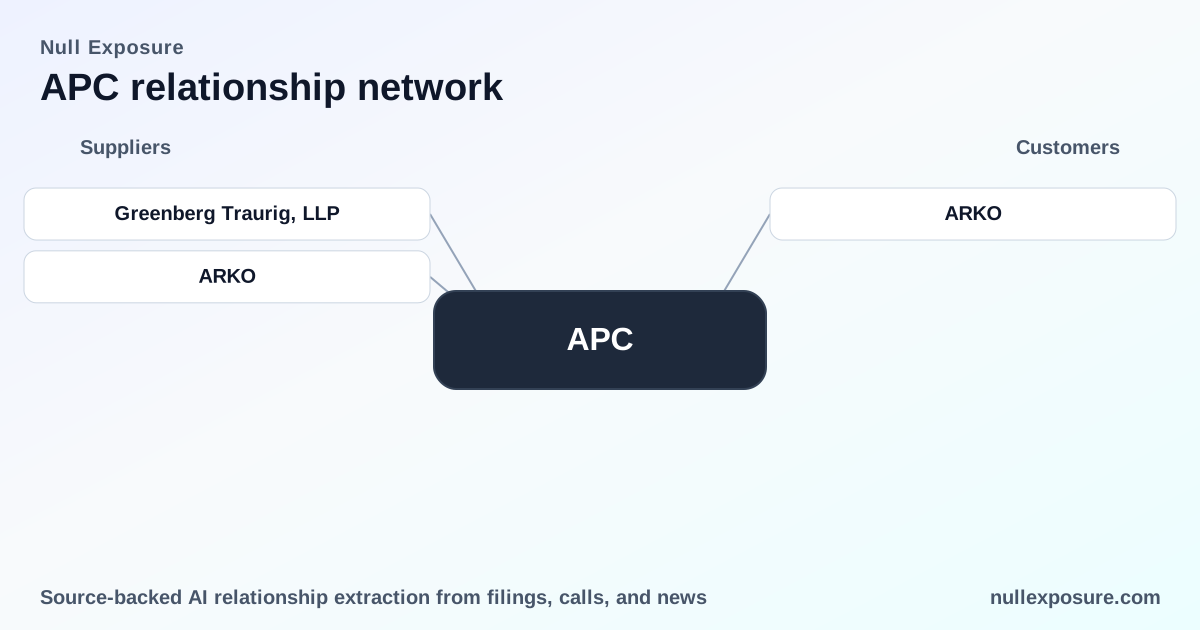
APC (ARKO Petroleum Corp.) operates as a wholesale fuel supplier and distributor that monetizes through long-term supply contracts, wholesale fuel margins, and distribution economics tied to convenience-store networks. The company’s commercial strategy centers on anchoring predictable volumes with a single large retail counterparty—ARKO—through exclusive supply and omnibus agreements that lock in pricing formulas and multi-year distribution commitments, reducing topline volatility while concentrating counterparty risk.
For a deeper look at how those customer contracts shape APC’s cash flows and risk profile, visit https://nullexposure.com/.
Why the ARKO relationship is the defining customer signal for APC
APC’s disclosed ties to ARKO are not peripheral—they are structural. The agreements described in the public coverage convert a material portion of ARKO’s retail estate into dealer-supplied locations and designate APC (through its subsidiaries) as the exclusive motor fuel distributor for ARKO’s stations for a multi-year term, creating volume visibility and contractual pricing mechanics that convert commodity exposure into more predictable distribution revenue.
- Contracting posture: Long-term exclusive supply agreements with explicit pricing formulas create operational predictability and favorability in working-capital planning.
- Concentration: A single large retail counterparty dominates the customer profile, concentrating credit and operational risk.
- Criticality: The relationship is operationally critical—exclusive distribution rights imply that APC’s wholesale volumes are materially tied to ARKO station throughput.
- Maturity: The commercial relationship is at a transitional maturity stage driven by ARKO’s retail-to-dealer conversions and the corporate carve‑out/IPO dynamic.
These commercial characteristics shape how investors should value APC: premium for cash-flow stability from contracted volumes, discount for single-counterparty concentration.
The full set of customer mentions surfaced in the coverage
Below are every relationship item surfaced in the feed. Each entry includes a concise plain-English summary and its source.
Globe and Mail press release: new fuel distribution and omnibus agreements (May 2026)
APC’s new fuel distribution and omnibus agreements solidify its role as ARKO’s sole fuel supplier for most locations, locking in long-term volume commitments and pricing formulas intended to stabilize APC’s cash flows while specifying how convenience-store and fuel distribution assets are allocated between the two companies. (The Globe and Mail, May 2, 2026 — https://www.theglobeandmail.com/investing/markets/stocks/ARKO/pressreleases/317158/arko-corp-solidifies-control-with-apc-ipo-agreements/)
Globe and Mail (ARKO-Q): ten-year exclusive distribution term (March 2026)
APC’s subsidiaries become the exclusive motor fuel distributors to ARKO’s stations for ten years, converting a core portion of ARKO’s retail footprint into a long-term wholesale revenue stream for APC. (The Globe and Mail, March 9, 2026 — https://www.theglobeandmail.com/investing/markets/stocks/ARKO-Q/pressreleases/317158/arko-corp-solidifies-control-with-apc-ipo-agreements/)
Globe and Mail duplicate entry (ARKO Corp) — editorial cross-listing (March 2026)
A duplicate listing reiterates the same commercial commitment: APC’s exclusivity and the ten-year horizon are central to the corporate separation and operational plan. The repetition in coverage underscores market attention on the contractual terms. (The Globe and Mail, March 9, 2026 — https://www.theglobeandmail.com/investing/markets/stocks/ARKO-Q/pressreleases/317158/arko-corp-solidifies-control-with-apc-ipo-agreements/)
Manila Times / GlobeNewswire: retail-to-dealer conversions (March 2026)
ARKO reported converting 62 retail convenience stores to dealer locations in Q4 2025 and 256 conversions for the full year, bringing total conversions since mid‑2024 to 409 sites, a structural shift that funnels volumes into APC’s wholesale segment under the dealer model. (GlobeNewswire via The Manila Times, March 31, 2026 — https://www.manilatimes.net/2026/03/31/tmt-newswire/globenewswire/arko-petroleum-corp-reports-fourth-quarter-and-full-year-2025-results/2310894/amp)
TradingCalendar summary of the ARKO spin and APC IPO (March 2026)
Coverage of the spin‑off and APC IPO notes that ARKO retains commercial ties with APC, preserving supply continuity while separating financial reporting, thereby allowing APC to show standalone wholesale economics while ARKO focuses on retail operations. (TradingCalendar, March 9, 2026 — https://www.tradingcalendar.com/post/arko-spin-off-apc-ipo)
What these relationships imply for APC’s financial profile
APC’s consolidated financials already show scale—Revenue TTM of roughly $5.58bn and EBITDA near $140m—so the ARKO exclusivity is a lever for converting throughput into predictable wholesale margins. The ten-year exclusivity and formal pricing formulas materially reduce top-line volatility that would otherwise be driven by spot fuel prices and ad-hoc retail supply arrangements.
At the same time, concentration risk is elevated: a large share of APC’s contracted volumes are tied to a single counterparty whose strategic choices (retail conversions, dealer model rollouts, or wider corporate actions) directly affect APC’s throughput and working-capital profile. The retail-to-dealer conversions noted in ARKO reporting shift where margins accrue (toward APC’s wholesale line) but also change cash-collection and operational responsibilities.
Operationally, the agreements create a clear contracting posture—long-termed, exclusive, and prescriptive on pricing—which supports debt capacity and cash-flow forecasting but compresses APC’s ability to diversify customers absent new distribution agreements.
Investment implications and risk checklist
- Positive: Long-term exclusive agreements provide revenue visibility and reduce commodity-driven volatility in reported distributions. APC’s role as the exclusive distributor is a structural competitive advantage for securing wholesale volumes.
- Negative: Customer concentration introduces single‑counterparty credit and strategic risk; any adverse change in ARKO’s retail footprint or corporate strategy would disproportionately affect APC.
- Operational watch-items: Monitor conversion pace of ARKO retail sites to dealer locations, the exact mechanics of the agreed pricing formulas, and any amendments to the omnibus agreements during the ten‑year term.
- Financial signals: With a trailing EV/EBITDA around 13.1 and modest profit margin metrics, APC’s valuation already reflects structural margin pressure; exclusive supply agreements are the primary lever for improving margin predictability.
For further context and ongoing monitoring of APC’s commercial relationships, see https://nullexposure.com/.
Bottom line: predictable, but concentrated
The public coverage establishes APC as the commercial backbone for ARKO’s fuel supply under long-term exclusive agreements that materially increase revenue predictability but concentrate counterparty risk. Investors should value APC’s contracted cash-flow stability while rigorously stress-testing scenarios where ARKO’s retail strategy diverges from current plans. The contracts are an asset; concentration is the offsetting liability.