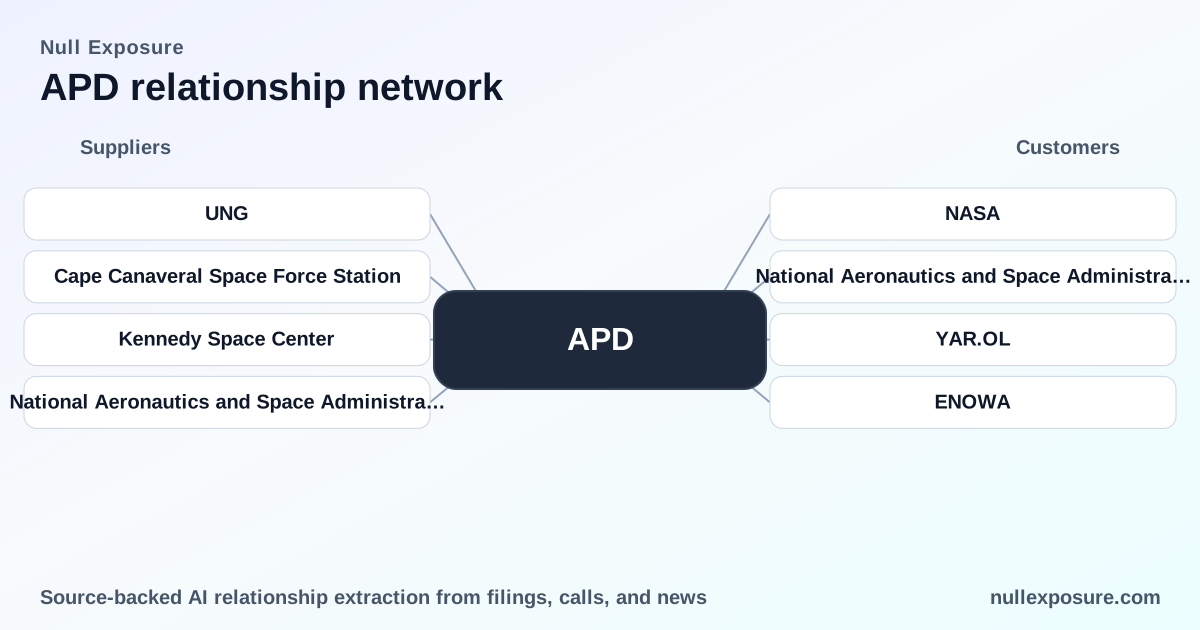
Air Products (APD) — Customer Relationships and Strategic Implications
Air Products monetizes by selling industrial and specialty gases, equipment, and related services through a mix of long-term on‑site agreements and shorter-term merchant supply, plus large project engineering and asset‑ownership contracts. The company captures predictable cash flows from 15–20 year on‑site contracts while also leveraging project engineering and BOO/O&M arrangements to secure large, discrete backlog dollars; recent wins with government and semiconductor customers illustrate both the stability and scale of revenue generation. Explore deeper coverage at https://nullexposure.com/.
How APD’s customer model actually works for investors
Air Products runs a dual operating model: core industrial gases delivered under long-term on‑site contracts (roughly half of sales) and merchant/packaged deliveries for variable demand. The company operates globally across ~50 countries and balances capital‑intensive, long‑dated commitments with shorter merchant sales—this combination produces high contractual predictability on large accounts and flexibility on merchant volumes.
- Contracting posture: On‑site supply contracts are typically 15–20 years and allow APD to pass through energy costs; merchant gas contracts are generally five years or less.
- Concentration and criticality: No single customer represents more than 10% of sales, but on‑site contracts are critical—they generate approximately half of consolidated revenue and underpin the company’s competitive moat.
- Maturity and scale: APD is a mature, capital‑intensive operator that monetizes through equipment sales, long‑term offtake agreements, and service/O&M for large hydrogen and industrial gas plants. Remaining performance obligations are sizable (~$26 billion as of Sept 30, 2025), signaling material project backlog and multi‑year revenue visibility.
- Risk profile: The business blends stable cash flow from long contracts with exposure to project execution, energy cost pass‑through mechanisms, and the timing of FIDs on large projects.
For further company relationship analysis and to track evolving contract wins, visit https://nullexposure.com/.
Customer relationships and what they mean for APD’s strategy
NASA — government anchor for liquid hydrogen (SNS Insider, Mar 9, 2026)
Air Products is highlighted as an ongoing liquid hydrogen supplier to NASA, underlining a strategic role in government space programs and clean hydrogen infrastructure. Source: SNS Insider blog, March 9, 2026.
National Aeronautics and Space Administration (Finviz, Mar 9, 2026)
Finviz reported APD secured new contracts worth more than $140 million to supply liquid hydrogen to multiple NASA facilities, reinforcing a durable government revenue stream tied to space missions. Source: Finviz news, March 9, 2026.
NASA — hydrogen revenue cited by investor commentary (Sahm Capital, Feb–Mar 2026)
Investor commentary emphasized the company’s more than $140 million NASA liquid hydrogen contracts as a meaningful validation of APD’s clean‑hydrogen ambitions and specialty product capabilities. Source: Sahm Capital, February–March 2026.
NASA — extension of space and clean energy narrative (Sahm Capital, Feb 4, 2026)
Sahm Capital noted that major liquid hydrogen supply deals with NASA extend APD’s market narrative from space logistics into broader clean energy infrastructure. Source: Sahm Capital, February 4, 2026.
NASA referenced alongside strong quarterly results (Sahm Capital, Feb 10, 2026)
Sahm Capital tied APD’s Q1 financial strength to the NASA hydrogen wins, listing the $140M+ deal as part of the earnings momentum. Source: Sahm Capital, February 10, 2026.
Samsung Electronics — semiconductor supply expansion (MarketBeat, May 2, 2026)
MarketBeat reported APD will expand industrial gas supply for Samsung Electronics’ next‑generation fab in South Korea, indicating a sizable, multi‑phase commercial relationship in semiconductors. Source: MarketBeat alert, May 1–2, 2026.
Yara — NEOM marketing and distribution negotiations (InsiderMonkey, May 2, 2026)
APD stated that negotiations with Yara on a marketing and distribution agreement tied to NEOM projects are progressing in line with expectations, signaling partnership dialogue on low‑emission ammonia and related products. Source: InsiderMonkey transcript of Q2 2026 earnings call, May 2, 2026.
NASA — role in Artemis 2 mission supply (InsiderMonkey, May 2, 2026)
Management noted APD’s participation in NASA’s Artemis 2 mission through provision of liquid hydrogen and helium using proprietary pumps, demonstrating technical differentiation in cryogenic capabilities. Source: InsiderMonkey earnings call transcript, May 2, 2026.
YAR.OL — Louisiana project linkage and asset sale plan (Finviz, Mar 9, 2026)
Finviz coverage described an $8–$9 billion Louisiana clean‑ammonia project where approximately 75% of capital targets the industrial gas complex, with ammonia production/distribution assets intended for sale to Yara. This situates Yara as a potential industrial partner for APD’s large projects. Source: Finviz research note, March 9, 2026.
ENOWA — NEOM hydrogen station agreement (Air Products press release, Mar 19, 2023)
APD’s Qudra business signed an agreement with ENOWA to build, own, and operate NEOM’s first hydrogen fueling station, illustrating APD’s BOO/O&M footprint in hydrogen mobility infrastructure. Source: Air Products press release, March 19, 2023.
SREA — technology selection for Sempra’s ECA LNG project (Offshore‑Energy.biz, first reported FY2021)
Offshore‑Energy.biz noted Air Products technology was selected for Sempra’s ECA LNG project, reflecting historical technology and project work across large energy customers. Source: Offshore‑Energy.biz (report referencing FY2021 project selection).
Yara International — project economics and strategic sale (Finviz, Mar 9, 2026)
Finviz reiterated that the Louisiana project contemplates selling ammonia assets to Yara, underscoring APD’s use of partner disposals to de‑risk capital intensity and lock in offtake routes. Source: Finviz, March 9, 2026.
NASA — sentiment framing APD as better positioned (SimplyWallSt, May 2, 2026)
SimplyWallSt summarized the $140M NASA contracts as validating APD’s ability to capture government‑backed hydrogen demand, a positive sentiment signal for investors. Source: SimplyWallSt narrative, May 2, 2026.
Samsung — selection for production facilities and bulk specialty gas system (WFMZ, May 2, 2026)
Local reporting noted APD was selected to build, own and operate multiple production facilities and a bulk specialty gas supply system for Samsung’s new advanced fab in South Korea, highlighting scope—capex plus long‑term supply. Source: WFMZ news, May 2, 2026.
Samsung — earnings call confirms multi‑facility BOO work (InsiderMonkey, May 2, 2026)
APD’s earnings call confirmed the Samsung project involves building and operating multiple production facilities and specialty gas systems for a new advanced fab—consistent with large backlog additions. Source: InsiderMonkey Q2 2026 transcript, May 2, 2026.
Samsung — backlog boost quantified (TipRanks, May 2, 2026)
TipRanks reported management expects $1.5–$2.0 billion to be added to backlog within six months, led by a major multi‑phase Samsung deal, indicating near‑term revenue visibility from semiconductor investments. Source: TipRanks company announcement summary, May 2, 2026.
Yara International — sentiment on low‑emission ammonia updates (SimplyWallSt, May 2, 2026)
SimplyWallSt noted that definitive updates on low‑emission ammonia projects with Yara would materially influence sentiment and signal expansion of APD’s clean‑energy moat. Source: SimplyWallSt narrative, May 2, 2026.
Investment implications — what to watch
- Backlog and RPOs: With remaining performance obligations near $26 billion, APD’s revenue runway is substantial and should support steady cash generation as projects convert.
- Government and semiconductor anchors: NASA and Samsung wins are strategic — NASA validates high‑spec cryogenic capability; Samsung provides high‑value, multi‑year semiconductor supply revenue.
- Project execution risk: Large BOO/O&M deals bring execution and capex timing risk despite contractual protections and pass‑throughs.
- Customer concentration: No single customer exceeds 10% of sales, which reduces counterparty concentration risk while keeping APD’s top‑line diversified.
For a concise tracker of APD’s customer wins and contract posture, visit https://nullexposure.com/.
Bold wins with NASA and Samsung strengthen APD’s transition story into clean hydrogen and specialty supply, while the company’s hybrid long‑term and short‑term contract structure delivers both stability and optionality for investors.