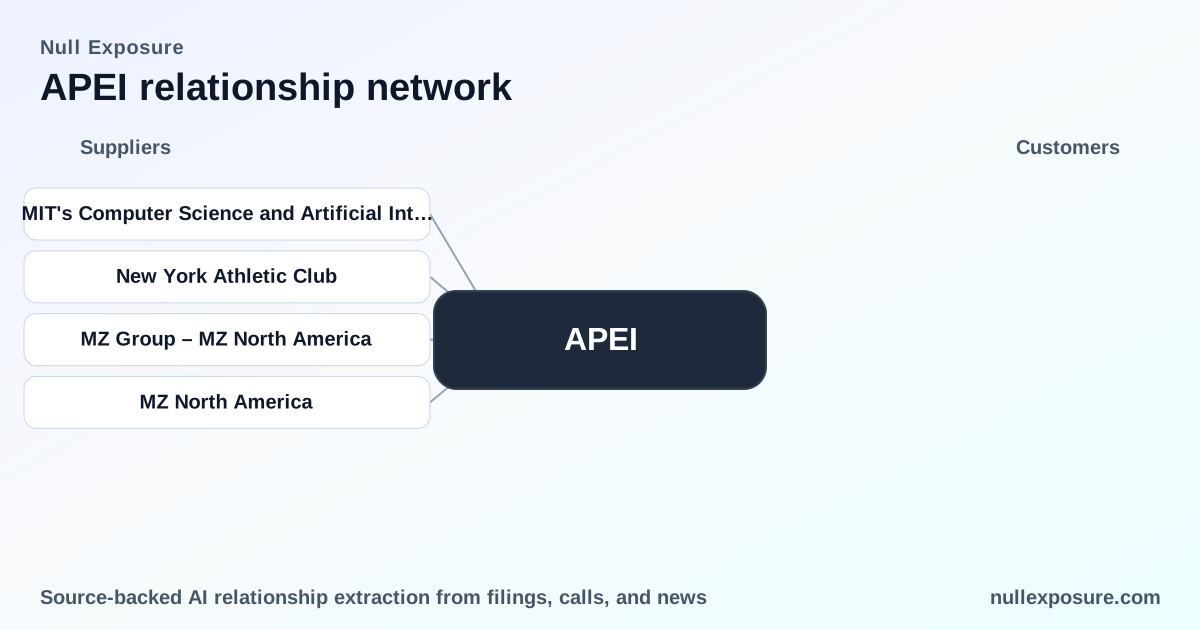
American Public Education (APEI): Customer relationships and what they mean for investors
American Public Education, Inc. operates a multi-brand education services business that sells online and campus-based degree and career programs through subsidiaries (APUS, Rasmussen University, Hondros College of Nursing, Graduate School USA). The company monetizes through tuition and contract training fees, Title IV federal aid funding, Department of Defense tuition assistance, veteran benefits, and direct government and corporate training contracts—a hybrid model that combines high-frequency, short-term course revenue with meaningful, recurring government and institutional contracts. This structure drives predictable per-term revenue yet concentrates APEI’s exposure to government payment programs and regulatory oversight.
For a closer look at customer-level relationships and the company-level operational constraints that shape revenue durability and risk, read on. If you want structured signals across public education customers, visit https://nullexposure.com/ for more coverage.
A single visible customer partnership — and why it matters
American Military University (an APUS brand) announced a formal partnership with the Military Officers Association of America (MOAA) that provides MOAA members and eligible family members a 20% tuition grant, opening access to a pool of approximately 350,000 eligible members and their extended families. This is a direct marketing and enrollment channel that both widens APEI’s addressable market among military-affiliated learners and locks a price-based incentive to drive conversion and retention. According to press distribution and news pickups, the announcement was publicized in early April 2026 and reported by MarketBeat and Finviz on May 2, 2026.
Key takeaway: the MOAA deal is a customer-facing partnership designed to increase enrollment flow from a defined, high-value segment (active and former military officers and dependents), enhancing APUS’s tuition-funded revenue without altering the company’s fundamental dependence on government benefit programs.
Relationship entries from the collected results
American Military University / MOAA — Finviz report (first item)
American Military University (APUS) signed a partnership enabling 350,000 MOAA members and their families to access a 20% tuition grant, positioning APUS to capture incremental enrollments from a concentrated military-officer cohort. Source: Finviz news pickup of the PR release, first seen May 2, 2026.
American Military University / MOAA — MarketBeat / PR Newswire mention (second item)
A PR Newswire release dated April 7, 2026 and carried by MarketBeat reiterates the AMU–MOAA partnership, highlighting the tuition savings program offered to MOAA members and extended families and confirming the public launch of the initiative in Q2 2026. Source: MarketBeat instant alert summarizing the April 7, 2026 PR Newswire announcement.
How this relationship fits APEI’s operating model
APEI runs a dual monetization model: frequent, short-duration course revenue (8–16 week terms for APUS; quarterly terms for other brands) and longer, contract-based training arrangements through Graduate School USA and government channels. The evidence set suggests the company manages a blend of contract tenures:
- Short-term course billing dominates classroom revenue recognition because most tuition is recognized ratably over eight-to-sixteen-week terms or quarterly cycles. This generates steady, per-term cash flow tied to enrollment activity.
- Some long-term contracting exists — Graduate School USA holds a GSA Schedule with renewal terms that extend through multi-decade windows, reflecting a longer contracting posture for government career-learning clients.
- Framework arrangements are present (e.g., Memoranda of Understanding with DoD for tuition assistance programs), which establish standardized participation terms rather than a single multi-year purchase order.
Collectively, these contract characteristics produce a revenue profile that is operationally nimble for student-facing programs yet anchored by longer-duration government contracts for career training.
Company-level constraints that shape revenue and risk
Several company-level signals in filings and public disclosures are material for investors evaluating customer exposures:
- Counterparty mix is bifurcated between individuals and government: APEI serves roughly 106,700 students and 24,600 career-learning participants, but it also provides contract training to over 100 federal agencies through GSUSA. This produces revenue sources from both direct consumers and government payors.
- Government funding is material and critical: Title IV funds and Department of Defense tuition assistance accounted for a substantial portion of revenue—Rasmussen reported 76% of its 2024 segment revenue from Title IV—making government program access pivotal to cash flow.
- Contract maturity is mixed: while most instructional revenue is short-term by course or quarter, GSUSA’s GSA Schedule and DoD MOUs create long-dated, framework-style commitments that underwrite a portion of contract training revenue.
- Relationship stage is active: deferred revenue and ongoing program approvals (e.g., post-acquisition Title IV provisional arrangements) indicate active, ongoing enrollments and government program participation.
- Geographic concentration is domestic (U.S.): regulatory oversight, state licenses, and federal program involvement center APEI’s exposure on the U.S. higher-education policy environment.
Investor implication: APEI’s economics are durable while government programs function normally, but exposure to regulatory, funding, or policy shifts in Title IV/DoD/VA benefits creates asymmetric downside relative to private-pay education peers.
Risks and concentration points investors should prioritize
- Regulatory funding dependency: Large portions of revenue flow through Title IV and DoD tuition assistance, creating counterparty concentration risk that is both financial and regulatory. Company filings for 2024 emphasize the materiality of these sources.
- Enrollment sensitivity to pricing incentives: Partnerships like the MOAA 20% tuition grant drive enrollment but compress headline tuition; investors should track net price realizations and retention.
- Contract mix complexity: Short-term course revenue cycles produce steady near-term cash but require persistent marketing and enrollment investment; long-term government contracts are stable but tied to compliance and renewal cycles (GSA schedules, MOUs).
- Operational concentration in the U.S.: State authorization and federal approvals are gating items that influence revenue continuity and growth.
Investor takeaway and next steps
APEI combines volume-driven short-cycle tuition revenue with a stable base of government and institutional training contracts. The MOAA partnership is a tactical customer-channel win that bolsters military-affiliated student acquisition, but the company’s valuation and risk profile remain substantially driven by its exposure to Title IV, DoD, and VA funding. For investors and operators, monitoring enrollment trends from partner channels, net tuition realization after grants, and regulatory developments in federal student aid will be decisive for thesis validation.
For a systematic view of customer relationships across the sector and to monitor changes in partnerships and contract posture, explore more research at https://nullexposure.com/.
Bold points to watch: government program access is critical, partnerships like MOAA increase addressable market but alter price mix, and contract tenure is mixed—short-term tuition plus select long-term government frameworks.