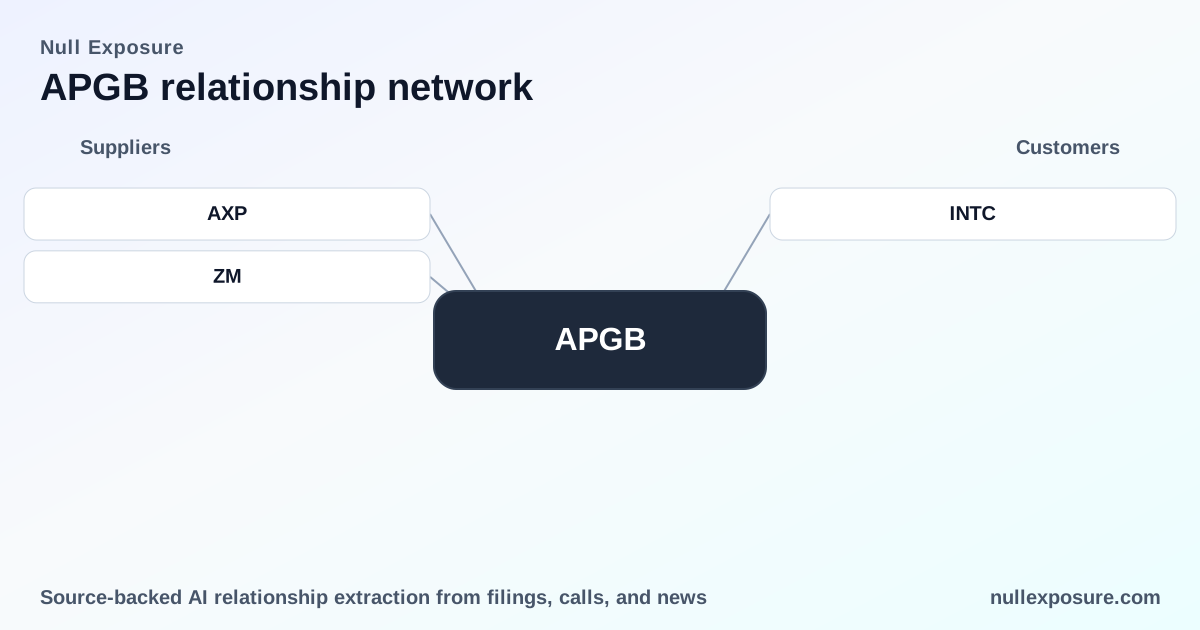
APGB customer relationships: what the Intel link reveals about business focus and risk
APGB’s customer footprint, as reflected in the recent relationship data, highlights engagement with large corporate sponsors and bespoke hybrid financing transactions. The company monetizes through structuring and facilitating tailored capital solutions for sizable corporate borrowers and strategic investors—capturing arrangement fees, ongoing servicing fees, and interest spread on financed positions. This positioning places APGB in a high-touch, counterparty-focused segment of the capital markets where revenue scales with deal complexity and client scale.
If you want a concise investor-ready view of counterparty exposure and commercial signaling, review the full offering at https://nullexposure.com/ — it distills customer relationships into actionable risk and revenue signals.
Why the Intel mention matters
- The single-News-item relationship set ties APGB to a bespoke financing context involving Intel, reported in industry press on March 9, 2026. Engagements with blue-chip corporates like Intel indicate APGB is active in structuring or participating in hybrid capital transactions that require bespoke underwriting and negotiation capability.
- Bespoke hybrid financing is a margin-rich but execution-intensive business line, which benefits operators with strong credit underwriting, documented deal-sourcing, and relationship-driven origination channels.
How to interpret operating posture and business-model constraints
- The provided records contain no explicit contractual constraints or operational caveats; that absence itself is a company-level signal: public visibility into contractual concentration, counterparty exclusivity, and renewal terms is limited. Investors should therefore treat concentration and contractual rigidity as material unknowns until APGB discloses more granular counterparty terms.
- The presence of corporate-scale counterparties implies a contracting posture that is bespoke and negotiated case-by-case rather than standardized, raising the importance of deal-level diligence and legal backbone.
- The commercial profile suggested by these customer links is one of high criticality but concentrated exposure: individual relationships can be commercially meaningful to revenue and balance-sheet composition, and the maturity of those relationships will depend on how many repeat or multi-deal customers APGB sustains over time.
Detailed readout of every listed relationship
INTC — a named participant in a hybrid transaction narrative
APGB’s customer set includes an entry tied to Intel (ticker INTC) referenced in coverage of hybrid-capital activity; the cited article lists a bespoke financing structure for Intel among recent hybrid transactions. According to East & Partners (published March 9, 2026), that transaction was called out alongside other strategic deals in the hybrid-capital market. Source: East & Partners news article, March 9, 2026 — https://eastandpartners.com/news/apollo-reshapes-growth-strategy-as-hybrid-capital-unit-breaks-away-from-buyout-division/
Intel — duplicate mention but substantively the same relationship
The dataset duplicates the Intel reference under the plain company name “Intel,” again linking APGB to a reported bespoke financing involving Intel in the same East & Partners story. This reinforces that Intel is singled out in public coverage as part of APGB’s customer-related activity, rather than an isolated or inferred exposure. Source: East & Partners news article, March 9, 2026 — https://eastandpartners.com/news/apollo-reshapes-growth-strategy-as-hybrid-capital-unit-breaks-away-from-buyout-division/
Key takeaways for investors and operators
- Concentration risk is elevated. With public coverage focused on a small set of large, bespoke transactions, APGB’s revenue and risk profile can be materially influenced by a handful of counterparty relationships.
- Execution and legal capabilities are core assets. Monetization in bespoke hybrid finance flows to counterparties that can structure, document, and syndicate complex financing—so operational maturity on origination, underwriting, and documentation is critical.
- Public transparency is limited. The record contains no contractual constraints or granular terms; therefore, valuation and risk assessment rely heavily on deal-level disclosure or management commentary.
- Relationship-critical revenue stream. Engagements with enterprise-grade borrowers such as Intel signal access to high-ticket financing mandates that generate fees and recurring servicing income when executed competently.
Practical implications for due diligence
- Request deal-level documentation and fee schedules for reported transactions tied to named counterparties to quantify revenue per deal, credit exposure, and residual servicing obligations.
- Validate whether these client engagements are one-offs or part of an ongoing pipeline; repeat business with the same corporates materially reduces revenue volatility.
- Confirm whether APGB retains on-balance-sheet risk or acts purely as arranger/distributor—this distinction changes capital allocation, regulatory capital needs, and earnings volatility.
Final assessment: where the relationship map points The customer references connecting APGB to Intel through public coverage of hybrid-capital deals position the company as an active participant in bespoke corporate financing. That strategic focus offers both higher margin opportunity and heightened concentration and execution risk. Investors should prioritize obtaining deal-level clarity and contractual disclosures to convert descriptive press mentions into quantitative exposure metrics.
For a structured, side-by-side view of APGB’s counterparties and commercial signals, visit https://nullexposure.com/ — the platform consolidates relationship-level information into investment-ready insights.