Applied Digital (APLD): How hyperscaler leases are reshaping the revenue base
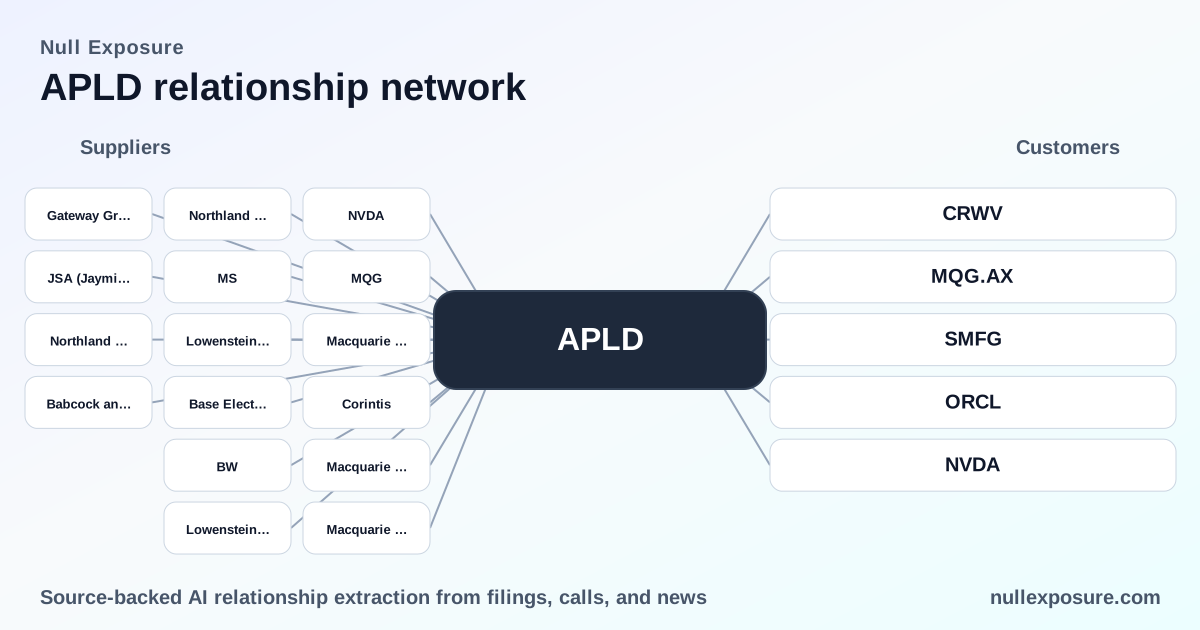
Applied Digital builds and operates next‑generation data centers and monetizes primarily through long‑term, large‑ticket leases and hosting services for AI/HPC hyperscalers and crypto operators. The company’s recent wave of multi‑year leases and financing arrangements converts developmental pipeline optionality into predictable, contractually backed cash flows, while simultaneously concentrating execution and counterparty risk in a small set of counterparties. For a concise vendor and counterparty map for underwriting and operational diligence, see our coverage at https://nullexposure.com/.
The investor thesis in one line
APLD is executing a capital‑intensive build‑and‑lease model: it develops purpose‑built AI/HPC campuses, signs long‑term leases with hyperscalers and cloud specialists, and captures recurring lease and hosting revenue while financing construction via institutional partners and project finance.
Why the CoreWeave relationship matters more than headlines
Applied Digital’s relationship with CoreWeave sits at the center of the company’s FY2026 narrative. CoreWeave is the primary tenant at Polaris Forge 1, holding 400 MW under contract and representing a material portion of APLD’s prospective lease revenue (reported as roughly $11 billion of the contracted book). Applied Digital has restructured leases and added credit support — including guarantees from CoreWeave and a $50 million letter of credit tied to one lease — to buttress the economics and financing profile of those assets. (See APLD press materials and market coverage in Q2/FY2026.)
Key takeaway: CoreWeave converts APLD’s development backlog into contracted revenue, but also concentrates revenue and execution risk in a single counterparty. Investors must balance locked‑in cashflows against counterparty concentration and construction delivery risk. More detail on relationships below; or visit https://nullexposure.com/ for our platform analysis.
Relationship roster — concise, referenceable summaries
Below are every counterparty referenced in the source results and a plain‑English summary with source context.
-
CoreWeave / CRWV
CoreWeave is APLD’s largest customer; it holds multiple 15‑year leases across Polaris Forge campuses that together represent the majority of APLD’s contracted revenue pipeline (commonly reported as about $11 billion of lease value). Several news outlets and APLD filings in FY2026 document the 15‑year structures and the significant megawatt commitments. (See APLD press releases and trading/financial press coverage, March–May 2026.) -
CoreWeave, Inc.
APLD’s filings identify CoreWeave, Inc. as the counterparty in May 2025 data center lease agreements that deliver infrastructure at Polaris Forge 1, and later disclosures describe lease restructuring and additional credit support provided by CoreWeave, Inc. (APLD FY2026 press release and Q3 FY2026 report.) -
CoreWeave Compute Acquisition Co. VIII, LLC
Applied Digital disclosed a new data center lease with this wholly‑owned CoreWeave subsidiary covering two data halls on substantially the same terms as the parent deal, indicating the CoreWeave group has used special‑purpose vehicles to take occupancy and secure lease economics. (Benzinga, April–May 2026.) -
Macquarie Asset Management / MQG.AX
Macquarie agreed a transaction allowing it to invest up to $5 billion of capital to support development of APLD’s next‑generation data centers; this injects long‑term infrastructure capital that reduces equity dilution and supports buildout cadence. (APLD earnings call transcript, 2025 Q3.) -
Sumitomo Mitsui Bank Corporation / SMFG
APLD arranged a $375 million financing facility with Sumitomo Mitsui, reflecting traditional project and construction financing participation from global banking groups experienced in data center finance. (APLD earnings call transcript, 2025 Q3.) -
NVIDIA / NVDA
NVIDIA participated in a private placement with APLD (and related institutional investors) under a securities purchase agreement dated September 5, 2024, indicating strategic investor interest from major GPU suppliers. (APLD 10‑K for FY2025.) -
Oracle / ORCL
Oracle is referenced in market reporting and filings as a tenant at Polaris Forge 2 in certain transaction disclosures and coverage, and APLD sought debt financing structures — including a $2.15 billion bond package referenced in press coverage tied to Oracle-related development plans. (Finviz and TS2.tech coverage; filings in FY2025–FY2026.) -
KBR
KBR and Applied have a commercial collaboration connected to INSITE 3.0, where Applied participated in a venture to enhance operational performance using physics‑based AI — illustrative of APLD’s non‑leasing, services‑adjacent relationships. (Insidermonkey coverage of Q4 2025 transcripts reporting a new Applied venture.)
Operating model and constraint signals for underwriters and operators
APLD’s public disclosures and the collected evidence point to a distinct set of operating characteristics investors and counterparties must price into models:
-
Long‑term contracting posture: APLD’s core commercial model is built on lengthy, fixed‑term leases (15‑year structures are repeatedly disclosed). Where the record explicitly ties those long terms to CoreWeave leases, that relationship carries contractual permanence that underpins lease revenue forecasts. (Contract schedule and May 28, 2025 lease disclosures.)
-
High customer concentration and criticality (company‑level): One major customer accounted for 93% of revenue in FY2025; this is a company‑level concentration signal that elevates counterparty and execution risk and reduces diversification of cashflow sources. (FY2025 revenue concentration disclosure.)
-
Capital intensity and spend bands: The company reports multi‑year minimum contracted payments in the hundreds of millions per year and multi‑billion total contracted receipts in its schedules, consistent with $100m+ spend bands per large customer and multi‑billion overall contracted pipelines. (Minimum contracted payments table cited in filings.)
-
Geography and scale: APLD operates primarily in North America; the business builds large campuses in the U.S. and funds construction through project finance and institutional capital partners, which concentrates operational logistics and regulatory exposure within one region. (Company description and segment disclosures.)
-
Relationship roles: APLD functions primarily as a service provider and seller of energized space (infrastructure provider), delivering power‑enabled hosting environments to customers who place compute hardware on site; that role requires tight coordination across construction, electrical delivery, and tenant integration. (Business segment descriptions.)
-
Life‑cycle status across assets: The company runs a mix of mature, operating facilities (Jamestown and Ellendale) and ramping, under‑construction assets (Polaris Forge 1 and 2), so near‑term revenue recognition and capex needs differ materially between assets. (Facility operational status and construction program excerpts.)
Investment implications and risk checklist
- Positive drivers: large, contracted lease revenues convert growth capex into recurring cashflow; institutional capital partners (Macquarie, Sumitomo Mitsui) and strategic investors (NVIDIA) provide financing and commercial validation.
- Principal risks: customer concentration, execution risk on buildouts, and the need to maintain project finance economics until facilities reach stabilized occupancy. APLD’s valuation will remain highly sensitive to delivery timelines and the credit backing of its largest tenants.
For a systematic counterparty and contract risk report tailored to an institutional diligence workflow, visit https://nullexposure.com/ to view our product offerings and datasets.
Bold, large leases and institutional financing put Applied Digital at an inflection point: the company is no longer solely a developer of optional projects but a large counterparty to hyperscalers — that change improves revenue visibility while concentrating execution exposure. Investors should underwrite both sides of that trade before sizing positions.