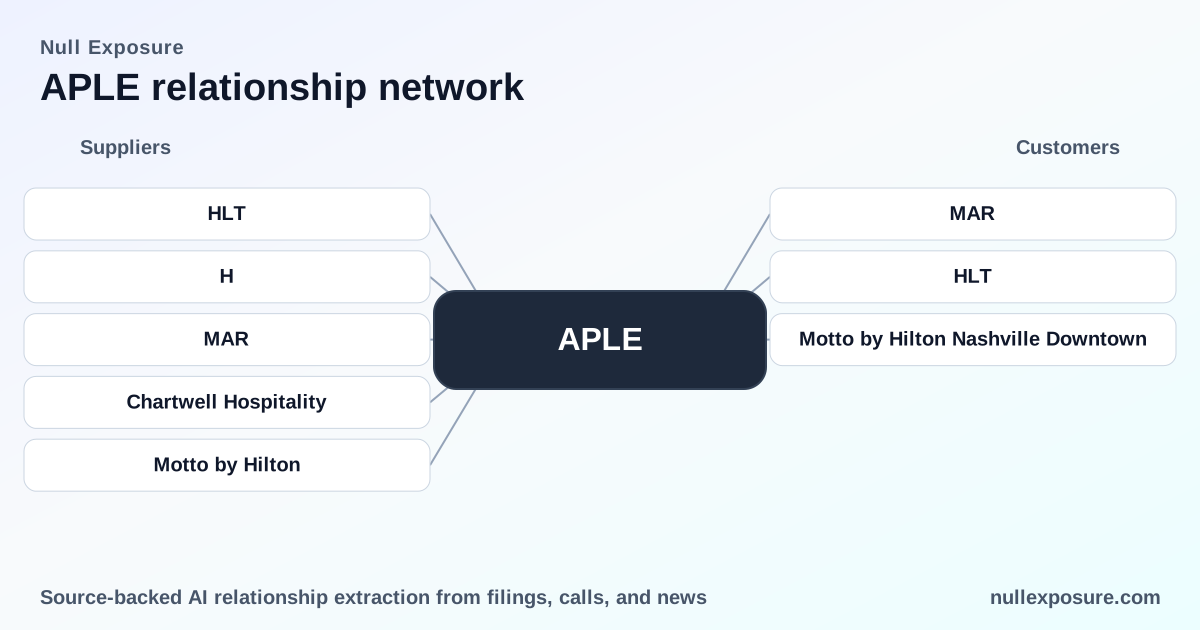
Apple Hospitality REIT (APLE): Customer Relationships that Drive a U.S.-Focused Hotel Portfolio
Apple Hospitality REIT operates and monetizes a portfolio of upscale, rooms-focused hotels across the United States by owning real estate and capturing revenue as the property owner while third-party brand operators run day-to-day hotel operations; the company earns recurring cash flows from room rentals, food & beverage, and ancillary hotel services and supplements returns through selective acquisitions, forward-purchase contracts, and dispositions. For investors, the critical lens is landlord economics — asset-level cash flow stability from branded operators combined with asset rotation and disciplined capital allocation. Learn more about coverage and data at https://nullexposure.com/.
How Apple Hospitality’s customer relationships actually work in practice
Apple Hospitality is not a consumer-facing franchise chain; it is a self-advised REIT that contracts with hotel brands and third-party operators while its ultimate “customers” are a mix of transient guests and institutional counterparties tied to development and asset sales. The company’s commercial posture combines long-term operating arrangements at the property level with highly short-term revenue recognition from individual guests, producing a hybrid exposure profile: stable landlord cash flow underpinned by volatile room-night revenue.
Portfolio-level commercial constraints that matter to investors
Several company-level signals from Apple Hospitality’s filings and reporting shape how to evaluate its customer relationships and risk.
- Contracting posture: The company operates a blend of long-term leases or operating agreements with third-party hotel operators and the short-term contracts inherent to nightly room stays. For example, Apple Hospitality disclosed a 15-year operating lease entered in May 2023 for a New York boutique property, which signals a willingness to lock into multi-year operator relationships while still recognizing nightly revenue from guests over short durations.
- Concentration and materiality: Apple Hospitality reports that no single customer accounts for 10% or more of total revenues, which positions revenue concentration risk as immaterial at the company level.
- Geographic footprint: All operations and assets are U.S.-based; the company explicitly states it has no foreign operations or assets, concentrating both revenue and market risk in North America.
- Counterparty mix and criticality: Revenue drivers are a combination of individual transient customers (very short-term contracts) and institutional relationships with brand operators and developers (longer-term, higher criticality to asset performance).
- Role and segment: The business acts primarily as a seller/owner of hotel real estate and a provider of hotel services via third-party operators, with core focus on rooms-focused, upscale lodging but reporting a single combined operating segment.
- Maturity and structure: As a self-advised REIT formed in 2007, Apple Hospitality runs a single-reportable-segment operating model that concentrates execution risk in property selection, operator performance, and capital allocation.
Taken together, these constraints show Apple Hospitality’s customer exposure is diversified across many individual guests, anchored by long-term operator relationships, and geographically concentrated in the U.S., creating a specific risk-return profile for premium finance and counterparty evaluation.
Relationship-by-relationship review (plain-English summaries)
Below are all relationships captured in the most recent reporting results; each entry includes a short plain-English summary and the reporting source.
Marriott (MAR)
Apple Hospitality has executed forward-purchase and development-linked arrangements involving Marriott-branded assets, including a planned AC Hotel in Anchorage and the inclusion of Residence Inn in a dual-branded Las Vegas development under a fixed-price forward-purchase contract. According to the company’s results of operations summary published March 9, 2026 via AIJourn, these Marriott-brand engagements are part of the REIT’s acquisition pipeline and development commitments for 2027.
AC Hotel by Marriott
Apple Hospitality has a hotel under contract in Anchorage, Alaska — an AC Hotel expected to cost about $65.5 million for roughly 160 rooms and slated for acquisition in late 2027. This transaction was disclosed in the company’s FY2025 results commentary reported March 9, 2026 on AIJourn.
Residence Inn by Marriott
The REIT entered into a fixed-price forward-purchase contract for a dual-branded Las Vegas project that will include a Residence Inn by Marriott, with the combined development priced at approximately $143.7 million. This forward-purchase commitment was described in the FY2025 results narrative available on AIJourn on March 9, 2026.
Hilton (HLT)
Apple Hospitality completed multiple Hilton-branded acquisitions in 2025, including newly constructed and conversion assets, demonstrating an active acquisition posture with Hilton brands. The company’s FY2025 report summarized on AIJourn on March 9, 2026 lists these Hilton transactions as recent portfolio additions that reinforce the REIT’s upscale rooms strategy.
Homewood Suites by Hilton Tampa-Brandon
In June 2025 Apple Hospitality acquired the Homewood Suites by Hilton Tampa-Brandon, a 126-room property purchased for $18.8 million (about $149,000 per key). The acquisition detail is disclosed in the company’s FY2025 results commentary published March 9, 2026 on AIJourn.
Motto by Hilton Nashville Downtown
Apple Hospitality acquired the newly constructed Motto by Hilton Nashville Downtown in December 2025 for approximately $98.2 million (around $378,000 per key), a transaction highlighted in both the company’s FY2025 results and independent market coverage. A summary of this acquisition appears in the company reporting posted March 9, 2026 on AIJourn and is also referenced in Simply Wall St coverage of the firm’s 2025 activity.
What these relationships tell investors about risk and upside
- Operator dependency but diversified counterparties: Apple Hospitality’s earnings depend on third-party brand operators to deliver hotel operating performance, yet the REIT’s revenue is spread across hundreds of hotels and millions of guest nights, limiting counterparty concentration risk at the corporate level.
- Capital deployment through forward purchases: The use of fixed-price, forward-purchase contracts for new developments (e.g., Las Vegas dual-brand) demonstrates a strategic emphasis on controlled acquisition pricing and pipeline growth, increasing near-term capital commitments and execution risk while locking in price exposure.
- Revenue volatility vs. landlord stability: Nightly guest revenues are intrinsically short-term and sensitive to demand cycles, but long-term operating agreements and branded management relationships provide a stabilizing landlord cash-flow overlay.
- U.S.-centric exposure: Geographic concentration in the United States concentrates macroeconomic tourism and business travel risk domestically, which simplifies market analysis but increases sensitivity to U.S.-specific travel trends and regulation.
- Materiality reduces single-customer risk: With no customer representing 10%+ of revenue, the company’s revenue base is operationally diversified, reducing the likelihood of outsized counterparty shocks.
Bottom line and action points for investors
Apple Hospitality’s customer relationships are fundamentally landlord-driven, anchored by branded operator agreements and diversified guest demand across the U.S. For investors and operators evaluating counterparty credit and premium financing structures, focus on operator contract lengths, forward-purchase commitments, and regional demand drivers; these elements dictate cash-flow durability and collateral performance.
For a detailed look at portfolio transactions and to explore analytic coverage, visit https://nullexposure.com/.
Key takeaway: APLE presents a blend of stable, landlord-style cash flows supported by long-term operator relationships, tempered by the short-term cyclicality of room-night revenues and concentrated U.S. exposure.