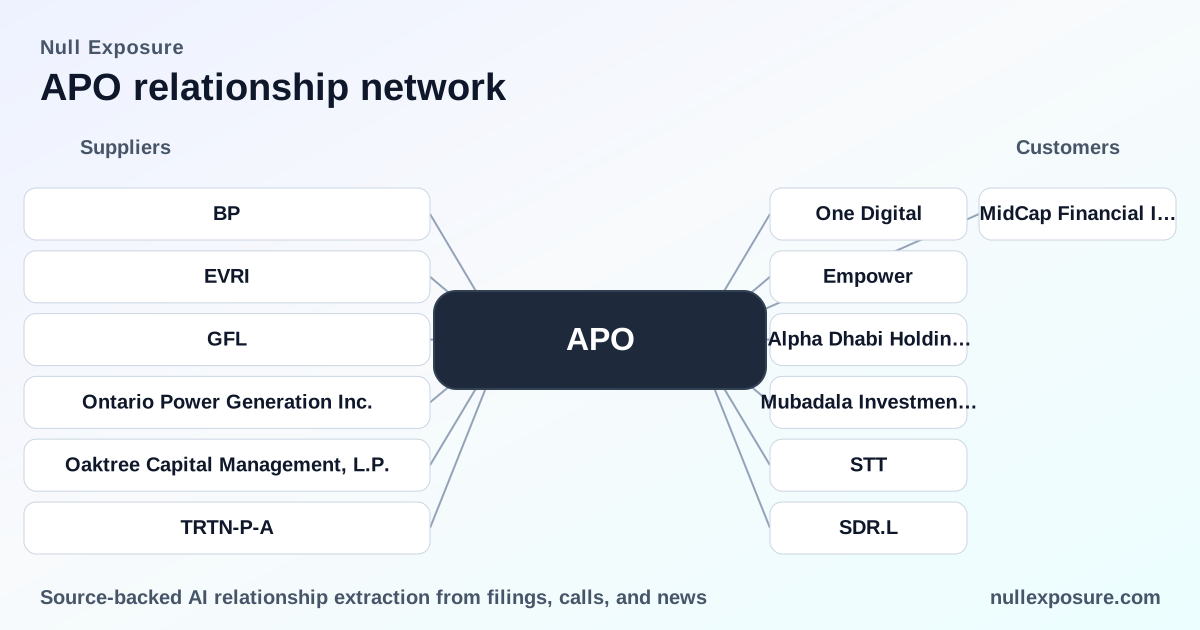
Apollo (APO) customer map: who pays the fees and where value flows
Apollo Global Management operates as a large, diversified alternative asset manager and retirement-services provider that earns management, performance and capital solutions fees by managing pooled funds, separately managed accounts, and bespoke financing transactions across private equity, credit and real estate. Its business model monetizes scale and origination — Apollo sources, underwrites and manages assets (often long-dated) and charges recurring and transaction-based fees, while also using balance-sheet capital to seed or co-invest. For investors, the relevant signal is simple: Apollo is both a fee-for-service manager and a sponsor of capital solutions, and its customer relationships span insurers, financial institutions, listed finance vehicles and corporate borrowers. Learn more at https://nullexposure.com/.
How the customer mix drives revenue and risk
Apollo’s customer roster shows three commercial truths that drive results and downside: scale, structural concentration, and long-duration lock-ins. The firm’s model relies on large institutional mandates and sponsored vehicles that generate recurring management fees and sizable capital solutions fees; that concentration translates to material revenue swings when major partners reallocate capital. Contracting posture is predominantly service-provider — Apollo manages assets for clients and externally-managed vehicles — and many mandates are long-term by design, which supports earnings visibility but increases operational dependence on a small set of counterparties.
- Scale and maturity: Apollo manages hundreds of billions in AUM and conducts global activity with North America as the revenue engine.
- Counterparty breadth: Clients include governments, large enterprises, institutional investors, non-profits and individual high-net-worth channels.
- Role concentration: The firm functions primarily as asset manager and capital arranger; distribution and product-seller activities are secondary.
A mid-article note: for direct access to the research platform referenced here, visit https://nullexposure.com/.
Active partnerships and deal flow: the relationships you need to know
Below I map every named customer/partner found in recent Apollo filings and market coverage. Each entry is a concise, plain-English description with a source citation.
-
Empower — Apollo cited progress with Empower on defined-contribution and 401(k) product initiatives during its 2025 Q4 earnings call, highlighting retirement-services distribution traction. (2025 Q4 earnings call transcript, March 2026)
-
One Digital — Apollo referenced One Digital alongside Empower and State Street as distributors/partners in retirement plan product development on the 2025 Q4 earnings call. (2025 Q4 earnings call transcript, March 2026)
-
ATH-P-E (Athene preferred E) — Media outlets report Apollo will oversee Athene’s investment in Foundation Home Loans contingent on approvals, underscoring Apollo’s asset-management role for Athene-related strategies. (National Mortgage News, FY2021 reporting; coverage March 2026)
-
ARI (Apollo Commercial Real Estate Finance, Inc.) — ARI is an externally managed vehicle that leverages Apollo’s real estate credit origination and underwriting; press releases and market coverage note ARI committed capital and portfolio activity tied to Apollo’s platform. (Globe and Mail / MarketBeat coverage, FY2026)
-
The Real Brokerage Inc. — The Real secured a $550 million financing commitment arranged with Apollo Global Funding, LLC as joint lead arranger and bookrunner for the RE/MAX transaction, highlighting Apollo’s role as arranger for corporate financings. (MileHighCRE coverage, FY2026)
-
AERO (Aeroméxico) — Apollo Global Securities acted as a book-running manager on Aeroméxico’s global offering, indicating participation in underwriting and capital markets execution. (GlobeNewswire/Aeroméxico release, FY2025)
-
PRSD (State Street private-credit ETFs) — Reporting shows Apollo sources private-credit investments and provides liquidity on State Street’s private credit ETF products, tying Apollo’s credit origination to ETF distribution. (The Daily Upside, FY2025–FY2026)
-
ATH-P-A (Athene preferred A) — Multiple releases document Athene’s use of Apollo-managed solutions and portfolio acquisitions from Apollo, confirming a deep strategic asset-management partnership. (GlobeNewswire and related releases, FY2023–FY2026)
-
MFICL (MidCap Financial Investment Corp. - unsecured notes) — Apollo Global Securities acted as a co-manager on MFICL’s unsecured notes offering; filings note MFIC is externally managed by an Apollo affiliate. (FinancialContent / offering documents, FY2023)
-
STT-P-G (State Street target-date/private markets product) — State Street’s target-date platform includes a pooled private-markets vehicle managed by Apollo, signaling distribution partnership in retirement products. (401kSpecialist coverage, FY2025)
-
PDCC (Pearl Diver CLO) — Pearl Diver disclosed its largest CLO manager exposure is Apollo at 11.0%, evidence that Apollo is a material CLO manager for third-party structured-credit investors. (Investing.com coverage, FY2026)
-
ATH-P-D (Athene preferred D) — Public commentary and press releases cite Apollo as Athene’s asset manager and reference Apollo-managed sidecars raising commitments for Athene strategies. (InsuranceNewsNet and Artemis reporting, FY2023–FY2025)
-
MFIC (MidCap Financial Investment Corp.) — Multiple filings and press pieces confirm MidCap is externally managed by Apollo Investment Management, L.P., embedding Apollo operationally in the BDC’s governance and results. (GlobeNewswire / Marketscreener / FY2022–FY2026 filings)
-
Alpha Dhabi Holding PJSC — Alpha Dhabi (and Mubadala) purchased Apollo’s European direct lending portfolio, demonstrating Apollo’s ability to monetize loan portfolios via strategic secondary sales. (SimplyWall.St summary, FY2026)
-
Mubadala Investment Company PJSC — Mubadala joined Alpha Dhabi in acquiring Apollo’s direct-lending assets, reflecting institutional demand for Apollo-originated loans. (SimplyWall.St summary, FY2026)
-
CCO (Clear Channel Outdoor) — Apollo-managed funds committed to invest preferred equity in the Clear Channel transaction, showing participation in sponsor-level equity for media assets. (PR Newswire, FY2026)
-
SDR.L / Schroders — Apollo announced a strategic distribution/partnership with Schroders that management expects to scale into a multibillion-dollar collaboration, illustrating third-party asset-management alliances. (2025 Q4 earnings call, March 2026)
-
Athene Holding (ATH / ATHS) — Public filings and press coverage document Athene as a strategic asset-management client and shareholder relationship, with Athene sourcing annuity liabilities and Apollo managing the matching assets. (Various filings and news, FY2024–FY2026)
-
ADT — ADT’s 2025 proxy notes fees paid to Apollo for debt-related services, an example of corporate advisory and financing services provided to public companies. (ADT SEC proxy filing, FY2026)
-
MidCap Financial Investment Corp. (public coverage) — Independent coverage noted Apollo-managed MidCap cut its dividend, reinforcing the visibility of Apollo’s managerial influence on sponsored vehicles. (SimplyWall.St, FY2026)
-
Elon Musk’s xAI — Reporting in February 2026 indicated Apollo was nearing a multibillion-dollar lending arrangement for leased Nvidia chips to xAI, reflecting Apollo’s role in complex, non-traditional lending deals. (The Information / The Daily Upside, FY2026)
-
PSIG — PSIG’s disclosures list Apollo Investment Management, L.P. as its investment adviser, indicating advisory relationships beyond Apollo’s largest sponsored vehicles. (TradingKey coverage, FY2026)
-
STT / State Street — Apollo’s ETF PRIV with State Street approached $700 million and is a top-performing investment-grade ETF, demonstrating Apollo’s influence in institutional ETF product strategies. (2025 Q4 earnings call, March 2026)
-
O (Realty Income) — Reporting describes a financing partnership where Apollo provided an initial $1 billion investment for a 49% interest in a U.S. retail asset portfolio, showing strategic direct-investment funding. (TradingView / market coverage, FY2026)
-
RE/MAX Holdings — RE/MAX’s acquisition financing included a $550 million facility arranged by Morgan Stanley and Apollo Global Funding, LLC, showcasing Apollo’s role in leveraged deal financing. (MileHighCRE coverage, FY2026)
-
BALY-T (Bally’s notes) — Bally’s financed part of a merger with $500 million of senior secured notes provided by Apollo-managed funds, underscoring Apollo’s placement of credit into corporate M&A financing. (Investing.com coverage, FY2025)
This catalog captures every named relationship from the recent collection of Apollo disclosures and press mentions; sources include Apollo’s 2025 Q4 earnings call and multiple deal and news releases across 2023–2026.
Operational constraints and what they imply for investors
Apollo’s relationship constraints paint a consistent corporate signal: contracts skew long-term, counterparties range from sovereign and institutional to large enterprises and individuals, and the firm operates as a service provider for many externally managed vehicles. Highlights:
- Contracting posture: Long-term mandates are common across retirement services and insurance asset management, creating durable fee streams but also concentration risk if large clients reallocate.
- Counterparty mix: Apollo serves governments, large enterprises, non-profits, and wealthy individuals, reflecting diversified demand but also exposure to institutional flows.
- Criticality & materiality: Certain mandates (notably Athene and other externally-managed vehicles) are material to fees, per company disclosures citing substantial fee revenue from Athene and affiliated vehicles.
- Maturity & scale: Apollo’s global footprint and $700+ billion AUM imply a mature, institutional-scale operating model capable of underwriting complex financings and secondary dispositions.
Bottom line for investors
Apollo’s customer relationships are the engine of its fee and capital-solutions revenues: large, long-duration mandates and sponsored vehicles generate predictable fees but concentrate exposure to a handful of strategic partners. Monitor developments with Athene, State Street products, ARI/MFIC performance and secondary portfolio sales to gauge fee durability and capital redeployment.
For deeper, structured intelligence on these customer relationships and the documents that support them, visit https://nullexposure.com/.