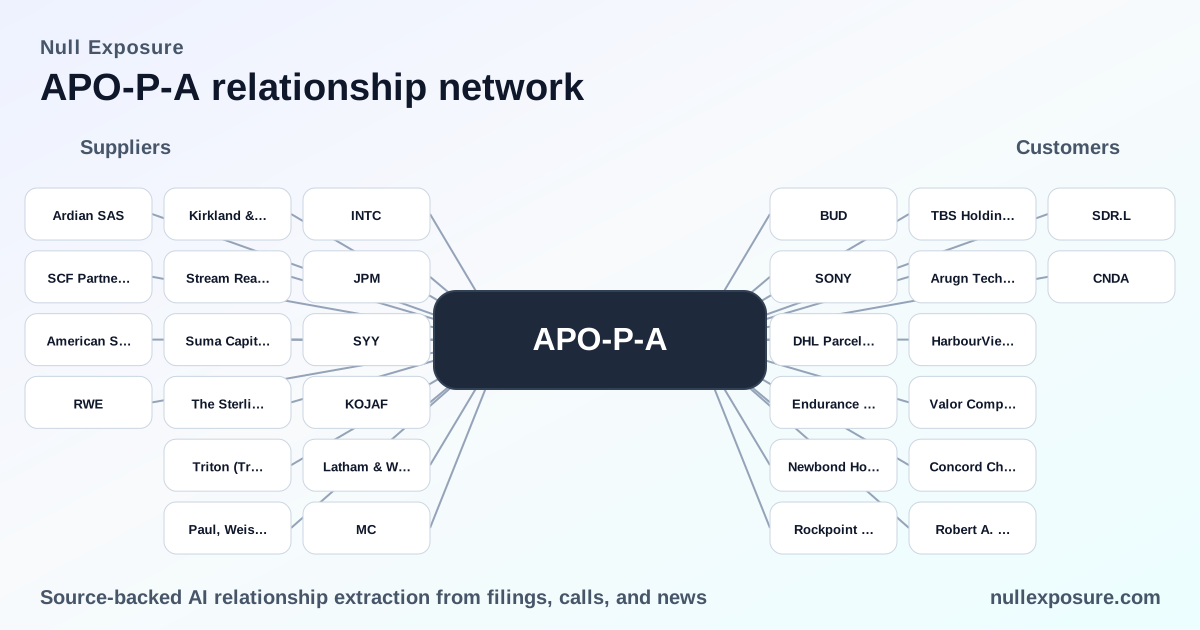
APO-P-A: What Apollo’s customer relationships tell fixed-income investors
Apollo Global Management’s 6.375% Series A preferred shares are a fixed-income instrument backed by the cash-generative franchise of a global alternative asset manager. Apollo monetizes through management fees, performance fees (carry), lending and credit interest, and bespoke capital‑solutions arrangements it structures and syndicates for corporate and sponsor clients; those large, deal‑level engagements are the operational drivers behind the firm’s capital stability and the dividend coverage available to preferred holders. For a concise investor briefing on counterparty exposures and deal flow that affect APO-P-A’s risk profile, see Null Exposure’s research hub: https://nullexposure.com/.
Key takeaway for investors: capital solutions define counterparty exposure
Apollo’s public footprint in FY2024–FY2026 shows a clear tilt toward large, bespoke financing and asset sales: aircraft of capital solutions to corporates and strategic asset rotations to institutional buyers. That business is concentrated, bespoke, and reputationally critical for both Apollo and its counterparties, which amplifies both upside (fee accretion, sticky AUM) and downside (counterparty or deal execution risk) for preferred security holders.
Every customer relationship in the record, and what it means
Below I cover each named counterparty in the aggregated reporting sample and what the connection signals for investors. Each line includes the original reporting source.
-
BUD (ticker BUD) — Anheuser‑Busch InBev acquired the remaining 49.90% stake in the US Metal Container Plants previously owned by an institutional consortium led or advised by Apollo affiliates for approximately $2.9 billion. This is a portfolio exit that crystallizes value for Apollo’s funds and reduces ongoing asset-level exposure (Simply Wall St, March 9, 2026).
-
Anheuser‑Busch InBev SA/NV — The corporate buyer completed the buyout of the remaining metal container business interest from Apollo-led investors in a cash transaction, reflecting Apollo’s use of strategic asset sales to recycle capital (Simply Wall St, March 9, 2026).
-
SONY (Sony Group / Sony Music Group) — Apollo led a $700 million capital solution for Sony Music Group, deploying capital on behalf of affiliated and third‑party insurance clients to support music‑industry investments; that deal illustrates Apollo’s role as a structurer and allocator of large, creative financing (Apollo press release, July 2024).
-
Sony Music Group — Apollo acted as lead investor in the capital package that provides Sony Music Group with balance-sheet flexibility, demonstrating Apollo’s willingness to take structured exposures to media and IP cash flows (Apollo press release, July 2024).
-
Newbond Holdings — Newbond participated in the acquisition of The Westin Tampa Waterside, buying the asset from Apollo for $95 million, signaling normal portfolio rotation activity in Apollo’s real‑asset strategies (Simply Wall St, March 9, 2026).
-
Rockpoint Group, L.L.C. — Rockpoint co‑acquired The Westin Tampa Waterside from Apollo, a transaction that underscores the manager’s propensity to sell stabilized hospitality assets to other institutional real‑estate buyers (Simply Wall St, March 9, 2026).
-
TBS Holdings, Inc. — TBS acquired a minority stake in Legend Pictures from Apollo and Legendary’s leadership, representing a partial exit and third‑party take‑up of an entertainment asset held by Apollo funds (Simply Wall St, March 9, 2026).
-
Valor Compute Infrastructure L.P. — Apollo-managed funds led a $3.5 billion capital solution to back Valor’s $5.4 billion acquisition and lease of compute infrastructure (including high‑end GPUs) to an xAI subsidiary, illustrating Apollo’s participation in large-scale, tech-enabled infrastructure financing (The Globe and Mail, FY2026 reporting).
-
Arugn Technologies Private Limited — Arugn completed acquisition of a minority stake in Planetcast Media Services from an Apollo-managed fund, reflecting Apollo’s selective monetization of media holdings in growth markets (Simply Wall St, March 9, 2026).
-
DHL Parcel UK Limited — DHL agreed to acquire a minority stake in Evri Limited from Apollo, another example of strategic minority exits to trade buyers in logistics and parcel businesses (Simply Wall St, March 9, 2026).
-
Endurance Specialty Insurance Ltd. — Endurance completed the acquisition of Aspen Insurance Holdings from Apollo and partners, highlighting Apollo’s active management of insurance and specialty‑insurance assets via portfolio sales (Simply Wall St, March 9, 2026).
-
Concord Chorus Ltd — Apollo committed debt and minority equity to a bidding vehicle (Concord Chorus) proposing to acquire HSF, underscoring Apollo’s engagement across structured financings and copyrighted‑asset securitizations (Music Business Worldwide, FY2024).
-
HarbourView Equity Partners — HarbourView received backing from Apollo when formed in 2021, indicating Apollo’s strategy of supporting emerging managers and sponsor vehicles as a way to expand access to verticals in music and media (Music Business Worldwide, FY2024).
-
Schroders (SDR.L) — Apollo announced a multi‑channel distribution partnership with Schroders to expand investor flows, signaling the firm’s push to diversify distribution and reduce concentration in any one channel of capital origination (MarketBeat, FY2026 earnings report).
-
Arctic Slope Regional Corp. — Apollo agreed to sell Coinstar to Arctic Slope Regional Corp., evidencing Apollo’s willingness to transact with specialized strategic buyers and community investment vehicles on retail operational assets (Axios, January 2026).
-
Air France‑KLM — Apollo’s capital solutions business has executed jumbo deals including work for Air France‑KLM, demonstrating the unit’s appetite for complex, high‑profile corporate financings that drive fee revenue (CrainCurrency reporting, FY2025).
-
Robert A. Stanger & Co. Inc. — Industry tracker Robert A. Stanger & Co. reported significant fund placement activity that included Apollo, highlighting the scale of Apollo’s fund‑raising and distribution activity through private wealth and alternatives channels (InvestmentNews, FY2025).
-
VVARDIS Holding AG — VVARDIS announced funding from Apollo, showing continued targeted private investments in growth companies in FY2026 (MarketScreener reporting).
-
Vonovia SE — Apollo’s capital‑solutions activity included large agreements tied to companies such as Vonovia SE, underlining the strategic, large‑ticket nature of the unit’s transactional pipeline (CrainCurrency, FY2025).
-
Concord / CNDA — Apollo led a major ABS transaction for Concord in 2022 (about $1.8 billion), illustrating Apollo’s experience packaging intellectual‑property cash flows into securities and its role in securitizing non‑traditional assets (Music Business Worldwide, FY2024).
How Apollo’s operating model shapes counterparty risk (company‑level signals)
Apollo runs a sponsor‑driven, large‑ticket capital‑solutions engine: deals are bespoke, high‑value, and often syndicated to third parties or sold into institutional buyers. That operating posture implies:
- Contracting posture: Transactions are negotiation‑heavy and bespoke; Apollo typically leads structuring and retains partial economic exposure while syndicating risk across funds and strategic partners.
- Concentration: The firm’s revenue and AUM growth are driven by a relatively small number of jumbo deals, which creates episodic concentration risk but also materially higher fee capture per transaction.
- Criticality: For corporate counterparties and asset buyers, Apollo is often a pivotal provider of capital or exit liquidity, which elevates reputational risk and execution importance.
- Maturity: Many relationships are medium‑to‑long term (multi‑year capital solutions, partial exits, and asset rotations), which produces lumpy but durable cash flows that underpin preferred dividend coverage.
Investment implications and risk checklist
- Positive: Apollo’s ability to originate and lead large capital solutions generates high-margin fee income, which supports preferred dividend stability. Deals with strategic corporates (Sony, Air France‑KLM, Anheuser‑Busch) validate institutional demand for Apollo’s structuring capabilities.
- Risks: Concentration in large transactions concentrates execution and counterparty risk; asset disposals (hospitality, insurance, media) are subject to market timing and buyer appetite; syndication and third‑party co‑investors can limit Apollo’s ability to fully control exits.
- Operational watchpoints: Monitor deal cadence, realization proceeds from asset sales, and distribution partnerships (e.g., Schroders) that affect liquidity and fee distribution. For real‑time tracking and deeper counterparty mappings, visit https://nullexposure.com/ for ongoing updates.
Conclusion
For APO‑P‑A holders, the equity and asset‑sale activity documented in FY2024–FY2026 confirms that Apollo’s preferred dividend is materially supported by a capital‑solutions engine that originates large, fee‑rich, and often syndicated transactions. That business model delivers attractive cash flows but concentrates risk in execution and large counterparties; the relationship list above shows both the diversity of sectors Apollo serves and the scale of tickets that drive outcomes for preferred investors.