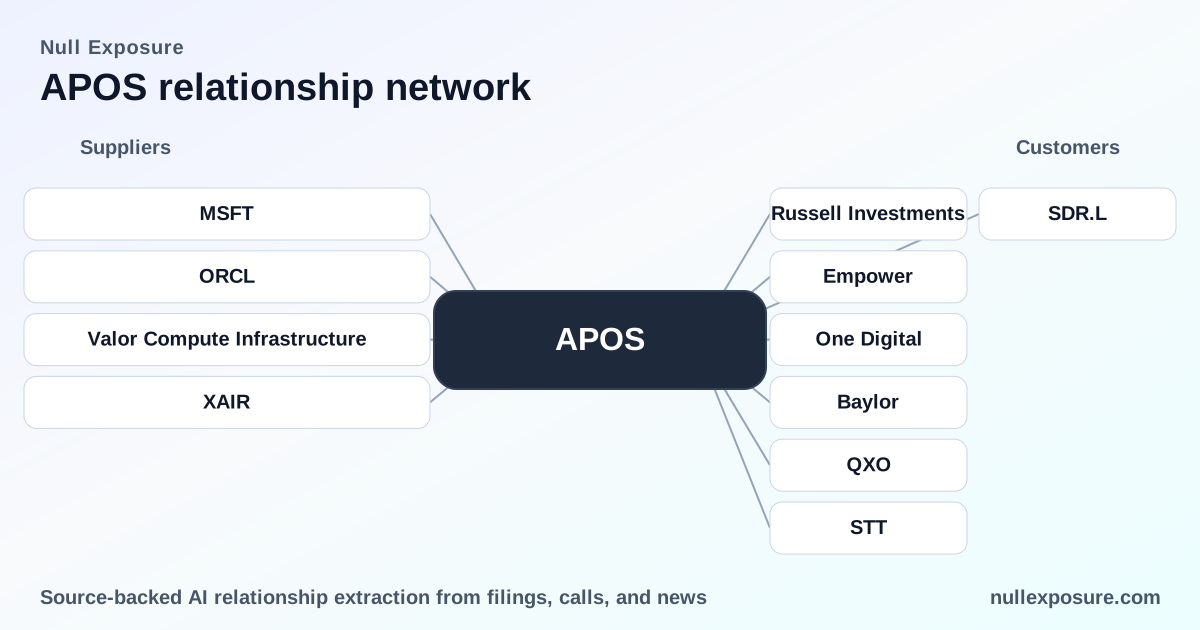
APOS Customer Map: Strategic Financings, Retirement Partnerships, and What Investors Should Price In
Apollo Global Management (ticker: APOS) operates as a global alternative asset manager and retirement services provider that monetizes through management fees, performance fees, strategic financing investments, and ownership of fee-generating assets. Its hybrid credit franchise both originates direct capital solutions and syndicates balance-sheet financings, while retirement and DC/401(k) product initiatives generate recurring, fee-based revenue streams tied to institutional and retail distribution. For investors evaluating customer relationships, Apollo’s 2025 Q4 disclosures and recent market reports show a mix of large, active capital-provider roles and distribution partnerships that collectively strengthen fee diversity and raise concentration and liquidity considerations. For a concise corporate intelligence briefing, visit https://nullexposure.com/.
How these relationships shape Apollo’s operating profile
Apollo’s customer map in late 2025 demonstrates a dual business model: credit and principal investments that take direct balance-sheet positions, and services/distribution relationships that produce recurring fees. Key operating characteristics emerge from public disclosures and the firm’s presentations:
- Contracting posture: A blend of long-duration capital vehicles (including perpetual public equity vehicles) alongside subscription-based limited partnership funds that accept monthly subscriptions — this creates both durable capital and subscription liquidity exposure.
- Counterparty mix and concentration: Institutional investors — including sovereign and public pension funds — sit alongside high-net-worth and individual investors, and large enterprise customers; revenue generation is concentrated materially in North America while operations remain global.
- Role and criticality: Apollo predominantly acts as a service provider (investment management, sub-advisory and operational support) while also acting as a direct capital provider on bespoke financings; these roles are active and core to fee realization.
- Maturity and product segmentation: Mature perpetual vehicles and established credit strategies coexist with growth segments such as infrastructure and retirement services, providing both fee stability and active capital deployment opportunities.
These characteristics combine to create diversified fee channels but also sensitivity to subscription liquidity dynamics and U.S. market concentration.
What the 2025 Q4 call and recent reports disclosed — relationship by relationship
Russell Investments
Apollo’s hybrid and credit franchise provided a $1.2 billion strategic financing to Russell Investments to back expansion and improve balance-sheet flexibility. This transaction underscores Apollo’s role as a large-scale capital partner in the investment-management ecosystem. Source: Apollo 2025 Q4 earnings call (March 8, 2026).
Baylor
In December Apollo led a $3.5 billion capital solution to support Baylor’s $5.4 billion acquisition and the lease of data center infrastructure to a subsidiary of XAI, signaling Apollo’s appetite for complex infrastructure financing tied to digital assets. Source: Apollo 2025 Q4 earnings call (March 8, 2026).
One Digital
Apollo reported progress in its defined-contribution and 401(k) product initiatives in conjunction with distribution partners, including One Digital as an active distribution channel for retirement products. This reflects growth in retirement-services distribution rather than a one-off capital investment. Source: Apollo 2025 Q4 earnings call (March 8, 2026).
Empower
Empower is named alongside other distribution partners where Apollo is advancing DC and 401(k) offerings, indicating ongoing commercialization and partnership-led distribution for retirement products. Source: Apollo 2025 Q4 earnings call (March 8, 2026).
QXO (Brad Jacobs–led building products distributor)
Apollo led a $3 billion convertible preferred financing for QXO in January, demonstrating the firm’s use of structured equity-like instruments to take meaningful positions in operating companies. Source: Apollo 2025 Q4 earnings call (March 8, 2026).
State Street (STT)
Apollo’s ETF partnership with State Street — the PRIV ETF — approached $700 million in assets, indicating traction in passive/ETF distribution partnerships and a tangible fee-generating asset under management. Source: Apollo 2025 Q4 earnings call (March 8, 2026).
STT (duplicate listing of State Street)
The call also records State Street (STT) explicitly as the ETF partner for PRIV, reinforcing the commercial relationship with a large custodial and ETF platform provider. Source: Apollo 2025 Q4 earnings call (March 8, 2026).
VVARDIS Holding AG
MarketScreener reported that VVARDIS Holding AG received funding from Apollo, reflecting continued direct-investment activity and selective equity financing into European industrial firms during FY2026. Source: MarketScreener report (Apr. 27, 2026).
SDR.L
Apollo referenced an announcement with Schroders (SDR.L) that the company expects to scale into a multibillion-dollar partnership, signaling a strategic distribution or product-alignment initiative with a traditional asset manager. Source: Apollo 2025 Q4 earnings call (March 8, 2026).
Schroders
Schroders is named explicitly in the call as a partner whose cooperation is projected to grow into a multibillion-dollar relationship, underscoring Apollo’s push to extend its asset-management footprint through alliances with established global managers. Source: Apollo 2025 Q4 earnings call (March 8, 2026).
What investors should take away — risks and value drivers
- Value drivers: Apollo’s dual model — direct capital solutions (e.g., QXO, Baylor, Russell) plus distribution/fee relationships (State Street, Empower, One Digital, Schroders) — creates diversified revenue channels and improves margin stability through recurring fees and balance-sheet income.
- Execution risks: Subscription-style fund structures introduce liquidity-management considerations, and U.S.-centric revenue generation creates geographic concentration risk even as the firm pursues global partnerships.
- Counterparty and concentration profile: The client base spans government entities, large enterprises, non-profits, and individuals; this broad mix reduces single-segment dependency but retains sensitivity to institutional flows.
- Operational posture: Apollo acts primarily as an active service provider and capital originator, making operational execution and risk management central to realizing stated fee potential.
If you want a concise intelligence pack linking these relationship disclosures to contract and counterparty risk frameworks, visit https://nullexposure.com/ for a tailored briefing.
Bottom line
Apollo’s disclosed customer relationships in late 2025 illustrate a deliberate strategy: deploy balance-sheet and hybrid credit solutions where returns justify concentration, while building recurring-fee businesses via distribution partnerships and ETFs. That combination supports durable earnings potential but requires investors to price in subscription liquidity dynamics and U.S. revenue concentration. For active investors, the most immediate signals are the scale of direct financings and the traction of partnerships with large distributors — both of which materially influence APOS’s near-term cash generation and strategic optionality.