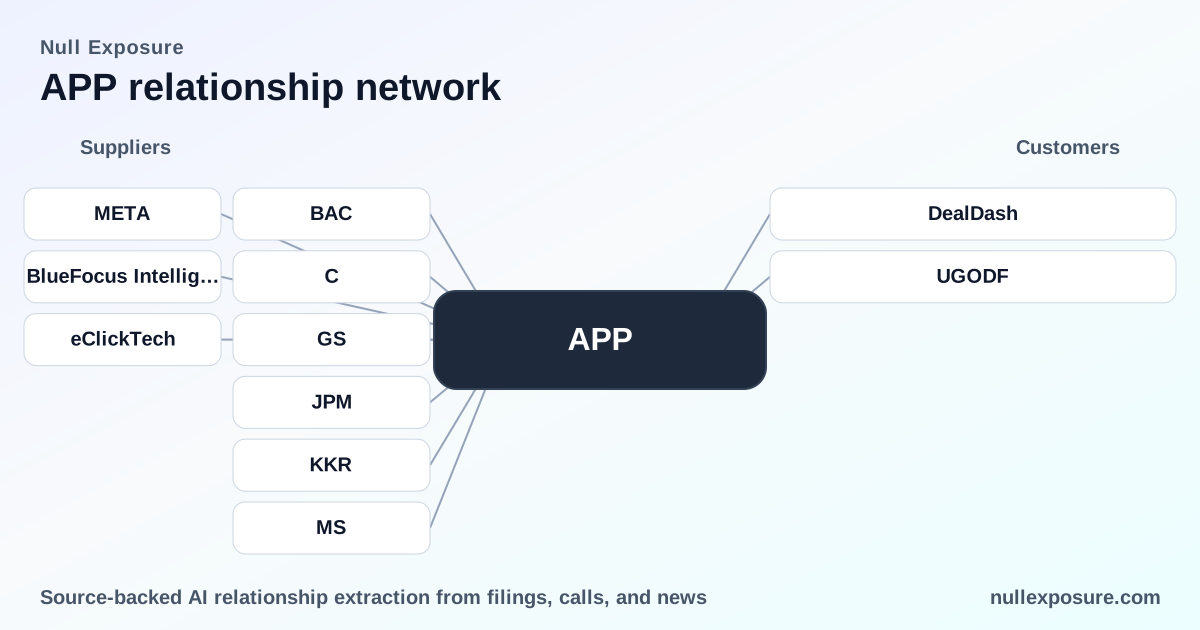
AppLovin (APP) — Customer Relationships and Commercial Posture
AppLovin operates a vertically integrated mobile advertising and app ecosystem that monetizes through a mix of advertising take-rates, usage-based content deals, and SaaS subscriptions, while also extracting economics from owned apps via in‑app purchases. The company's core revenue drivers are its AppDiscovery advertising platform and MAX mediation, complemented by Adjust (annual software subscriptions) and Wurl (usage-based content distribution), giving AppLovin a diversified yet advertising‑heavy monetization stack. For a deeper look at the platform and signals from customer interactions, visit https://nullexposure.com/.
Why customer relationships matter for valuation and risk
AppLovin’s model leans operationally toward short-term, usage-driven commercial arrangements, which creates quick revenue elasticity with advertising cycles but limited stickiness from long-term contracts. The company reported that advertising represented 68% of total revenue in the most recent period, making advertiser behavior the primary driver of top-line volatility. At the same time, no single customer contributed 10% or more of revenue historically, which reduces customer concentration risk while increasing the importance of scale and retention across a very large client base.
- Contracting posture: Advertising agreements are executed quickly and are generally cancellable on short notice, which incentivizes continuous performance optimization but lowers contractual protection.
- Revenue mechanics: AppLovin collects fees as a percentage of ad spend, charges usage-based fees for content distribution, and earns recurring subscription revenue from Adjust—creating a mixed but ad‑dominant revenue profile.
- Counterparty mix and geography: Customers span individuals, small businesses, large enterprises and very large internet platforms, with 43% of revenue from outside the U.S.—a global footprint that supports growth but amplifies macro and regulatory exposures.
- Materiality and maturity: Advertising is the core, mature revenue segment, while Adjust and Wurl provide higher-margin, more predictable software and content revenue streams.
Customer and partner relationships: what the market has reported
Below I cover every customer or partner relationship referenced in the collected results, summarizing the relationship and its public source.
DSP — CTV reach through Wurl integration
AppLovin has integrated IRIS_ID with Wurl, extending identity and advertising reach into connected TV; Wurl powers over 3,000 FAST channels across 55+ streaming services, which materially expands IRIS_ID’s addressable CTV inventory. This integration was disclosed on an earnings call covering 2025 Q2. According to the DSP earnings call (2025 Q2), the Wurl integration scales IRIS_ID's reach across a large FAST channel footprint.
DealDash — scaled UA with AppDiscovery
DealDash used AppLovin’s AppDiscovery to double its digital user acquisition volume while reducing costs by running Cost‑Per‑Purchase campaigns targeted to high‑value users. This client example highlights how advertisers use AppDiscovery to scale efficient installs; the relationship was described in an industry analysis of AppLovin’s AI and advertising strategy (FY2025) published by Klover.ai.
Stagwell — agency partnership on mobile advertising
Stagwell entered a partnership with AppLovin’s mobile advertising platform to utilize AppLovin’s demand and targeting capabilities for client campaigns. TradingKey reported the Stagwell partnership in March 2026, indicating AppLovin’s role as a platform partner to large marketing groups in FY2026.
JOYY / BIGO Ads — network traffic via MAX mediation
BIGO Ads significantly scaled its third‑party audience traffic through integrations with AppLovin MAX (and Unity LevelPlay), demonstrating that large publisher networks route program inventory through MAX to increase yield and audience reach. JOYY’s Q2 2025 financial release (PR Newswire) referenced these MAX integrations and the resulting traffic gains for BIGO Ads.
Upside (UGODF) — heavy install share from AppDiscovery
Upside scaled ad spend by 20x while keeping efficiency intact, with AppDiscovery accounting for 40% of total install volume for the cashback app. That case study, cited in Klover.ai’s FY2025 analysis, underscores AppDiscovery’s capacity to become a dominant acquisition channel for select apps.
What these relationships collectively signal for operators and investors
Taken together, these partner and client examples show AppLovin operates as both an ad seller (to advertisers) and a service provider (to publishers and agencies). The mix of use cases—direct advertiser acquisition (DealDash, Upside), agency partnerships (Stagwell), mediation/inventory routing (BIGO Ads), and CTV identity/content reach (Wurl via DSP)—reveals a platform that is:
- Highly transactional and performance-oriented, where client spend flows to the platform when ROI is demonstrable.
- Distributed across many counterparty types and geographies, mitigating single‑client concentration but increasing dependency on aggregate market demand.
- Mixed-revenue with a dominant advertising component—advertising is both the growth engine and the principal risk if digital ad spend retracts.
Operational constraints that affect customer economics
Company disclosures make clear the commercial constraints that shape customer behavior and lifetime value:
- Short-term, cancellable ad contracts drive fast revenue feedback loops but limited contractual revenue visibility; the company notes agreements can be executed in a day and terminated with two days’ notice.
- Usage-based monetization for content and mediation aligns AppLovin’s incentives with publisher and advertiser spend patterns; Wurl and MAX revenue are tied to consumption and ad budgets rather than long-term fixed fees.
- A material dependence on advertising (68% of revenue) creates cyclicality; software/subscription (Adjust) provides diversification but is a smaller share.
- Low customer concentration—no single customer exceeded 10% of revenue—signals resilience to buyer-specific shocks while reinforcing the need for scale economics.
These constraints translate into a go‑to-market that prioritizes performance, rapid onboarding, and global scale, rather than long-term, capital‑intensive contracts.
Investment takeaway and tactical considerations
AppLovin’s customer footprint demonstrates a platform that wins by scale, AI optimization, and breadth of ad inventory. For investors and operators, the critical signals are: high operating leverage to ad spend, contractual fluidity that amplifies revenue cyclicality, and diversification across client sizes and geographies that reduces single‑counterparty risk but requires sustained aggregate demand.
- Upside: Rapid monetization when ad demand is strong; Adjust and Wurl add margin diversification.
- Risk: Revenue sensitivity to ad budgets and the short-term cancellable contract structure.
- Execution focus: Retaining advertiser ROI and expanding inventory (CTV via Wurl) are the levers to protect margins and stabilize churn.
For a strategic vendor and investor playbook on how to evaluate platform partners and customer signals, consult additional analysis at https://nullexposure.com/.
Bold conclusion: AppLovin is a high‑growth advertising platform whose customer relationships are broad and transactional—growth comes from scale and performance, while downside concentrates in ad‑market cyclicality and contract cancellability.