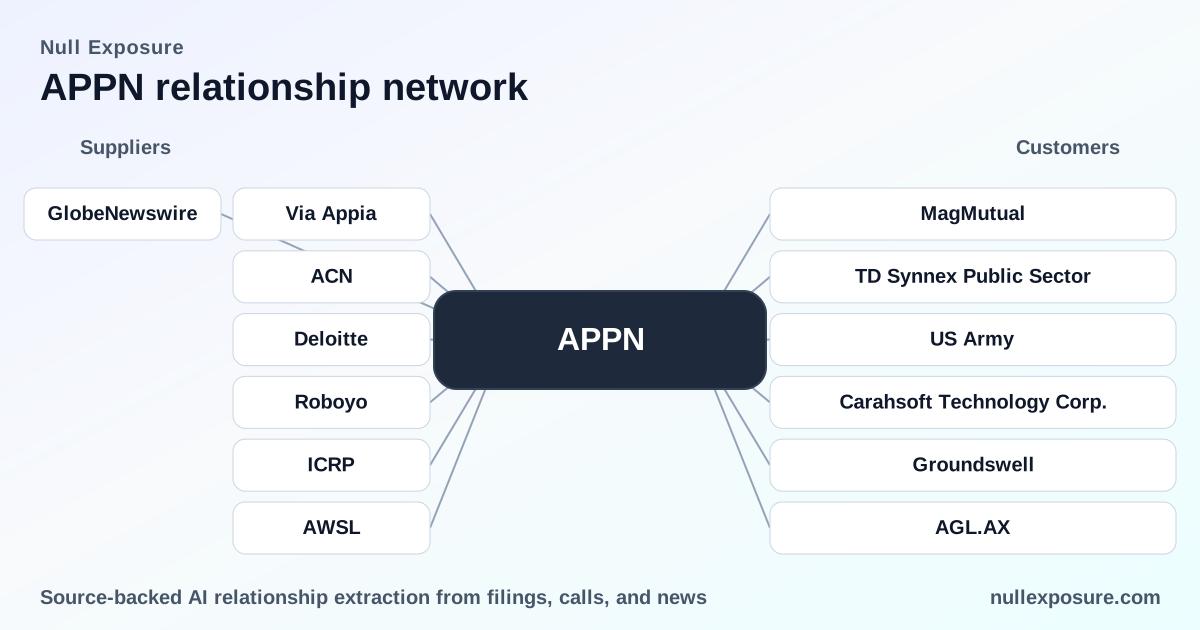
Appian’s Customer Map: Government scale, enterprise reach, and channel amplification
Appian (APPN) sells a low‑code automation platform primarily as subscription software to large enterprises and government agencies, and supplements recurring revenue with professional services and channel-led procurement. The company monetizes through advance‑billed subscriptions (annual, quarterly or monthly), high renewal economics, and partner distribution for large public‑sector deals — a model that creates durable revenue but concentrates exposure to a handful of large buyers and government channels. Explore the underlying customer evidence and relationship footprint at https://nullexposure.com/.
How Appian’s customer model actually works (and why it matters to investors)
Appian’s operating model is subscription-first: company filings show most revenue derives from subscriptions that are billed in advance and renewed at high rates, producing predictable cash flows and significant switching friction because applications built on the platform run only while subscriptions remain active. The firm targets large enterprises (organizations with >2,000 employees and >$2bn revenue) and operates globally from a cloud platform with data residency across multiple countries. At the same time, government customers represent a material revenue pool (federal agencies accounted for roughly 24% of revenue in 2024), creating both revenue stability and procurement concentration risk. Company disclosures also show an average cloud subscription gross revenue renewal rate of 98% over the last three completed fiscal years — a key indicator of customer stickiness and contract maturity.
- Contract posture: subscription contracts billed in advance, driving upfront cash collection.
- Concentration: no single customer >10% of revenue, but government as a group is material.
- Criticality: platform lock‑in for built applications increases switching costs.
- Maturity: high renewal rates indicate an established recurring base.
- Geography and segment: global footprint, enterprise and government focus; professional services complement software sales.
The customer relationships you need to know about
Below I walk through every named relationship surfaced in the coverage set. Each entry is a concise investor‑grade summary with the original reporting source.
US Army — enterprise agreement to scale defense spend
Appian signed an Enterprise Agreement with the US Army allowing up to $500 million of software and cloud purchases over 10 years and secured conditional authorization for its Appian Defense Cloud, positioning Appian as a strategic vendor for large defense automation projects. This development was reported in industry coverage in FY2026 and summarized in multiple filings and press recaps (SahmCapital, Jan 2026; StockTitan filings, Jan 2026).
Source: SahmCapital report on the $500M Army agreement (FY2026); StockTitan coverage of related filings (Jan 2026).
Carahsoft Technology Corp. — channel partner on DoD blanket purchase agreements
Carahsoft was named as one of three partners awarded multiple‑award BPAs for Appian products through the Department of Defense Enterprise Software Initiative, enabling federal procurement at scale through an established government reseller. The PR Newswire release covering the DoD ESI awards was published in FY2024.
Source: PR Newswire dispatch on DoD ESI awards (FY2024).
Groundswell — government channel for Appian products
Groundswell was also selected as a BPA awardee under the DoD Enterprise Software Initiative, reinforcing Appian’s strategy of using specialized channel partners to penetrate complex federal procurement environments.
Source: PR Newswire dispatch on DoD ESI awards (FY2024).
TD Synnex Public Sector — strategic reseller for public‑sector deals
TD Synnex Public Sector completed the trio of channel partners awarded DoD BPAs for Appian, providing broad distribution and procurement capability across government buyers that require reseller relationships for contracting and maintenance.
Source: PR Newswire dispatch on DoD ESI awards (FY2024).
MagMutual — commercial insurance operations modernization
MagMutual announced operational transformation efforts with Appian, using the platform to modernize insurance workflows and drive efficiency gains in underwriting and claims operations, according to Appian’s Q3 2025 results and related press commentary.
Source: GlobeNewswire / Appian Q3 2025 financial results press release (reported Nov 2025) and related press coverage.
Acclaim Autism — AI + low‑code deployment for social services
Acclaim Autism described Appian’s Agent Studio as an innovation ally that enabled faster clinician‑patient matching and reduced administrative friction by uploading existing processes into the agent knowledge base, exemplifying Appian’s traction in mission‑oriented healthcare and human services automation (FY2025 coverage).
Source: SahmCapital coverage of Appian’s AI capabilities launch (Nov 2025).
AGL Energy (AGL.AX) — retail operations modernization in Australia
AGL Energy public communications highlight the deployment of Appian to revolutionize retail operations, a reference case that underscores Appian’s international enterprise footprint and its ability to tackle complex, customer‑facing process flows in energy markets (FY2025 reporting).
Source: GlobeNewswire / Appian fourth quarter and full‑year 2024 results (Feb 2025).
CIB (Bancolombia case reference) — banking automation and document processing gains
Bancolombia’s implementation demonstrates Appian’s capability in banking: executives reported consolidating fragmented architecture and deploying Appian with AI and RPA features to reduce manual document processing time by roughly 70%, illustrating material operational uplift in financial services (FY2026 coverage).
Source: SiliconANGLE article covering AppianWorld and Bancolombia’s automation results (Apr 29, 2026).
ODV / Osisko Development mention — financing and corporate facility linkage
A financing report about Osisko Development referenced an existing US$450 million Appian facility, indicating Appian’s role in broader corporate finance structures and demonstrating that Appian’s financing or customer arrangements can be referenced in third‑party capital transactions (FY2026 briefing).
Source: SimplyWall.ST summary of Osisko Development financing (FY2026 coverage).
What this relationship map signals for investors
- Revenue durability: subscription billing in advance and a 98% cloud renewal rate drive predictable recurring revenue and strong retention economics. Company filings support this as a structural advantage.
- Government concentration risk: while no single customer exceeded 10% of revenue, government agencies collectively generate a material share (~24% federal in 2024), so procurement cycles and award timing materially influence near‑term revenue recognition.
- Channel leverage: awarding BPAs to Carahsoft, Groundswell and TD Synnex accelerates DoD penetration and reduces Appian’s direct sales friction into federal accounts.
- Global enterprise validation: cases with AGL, Bancolombia, MagMutual and Acclaim Autism confirm cross‑industry use cases, from energy and banking to insurance and social services.
- Operational lock‑in: apps usable only on Appian create switching costs that underpin renewals but also concentrate execution risk if product performance or pricing misaligns with large buyers.
If you want a consolidated investor view that integrates relationship signals with contract and renewal metrics, visit https://nullexposure.com/ for the complete mapping and source rollups.
Bottom line
Appian’s revenue model is subscription‑centered, partner‑amplified, and government‑weighted. The relationship set demonstrates both the upside of enterprise and public‑sector scale deals (Army Enterprise Agreement, DoD BPAs) and the exposure investors should watch (government procurement cycles and a concentrated but durable revenue base). For active diligence, focus on contracting cadence in federal procurement and renewal trajectory across the large enterprise cohort — those two dynamics will drive near‑term revenue volatility and longer‑term compound growth.