Digital Turbine (APPS): a concise investor primer on customer relationships
Digital Turbine operates as a commercial bridge between device manufacturers, mobile carriers, app developers, and advertisers—installing and monetizing app discovery and ad placements on mobile devices while operating a programmatic marketplace. The company earns revenue through a mix of short-term campaign fees, usage-based marketplace take-rates, licensing/subscription agreements with carriers and OEMs, and revenue share arrangements with publishers. For investors assessing customer risk and revenue durability, the relationship set combines diversified volume exposure with contract structures that skew short-term and usage-sensitive. Learn more at https://nullexposure.com/.
What the relationship map tells you about where value comes from
Digital Turbine’s commercial footprint splits into two operational modes: On-Device Solutions (ODS) that place apps and content on supplier devices and the AGP marketplace that clears programmatic advertising. ODS drives direct OEM and carrier relationships and tends to be delivered via licensing and placement deals; AGP delivers usage-based, impression-billed revenue and revenue shares with publishers. That combination produces recurring flows but with campaign seasonality and sensitivity to advertising spend.
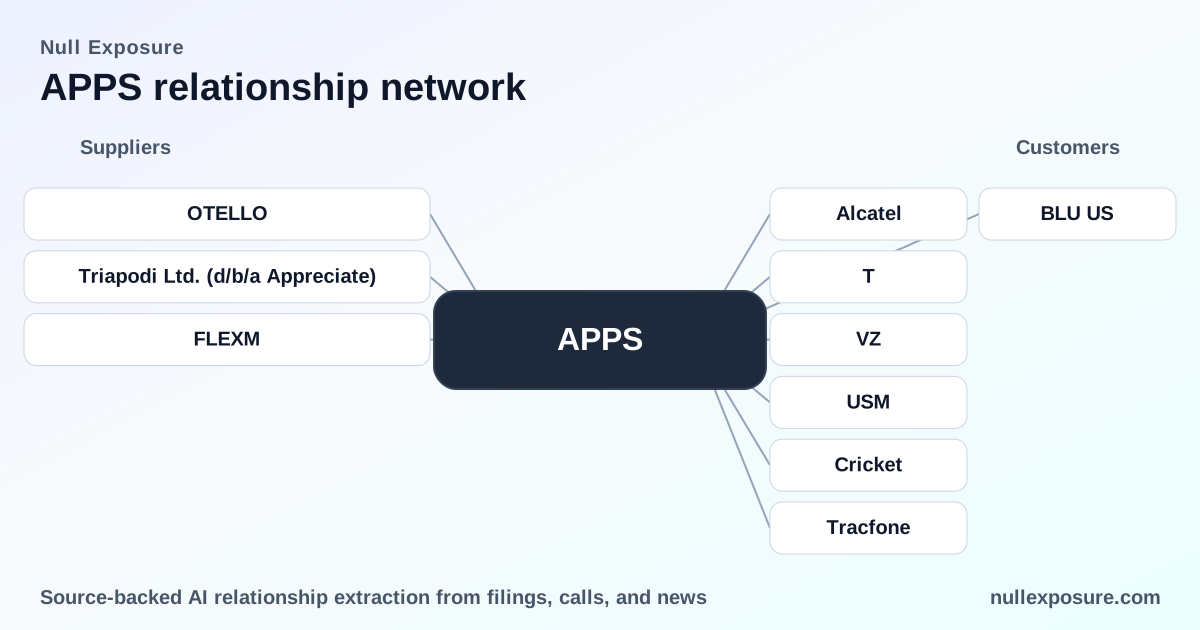
Below I walk through every relationship flagged in the source set and what each means to operators and investors.
Alcatel — StockTwits coverage (FY2025)
Digital Turbine announced a partnership with Alcatel to help deliver “seamless, personalized experiences” for Alcatel’s new smartphone launches in India, positioning Digital Turbine as a distribution and discovery partner on Alcatel devices. Source: StockTwits news article, March 9, 2026 — https://stocktwits.com/news-articles/markets/equity/digital-turbine-retail-chatter-spikes-as-stock-plunges/chm4TAtRRdo.
Alcatel — PR Newswire India release (FY2025)
A PR Newswire India release confirms Digital Turbine’s exclusive partnership with Alcatel announced in June 2025 and highlights the company’s push to scale its brand and agency business in India. This underscores direct OEM distribution relationships that support regional expansion in APAC. Source: PR Newswire India, company release (first seen March 9, 2026) — https://www.prnewswire.com/in/news-releases/digital-turbine-accelerates-growth-in-india-with-new-leadership-team-302555797.html.
ATT — PR Newswire (FY2023)
A PR Newswire announcement tied to Digital Turbine’s investment in Aptoide notes that GamesHub (a joint venture with Aptoide) is the platform of choice for major U.S. operators and lists carriers including ATT among strategic partners, reinforcing carrier distribution for the GamesHub storefront. Source: PR Newswire release about Aptoide funding (first seen March 9, 2026) — https://www.prnewswire.com/news-releases/aptoide-secures-8-5-million-investment-from-digital-turbine-strengthening-strategic-partnership-301982131.html.
Verizon — PR Newswire (FY2023)
The same PR Newswire release lists Verizon as a partner using the GamesHub platform, signaling that Digital Turbine’s storefront and publisher monetization reach includes one of the largest U.S. carrier ecosystems. Source: PR Newswire, Aptoide partnership release (first seen March 9, 2026) — https://www.prnewswire.com/news-releases/aptoide-secures-8-5-million-investment-from-digital-turbine-strengthening-strategic-partnership-301982131.html.
T (AT&T) — PR Newswire (FY2023)
A duplicate record captures AT&T (listed as T) again in the Aptoide/GamesHub release; that repetition reinforces the company’s narrative that GamesHub targets availability on 80–100 million U.S. devices through carrier partnerships. Source: PR Newswire, Aptoide release (first seen March 9, 2026) — https://www.prnewswire.com/news-releases/aptoide-secures-8-5-million-investment-from-digital-turbine-strengthening-strategic-partnership-301982131.html.
USCellular — PR Newswire (FY2023)
USCellular is named among the regional carriers participating in GamesHub distribution, adding mid-tier U.S. operator coverage to Digital Turbine’s channel strategy and broadening device reach. Source: PR Newswire, Aptoide release (first seen March 9, 2026) — https://www.prnewswire.com/news-releases/aptoide-secures-8-5-million-investment-from-digital-turbine-strengthening-strategic-partnership-301982131.html.
Cricket — PR Newswire (FY2023)
Cricket is called out in the same release as a carrier partner for GamesHub, indicating that Digital Turbine’s channel strategy includes prepaid and value-tier carriers that extend penetration into different consumer segments. Source: PR Newswire, Aptoide release (first seen March 9, 2026) — https://www.prnewswire.com/news-releases/aptoide-secures-8-5-million-investment-from-digital-turbine-strengthening-strategic-partnership-301982131.html.
Tracfone — PR Newswire (FY2023)
Tracfone is listed among carriers leveraging GamesHub and related deployments, which helps secure distribution on large, aggregated subscriber bases that often source devices through MVNO relationships. Source: PR Newswire, Aptoide release (first seen March 9, 2026) — https://www.prnewswire.com/news-releases/aptoide-secures-8-5-million-investment-from-digital-turbine-strengthening-strategic-partnership-301982131.html.
BLU US — PR Newswire (FY2023)
BLU US appears as a partner in the PR Newswire announcement, reflecting Digital Turbine’s OEM and channel angle into lower-cost device segments popular in the U.S. market. Source: PR Newswire, Aptoide release (first seen March 9, 2026) — https://www.prnewswire.com/news-releases/aptoide-secures-8-5-million-investment-from-digital-turbine-strengthening-strategic-partnership-301982131.html.
You can review a consolidated view of these relationship signals and commercial implications at https://nullexposure.com/.
Operating constraints and what they imply for revenue durability
The textual evidence in company disclosures and press coverage highlights operational patterns that define revenue behavior:
- Contracting posture is mixed but leans short-term for campaign-related business. Insertion orders specify campaign budgets and timelines and the company states that customer contracts for advertising campaigns are generally less than one year.
- There are subscription and licensing relationships as well. The company references SaaS agreements and licensing contracts with major carriers, indicating pockets of higher-duration, recurring revenue in addition to campaign work.
- Significant usage-based economics exist in the marketplace segment. AGP marketplace revenue is billed on impressions and bids, which ties revenue directly to advertiser spend and auction volumes.
- Geographic revenue distribution is broad and material. Reported results allocate meaningful revenue to APAC, EMEA, LATAM and North America, supporting a globally diversified footprint but also exposure to regional ad cycles.
- Customer concentration is low. The company states no single customer accounted for more than 10% of net revenue in recent fiscal years, which is a structural positive for revenue concentration risk.
- Roles are dual: Digital Turbine acts as both a buyer/intermediary for advertisers and a seller/platform operator to publishers and OEM/carrier partners. That duality creates both channel control and counterparty complexity.
- Business segments are mature in services (ODS) and developing in software/marketplace (AGP). ODS is the established distribution engine; AGP introduces programmatic scale but is more usage-sensitive.
Investment implications — what to watch next
- Revenue exposure is diversified by customer and geography, but much of the advertising revenue is short-term and tied to spend cycles; monitor ad demand and device OEM inventory flows.
- Marketplace take-rates and impression volumes drive margin leverage; watch AGP metrics and publisher revenue share dynamics disclosed in earnings commentary.
- Carrier and OEM partnerships provide distribution scale but are not singularly material per the company’s >10% disclosure; contract renewals and new OEM deals (for example, the Alcatel partnership in India) are the main routes to growth.
- Digital Turbine reported trailing twelve-month revenue of $541.9M and gross profit of $259.4M, demonstrating meaningful scale; profitability and cash flow will be sensitive to advertising cycles and campaign seasonality.
For a practical next step, review the relationship details above alongside the company’s quarterly commentary and investor materials at https://nullexposure.com/.
Conclusion: Digital Turbine’s customer relationships combine distribution agreements with carriers and OEMs plus a programmatic marketplace that ties revenue to usage. That hybrid model produces diversified reach with short-term revenue sensitivity—an attractive setup for scale if AGP impression growth sustainably outpaces ad-market volatility. Investors should prioritize cadence in carrier/OEM deal announcements, AGP volume growth, and commentary around licensing versus campaign revenue mix.