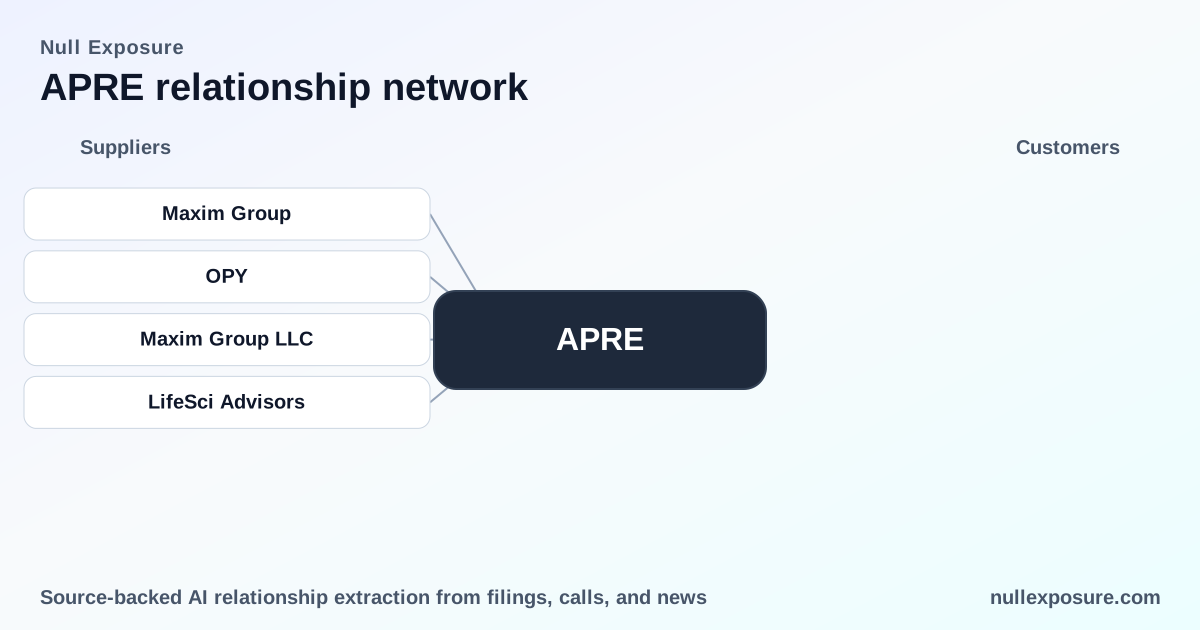
Aprea Therapeutics (APRE): Investor view on recent capital relationships and what they mean for commercialization risk
Aprea Therapeutics is a clinical-stage oncology company that develops small-molecule therapeutics that reactivate mutant p53 and retains worldwide development and commercialization rights to its pipeline. The company monetizes by advancing candidates through clinical proof-of-concept and then capturing value via product sales, partnerships, or licensing — but today its economics are driven almost entirely by financing events and investor support rather than commercial revenue. Recent fundraising activity and the profile of new investors materially change APRE’s capital runway and governance dynamics. For more on counterparty intelligence and relationship signals, visit https://nullexposure.com/.
The short thesis for investors
Aprea is a small-cap, clinical-stage biotech with limited current revenue (Revenue TTM: $285k) and heavily negative operating metrics; value realization hinges on clinical progress and continued access to capital. The March 2026 private placement that closed oversubscribed provides near-term funding but increases investor concentration and shifts the company’s stakeholder mix toward institutional private investors. This is a financing-dependent business model: product commercialization is the objective, but funding and regulatory constraints shape near-term valuation and operational choices.
Who led the financing and who joined — the roster investors
Aprea announced an oversubscribed $30 million private placement on March 30, 2026. The financing was led by Soleus Capital with participation from Vestal Point Capital and Squadron Capital Management, alongside existing investors and insiders. According to the company press release, this group provided the financing that underpins APRE’s near-term plan (GlobeNewswire, March 30, 2026).
- Soleus Capital — Soleus led the $30 million private placement, providing the principal external financing anchor for the transaction and signaling willingness to lead governance and capital formation rounds. (GlobeNewswire press release, March 30, 2026.)
- Squadron Capital Management — Squadron participated as a new institutional investor in the private placement, adding credible institutional capital to the financing syndicate. (GlobeNewswire press release, March 30, 2026.)
- Vestal Point Capital — Vestal Point joined the syndicate as another new investor, supplementing the placement and diversifying the institutional investor base backing APRE. (GlobeNewswire press release, March 30, 2026.)
These three names are the full set of new investors disclosed in the announcement; the company also noted participation from existing investors and certain insiders in the same release (GlobeNewswire, March 30, 2026).
If you want a structured view of these relationships and how they map to counterparty risk, our platform offers consolidated profiles and document-level evidence at https://nullexposure.com/.
What these relationships imply for APRE’s operating model
The financing roster and the company’s own disclosures produce a coherent picture of APRE’s business constraints and contracting posture:
- Contracting posture — seller and financing-dependent: Company disclosures emphasize that future arrangements with healthcare providers, payors and distributors will be tightly regulated and that APRE will act as a seller when products are commercialized. For now, APRE’s role is primarily that of a developer and capital seeker; the March 2026 private placement is a textbook example of external capital substituting for product cash flow (company filings; company press release, 2026).
- Geographic posture — global rights and obligations: Aprea retains worldwide development and commercialization rights for its candidates, which positions the company for global market opportunity but also exposes it to a wide set of regulatory and pricing regimes (company filings).
- Business segment focus — core product concentration: APRE is singularly focused on synthetic lethality-based cancer therapeutics targeting DNA damage response pathways. That concentration is a classic biotech concentrated-risk profile: binary clinical outcomes drive valuation, and near-term revenue options are limited until approvals arrive (company disclosures).
- Maturity and criticality — clinical-stage, investor-critical: Financials show very low revenue and negative operating margins, confirming that APRE is in the clinical maturity phase where investor capital is critical to survival and progression. The company’s ability to execute depends on continued willingness of institutional investors to fund development milestones.
- Government/regulatory exposure — high: Public filings highlight extensive potential impacts from U.S. healthcare reform and federal pricing programs, indicating that government counterparty risk is a material operational consideration rather than a peripheral issue (company disclosure on rebates, Medicaid/Medicare pricing).
These constraints are company-level signals drawn from APRE’s disclosures; they are not ascribed to any single investor relationship.
Strategic implications and risk profile for operators and investors
The composition of the new investor group has several practical implications:
- Immediate runway and dilution: The oversubscribed $30 million placement materially extends APRE’s cash runway and reduces near-term financing urgency. That said, additional funding rounds are probable given the clinical-development cash burn typical for companies at this stage (company cash flow profile; press release).
- Governance and influence: A lead investor such as Soleus often secures concessions in governance or information rights, shifting negotiation leverage away from management; this is especially consequential for a company with a small public float and limited institutional ownership (market cap: ~$10.1M; percent institutions: ~18.9%).
- Execution risk remains clinical and regulatory: Capital reduces funding risk but does not alter the binary nature of clinical trials or regulatory approval. Investor support is necessary but not sufficient to convert pipeline potential into commercial revenues.
- Concentration and counterparty exposure: With a small number of new institutional investors making a meaningful capital commitment, APRE’s stakeholder concentration increases; that raises both stability (fewer parties to coordinate) and vulnerability (single-party decisions can have outsized effects).
Bottom line: what investors and operators should watch next
- Key near-term monitor: enrollment and data readouts from lead clinical programs and any updates to partnering or licensing discussions that would de-risk commercialization. Financing gives runway, but clinical milestones determine valuation inflection points.
- Governance signals: monitor any 13D/13G or SEC filings that reveal board seats, observer rights, or preferred terms tied to the new investors — these will reveal how materially governance has shifted after the placement.
- Regulatory and pricing posture: given company disclosures on U.S. healthcare programs and global commercialization rights, pricing and access strategy will be central to eventual revenue models.
In sum, the March 2026 $30 million oversubscribed placement led by Soleus Capital and joined by Vestal Point and Squadron materially de-risks APRE’s immediate financing need while concentrating influence among a small set of institutional backers. Operational risk remains dominated by clinical outcomes and regulatory exposure; investors should treat liquidity improvement as a necessary but not sufficient condition for long-term value creation (GlobeNewswire press release, March 30, 2026; company filings).
For a consolidated view of APRE’s counterparties, contract language signals, and document-level evidence, visit https://nullexposure.com/ for the full relationship profile.