Aptevo Therapeutics (APVO): Financing-driven operations with asset-sale history — what investors should know
Aptevo Therapeutics is a clinical-stage U.S. biotech that generates value primarily through licensing, asset monetization and intermittent equity financings rather than product revenue. The company's balance sheet and operating runway are supported by targeted sales of contractual rights and standby equity purchase arrangements that provide liquidity on demand; this operating posture directly shapes counterparties’ negotiating leverage and the commercial criticality of each relationship.
For a focused view of Aptevo’s customer/financing relationships and their implications for investors and operators, see more at https://nullexposure.com/.
How Aptevo monetizes and why relationships matter
Aptevo’s core scientific assets remain pre-revenue: the company reported Revenue TTM of $0 and a market capitalization of roughly $6.4 million (latest quarter 2025-12-31), which leaves capital transactions central to corporate survival. Aptevo’s business model therefore relies on three levers: (1) selling rights to future payments or milestones, (2) structured equity facilities that convert market liquidity into working capital, and (3) one-off financing rounds under purchase agreements. That mix compresses counterparty bargaining power around financing terms and makes counterparties — financiers, licensees and acquirers of intangible assets — effectively essential to runway management.
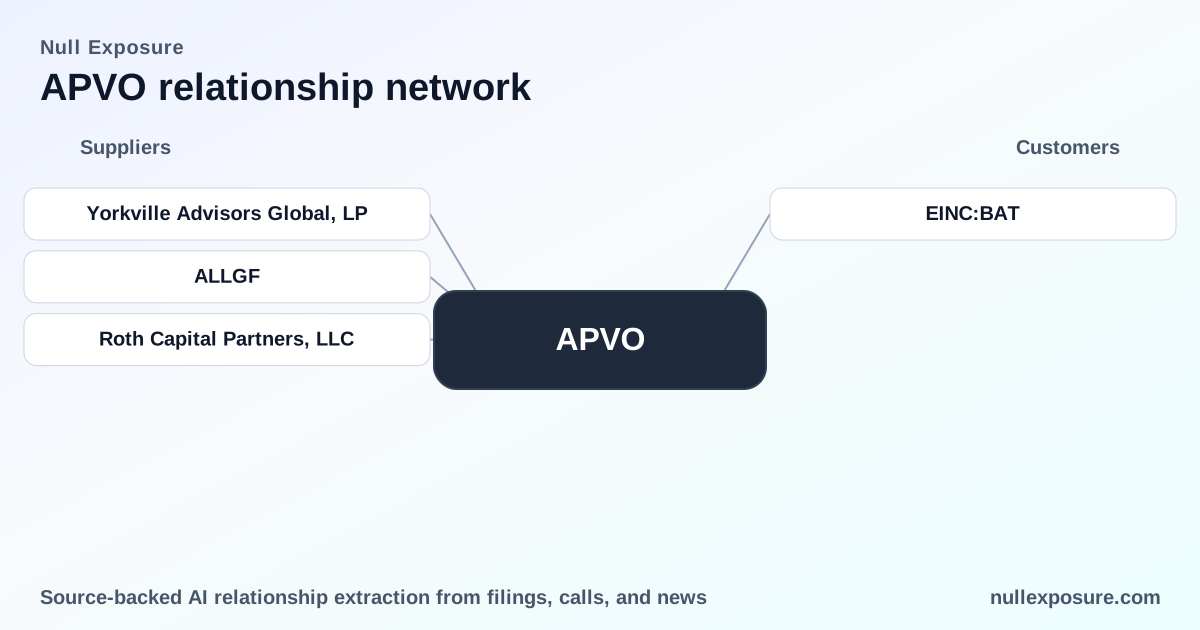
Active relationship: EINC:BAT — standby equity purchase agreement reported
Aptevo signed a standby equity purchase commitment that lets it sell common stock to Yorkville over a 36‑month period at 96% of the lowest three-day VWAP, with exchange and ownership caps limiting any single issuance to 19.99% by Nasdaq rules and a 9.99% ownership limit. This provides immediate access to capital while constraining dilution mechanics. (TradingView news report, March 9, 2026: https://www.tradingview.com/news/tradingview:c153082a00adc:0-aptevo-therapeutics-signs-standby-equity-purchase-agreement-with-yorkville/)
Active relationship: Yorkville — the counterparty named in the standby facility
The counterparty to the standby facility is Yorkville, a capital provider that will purchase shares under the stated VWAP-derived pricing formula subject to exchange and ownership caps; this converts market liquidity into a committed but usage-based funding source for Aptevo. (TradingView news report, March 9, 2026: https://www.tradingview.com/news/tradingview:c153082a00adc:0-aptevo-therapeutics-signs-standby-equity-purchase-agreement-with-yorkville/)
For deeper, structured relationship intelligence on counterparties and contract terms, visit https://nullexposure.com/.
Historical asset sale to XOMA and what it implies about contracting posture
Aptevo has previously sold contractual payment rights to third parties. According to a company filing dated March 29, 2023, Aptevo completed a purchase agreement with XOMA under which Aptevo sold all rights to deferred payments and part of milestone payments from a prior agreement, receiving $9.6 million at closing and an additional $50,000 post‑closing. The filing treated that transfer as a complete sale of a nonfinancial asset for accounting purposes. That transaction demonstrates that Aptevo will use outright asset sales to shore up liquidity rather than retain long-duration royalty streams. (Company filing, March 29, 2023)
Company-level signals on relationship roles and lifecycle
- Company disclosures also include a Securities Purchase Agreement dated April 10, 2024, indicating Aptevo has engaged in purchase‑agreement style financings where Aptevo is a counterparty to capital providers. This is a company-level signal that the firm operates both as a seller of rights and as a buyer/recipient of financing commitments. (Company Securities Purchase Agreement, April 10, 2024)
- A corporate-level note in filings states that contractual rights sold are derecognized and Aptevo has “no obligations going forward” after such sales; this points to a preference for clean divestitures over contingent or servicer roles when monetizing assets. (Company filing, referenced above)
What these dynamics mean for investors and operators
Aptevo’s pattern of transactions generates several practical implications:
- Contracting posture — reactive but decisive: Aptevo structures transactions that prioritize immediate liquidity (equity draws, asset sales) and favor clean legal derecognition of obligations; counterparties obtain defined economic streams and Aptevo reduces future contingent liabilities.
- Concentration and counterparty reliance: With no product revenue and low institutional ownership (1.88%), Aptevo is highly dependent on a small set of financial counterparties for funding; this concentrates negotiation risk and can compress funding options during market stress.
- Criticality of relationships: For Aptevo, financing and royalty buyers are functionally mission‑critical — their willingness to provide capital determines the company’s ability to continue R&D and maintain operations.
- Maturity of arrangements: The mix of a multi‑year standby facility (36 months) and one-off asset sales signals a hybrid maturity profile: short-to-medium term financing commitments supplemented by transactional monetizations to manage runway.
Risk and upside considerations for counterparties and acquirers
- Risk to counterparties: Equity purchasers such as Yorkville receive pricing protection and ownership caps, but they assume execution risk tied to market liquidity — the facility depends on VWAP pricing dynamics and Nasdaq-imposed issuance caps. For buyers of cash flows (e.g., XOMA historically), counterparty risk shifts to origination diligence on milestone likelihoods.
- Upside for Aptevo: These arrangements provide a pragmatic path to preserve operations without near-term product revenue; successful clinical progress or favorable market conditions could materially improve issuing capacity and reduce dilution.
Investor takeaways
- Aptevo runs as a financing‑centric biotech: its ongoing operations rely on structured equity facilities and asset monetizations rather than recurring revenue.
- Key counterparties (Yorkville; historically XOMA) shape runway and dilution outcomes: their contract terms are determinative for shareholders and potential acquirers.
- Operational posture favors clean sales of rights and use-as-needed equity draws, which reduces future obligations but concentrates exposure to funding partners.
For transaction-level intelligence and to monitor how these relationships evolve, visit https://nullexposure.com/.
Bold closing: Aptevo’s valuation and survival are contingent on capital markets and selective monetizations — counterparties that provide disciplined, flexible capital hold disproportionate influence over the company’s strategic options.