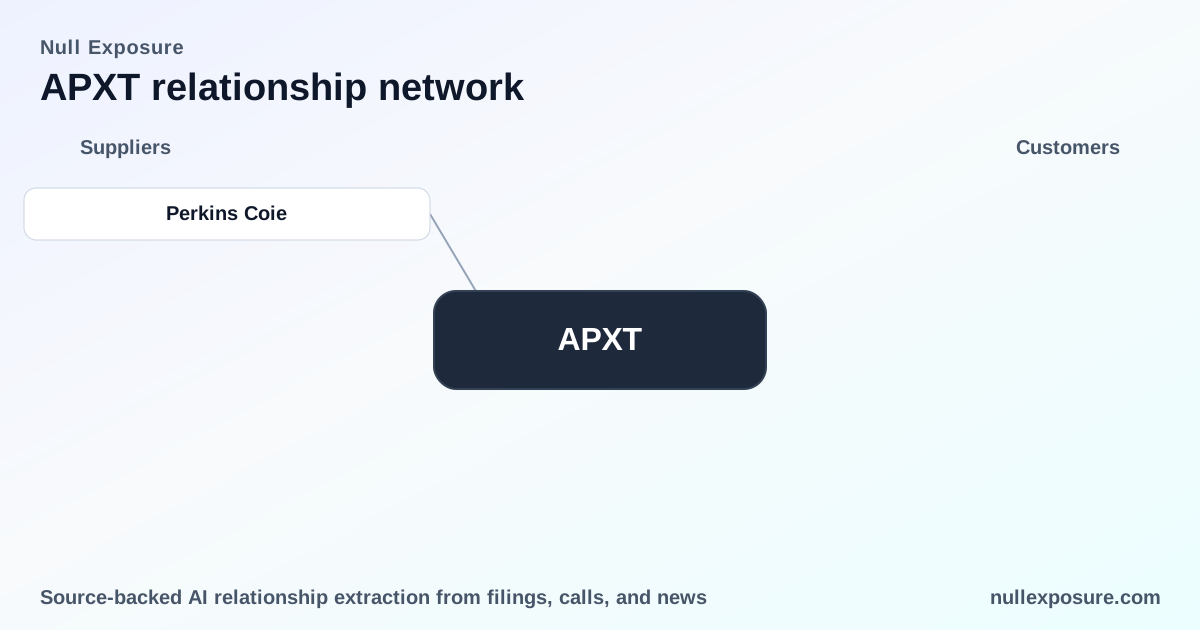
Apex Treasury Corporation (APXT) — Customer Relationships and What They Mean for Investors
Apex Treasury Corporation operates as a SPAC-style acquisition vehicle that raises capital through an IPO and concurrent private warrant placements, then monetizes via sponsor economics, underwriter arrangements, and the eventual business combination of target companies. Revenue and value realization hinge on capital markets execution — IPO proceeds, warrant sales, and sponsor participation — rather than operating cash flows from an operating company. For investors and operators evaluating APXT’s customer and counterparty footprint, the recent warrant placement activity and the counterparties that absorbed that issuance are the immediate, material signals for underwriting strength and sponsor alignment. For more background on APXT’s market positioning and data services, visit https://nullexposure.com/.
How the recent transactions frame APXT’s commercial posture
APXT completed a $3.447 million IPO with an overallotment option and ran a concurrent private placement of warrants. The company executed a concentrated placement of 8,894,000 warrants at $1.00 each, producing gross proceeds of $8.894 million, and two counterparties dominate that placement: Apex Treasury Sponsor LLC and Cohen & Company Capital Markets. These counterparties play distinct roles: the sponsor’s purchase signals founder alignment and economics, while the underwriter representative’s purchase indicates institutional underwriting support. According to Investing.com and contemporaneous filings reported on May 2, 2026, these transactions closed with the stated warrant allocations (see relationship notes below).
Counterparty breakdown — documented relationships
Cohen & Company Capital Markets
Cohen & Company Capital Markets purchased approximately 3,447,000 warrants as representative of the underwriters, participating in the private placement component of APXT’s capital raise. This purchase demonstrates underwriter commitment to the transaction and provides immediate liquidity and distribution support for the warrant instrument. Source: Investing.com coverage of APXT’s SEC filings, May 2, 2026 (https://www.investing.com/news/sec-filings/apex-treasury-corp-completes-3447-million-ipo-and-private-warrant-sale-93CH-4346619).
Investors also recorded the Cohen involvement in broader recaps noting the private placement generated $8,894,000 in gross proceeds with “significant purchases” by Cohen & Company Capital Markets (see supplementary market coverage). Source: Intellectia.ai summary of APXTU private placement activity, May 2026 (https://intellectia.ai/stock/APXTU).
Apex Treasury Sponsor LLC
Apex Treasury Sponsor LLC purchased approximately 5,447,000 warrants, constituting the sponsor’s substantial stake in the concurrent private placement and reflecting the sponsor’s anticipated economic upside tied to future business combinations. Sponsor purchases of this size align founder incentives with public investors and underwrite initial transaction economics. Source: Investing.com SEC filing recap, May 2, 2026 (https://www.investing.com/news/sec-filings/apex-treasury-corp-completes-3447-million-ipo-and-private-warrant-sale-4332109).
Market summaries also note that the private placement of 8,894,000 warrants at $1.00 each included “significant purchases” by Apex Treasury Sponsor LLC, corroborating the sponsor concentration reported in the filing notices. Source: Intellectia.ai transaction summary for APXTU, May 2026 (https://intellectia.ai/stock/APXTU).
What these relationships reveal about APXT’s operating and business model
APXT’s operating model is transactional and capital-markets centric. It does not depend on recurring operating revenue but instead on the successful placement of securities and the economics of sponsor and underwriter arrangements. Key company-level signals derived from the relationships:
- Contracting posture: APXT operates under short-term, deal-specific contracting — IPO underwriting agreements and private placement terms — rather than long-term supply contracts. The underwriter representative’s warrant purchase is part of this transactional structure.
- Concentration: The warrant placement is highly concentrated between the sponsor and a single underwriting representative, which is typical for SPACs but increases counterparty exposure compared with more distributed placements.
- Criticality: These counterparties are critical for execution — sponsor capital ensures founder alignment and market credibility, while underwriter participation enables distribution and absorbs risk at launch.
- Maturity: APXT is in an early-life corporate phase (post-IPO/private placement), where balance sheet strength is a function of capital raised and sponsor endorsements rather than operational traction.
There are no explicit contractual constraints reported in the dataset provided for this review; that absence is itself a company-level signal indicating no additional disclosed restrictions or downstream customer obligations in the source material.
Key risk and concentration takeaways for investors
- Sponsor concentration is a double-edged sword. Sponsor purchases align incentives and reduce issuance risk, but concentration with Apex Treasury Sponsor LLC creates reliance on a single sponsor’s capital commitment to drive value extraction.
- Underwriter involvement signals market confidence but not diversification. Cohen & Company Capital Markets’ purchase validates distribution support; however, its role as the principal professional counterparty means APXT’s market execution is tied to a limited underwriting network.
- Monetization timeline is event-driven. Value realization depends on identifying and closing a qualifying business combination; until then, liquidity and sponsor/underwriter commitments are the most material operational metrics.
Bullet summary of the most actionable points:
- Sponsor purchased ~5.45 million warrants — founder alignment and concentration.
- Underwriter rep (Cohen & Company) purchased ~3.447 million warrants — distribution support.
- Total private placement raised $8.894M via 8,894,000 warrants at $1.00 each — balance sheet bolstering pre-combination.
What investors and operators should watch next
- Monitor subsequent SEC filings and press releases for the identity of target(s) and any changes in warrant conversion terms or lock-up mechanics.
- Track any secondary placements or expanded underwriting syndicates that would reduce concentration risk.
- Review sponsor capital infusions and whether additional professional investors join to broaden the investor base.
For a concise, actionable feed on APXT counterparties, underwriting details, and sponsor economics visit https://nullexposure.com/.
Bottom line
APXT’s immediate counterparty profile shows a classic SPAC configuration: heavy sponsor participation complemented by underwriter support. That structure delivers near-term capital and alignment but concentrates execution risk in a small set of counterparties. Investors evaluating APXT should prioritize monitoring sponsor activity, underwriter syndicate expansion, and the next filings that disclose target combination terms — those events will convert the company’s market-facing capital into measurable performance outcomes.