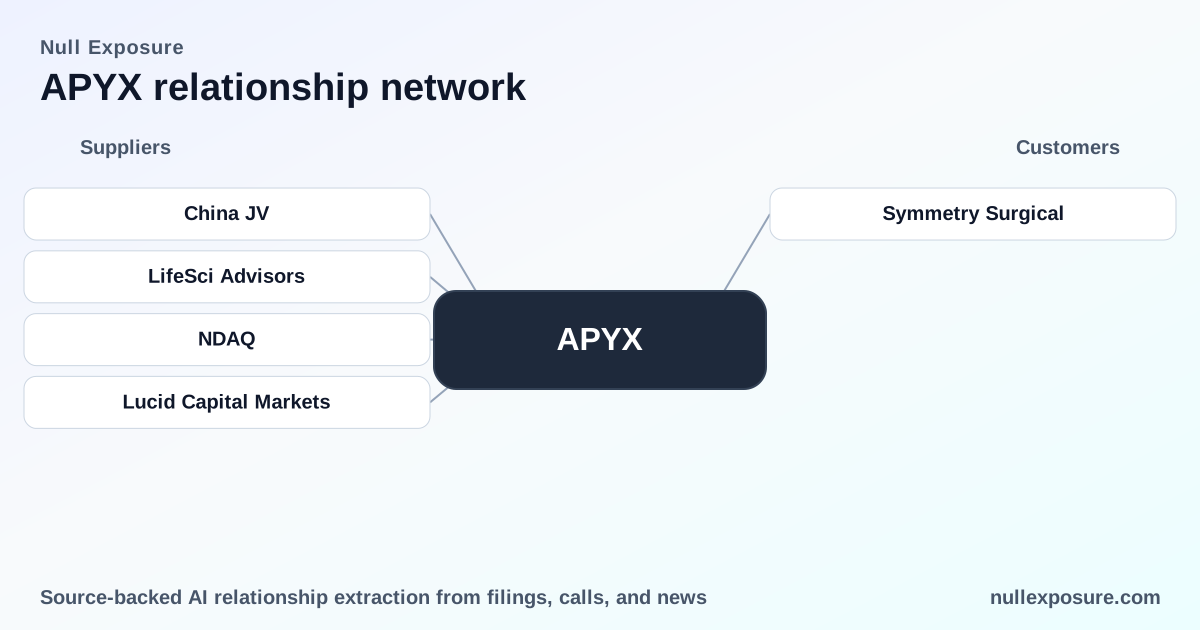
Apyx Medical: Customer relationships that shape revenue and risk
Apyx Medical sells advanced energy medical devices—principally its Renuvion/J-Plasma systems—by combining direct U.S. sales to physicians and surgical centers with international distribution and OEM manufacturing contracts. The company monetizes through hardware sales (generators), recurring single‑use consumables (handpieces and accessories), and long‑term OEM manufacturing agreements; these mixed channels create both durable margin drivers and concentration points that investors must price. Learn more about how these customer ties translate into revenue and operational exposure at https://nullexposure.com/.
Quick investor takeaways
- Core revenue engine: Advanced Energy systems (Renuvion/J‑Plasma) drive the business; hardware plus recurring disposables create a product + consumable revenue model.
- Channel mix matters: Direct U.S. sales are complemented by international distributors and OEM manufacturing relationships, producing global reach but heterogeneous contract terms.
- Concentration and contractual lock‑ins: OEM relationships include long‑term manufacturing commitments that are revenue‑significant and operationally critical.
- Regulatory expansion fuels growth: Recent NMPA clearance in China and a China distribution agreement unlock incremental international revenue.
Customer relationships: the on‑record connections every investor should know
Below I walk through every relationship mention found in public coverage and filings. Each entry is a plain‑English summary with the cited source.
Symmetry Surgical — ongoing OEM manufacturing commitment
- Apyx’s OEM sales decline commentary explicitly excludes Symmetry Surgical under a 10‑year generator manufacturing and supply agreement, indicating Symmetry is a contracted long‑term OEM customer whose purchases are governed by an extended supply arrangement. According to an earnings call transcript for Q1 2025, the company reported reduced OEM volume to other customers while maintaining the Symmetry agreement (InsiderMonkey, referenced March 2026). https://www.insidermonkey.com/blog/apyx-medical-corporation-nasdaqapyx-q1-2025-earnings-call-transcript-1531771/
Symmetry Surgical — historical asset transaction that shaped corporate lineage
- In 2018, the core Bovie business and brand were sold to Symmetry Surgical for $97 million, a transaction that informs the historical customer and OEM landscape for Apyx’s product lines and brand transitions (MassDevice, 2018). https://www.massdevice.com/bovie-to-rebrand-as-apyx-medical-move-to-nasdaq/
GlamMoon Medical Technology — China distribution agreement and market launch
- Apyx launched Renuvion in China through a distribution agreement with GlamMoon Medical Technology following regulatory clearance from China’s National Medical Products Administration (NMPA); this positions GlamMoon as the primary distributor for Renuvion in China and a channel for incremental revenue outside North America (Investing.com, May 2026). https://za.investing.com/news/analyst-ratings/apyx-medical-stock-rating-reiterated-by-citizens-on-ayon-system-rollout-93CH-3921214
GlamMoon Medical Technology — confirmation of distribution support for China rollout
- Coverage from Investing.com reiterated that the China launch is supported by the GlamMoon distribution agreement and NMPA clearance, reinforcing the strategic role of this partnership in Apyx’s international growth plan (Investing.com, May 2026). https://www.investing.com/news/analyst-ratings/lucid-capital-markets-initiates-apyx-medical-stock-with-buy-rating-93CH-4272226
GlamMoon Medical Technology — alignment with product feature expansion
- Apyx’s regulatory filings and press reporting on FDA and international filings mention that the China launch and GlamMoon agreement are part of broader efforts to commercialize new features such as the AYON power liposuction capability, tying distributor relationships to product roadmap milestones (Investing.com company news, May 2026). https://www.investing.com/news/company-news/apyx-medical-seeks-fda-clearance-for-ayon-power-liposuction-feature-93CH-4283921
How the disclosed constraints shape Apyx’s operating model and investor risk profile
The company disclosures establish a clear set of operating characteristics that drive revenue dynamics and risk.
-
Contracting posture: Apyx combines direct sales, distributor channels, and OEM manufacturing contracts. The company sells Renuvion directly in the U.S. to physicians and surgery centers while relying on a distributor network internationally and on OEM contracts for development and manufacturing work. This hybrid posture creates diversified go‑to‑market routes but requires managing different contract lengths and margin profiles (company filings for year ended December 31, 2024).
-
Concentration and geography: International sales represented roughly 29% of revenue in 2024, so growth and regulatory wins in markets like China have material impact on top line. Domestic sales remain the majority, but the international channel is large enough to influence volatility and currency/regulatory exposure.
-
Criticality and maturity of relationships: The OEM segment contributed 19.7% of consolidated revenue in 2024 and includes multi‑year manufacturing contracts; these deals are operationally critical because they drive production scale and recurring manufacturing revenue. The Advanced Energy segment accounted for the remainder and is the core product engine, where generators and single‑use consumables together create a hardware + consumables sales pattern.
-
Relationship roles and stage: The company is both a seller (direct sales of core products) and a contract manufacturer for other medical device firms; globally, the company largely operates through active relationships backed by firm purchase orders and formal distribution agreements.
These constraints produce a clear investment lens: durable product economics from consumables, offset by concentration risk in OEM contracts and the regulatory dependency of international rollouts.
What this means for investors and operators
-
Upside scenarios: Regulatory clearances (for example, China NMPA) and effective distributor execution can expand high‑margin consumable sales outside the U.S., accelerating revenue growth without proportional SG&A increases. The GlamMoon distribution agreement is a tangible example of that pathway.
-
Risk scenarios: Operational dependency on OEM contracts and a small set of commercial partners amplifies downside if a major OEM relationship changes; the Symmetry 10‑year manufacturing agreement is a structural exposure that reduces short‑term volatility but creates long‑term dependency on contract performance.
-
Execution considerations for operators: Prioritize supply‑chain resilience for discrete hardware and single‑use components, maintain tight regulatory pipeline management to feed distributor launches, and monitor OEM order cadence to anticipate revenue variability.
Explore deeper relationship analytics and how these dynamics affect valuation at https://nullexposure.com/ — the site consolidates customer‑level signals and filing evidence for investor due diligence.
Bottom line
Apyx’s revenue profile combines a core advanced‑energy product platform with recurring consumable economics, distributed through a mix of direct U.S. selling, international distributors (notably the GlamMoon China agreement), and meaningful OEM manufacturing contracts (notably the Symmetry 10‑year supply arrangement). Investors should value Apyx for its pathway to recurring revenue growth from international expansion while pricing the concentration and contract‑specific operational risk that flows from a relatively small set of high‑impact customer relationships.