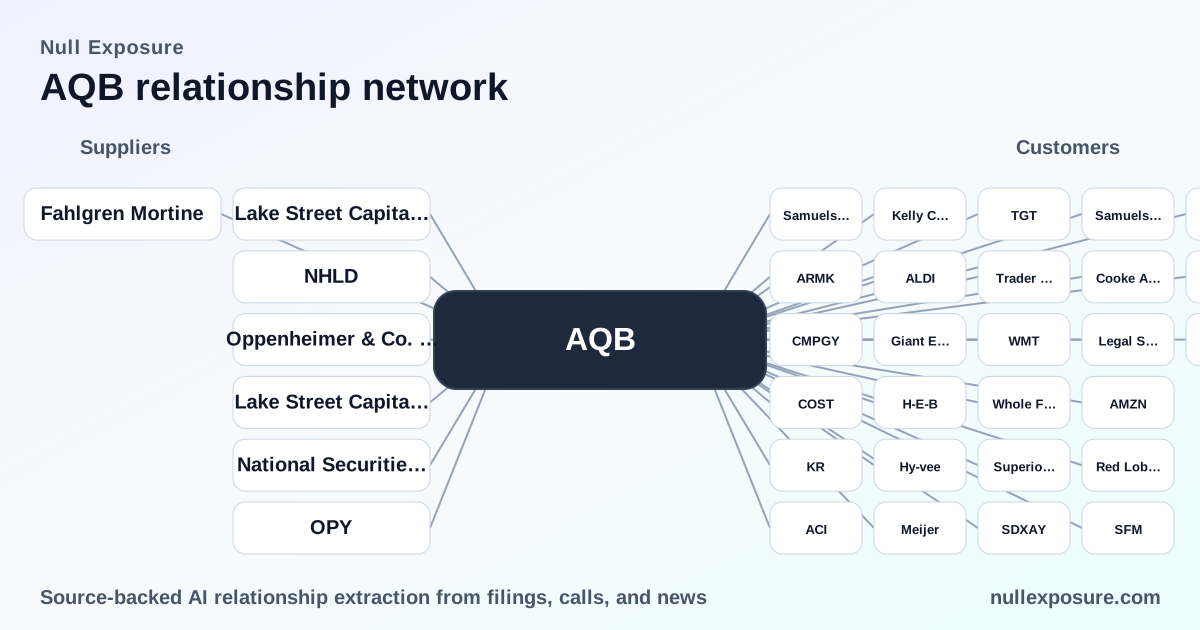
AquaBounty (AQB): customer map and commercial constraints for investors
AquaBounty operates as a niche biotechnology-driven fish producer that develops and sells genetically engineered Atlantic salmon through land-based farms and, until recently, a small Canadian subsidiary; the company monetizes by producing salmon for commercial sale and by divesting non-core assets to preserve liquidity. Revenue is predominantly transactional and seller-driven, with recent asset sales and third-party takeovers reshaping its buyer set and distribution reach. For a concise view of the company’s customer exposures and operating constraints, see more at https://nullexposure.com/.
How to read these customer signals (investor brief)
AquaBounty’s customer profile reflects a hybrid of direct commercial sales, limited distributor relationships, and large-retailer resistance driven by consumer and activist reactions to genetically engineered (GE) salmon. The evidence in the public record points to spot, sale-by-sale commercial interactions rather than long-term, captive contracts, and to concentration risk vis‑à‑vis large retail and distribution channels. These dynamics have driven the company toward asset sales and divestitures as a source of liquidity.
Bold takeaway: AQB is principally a seller/manufacturer of GE salmon with transactional counterparty engagements; exposure to large retailers and foodservice chains is a material commercial constraint.
Customer relationships—who’s mentioned and what that implies
-
Samuels and Son Seafood Co. — A Philadelphia-based seafood distributor publicly announced it was selling AquaBounty’s Atlantic salmon, highlighting one of the few commercial buyers willing to handle the product in FY2021; Perishable News covered this development in FY2021. (Source: PerishableNews, FY2021)
-
Walmart (WMT) — Multiple reporting threads document that Walmart was among the major retailers that declined to stock GE salmon following retailer pressure and advocacy campaigns, a pattern noted across FY2020–FY2024 reporting. (Sources: FoodSafetyNews, FY2020; FOE, FY2024)
-
Whole Foods (WFM / Whole Foods Market) — Whole Foods publicly signaled it would not offer the GE salmon, cited in consumer and food-safety coverage in FY2019 and updated coverage through FY2024. (Sources: NYPost, FY2019; OrganicAuthority, FY2024)
-
Superior Fresh — Superior Fresh acquired AquaBounty’s Indiana farm site in July 2024 and explicitly opted not to produce genetically modified salmon at that site, indicating a transfer of physical assets away from GE operations in FY2025. (Source: WFYI, FY2025)
-
Costco (COST / Costco) — Reporting lists Costco among large grocers that refused to stock the GE salmon in the U.S., a refusal referenced in coverage of retailer reactions in FY2024. (Sources: FoodSafetyNews, FY2020; OrganicAuthority, FY2024)
-
Target (TGT) — Target is repeatedly cited in retailer lists that opted out of selling GE salmon, recorded across the retailer-resistance coverage in FY2020 and FY2024. (Sources: FoodSafetyNews, FY2020; OrganicAuthority, FY2024)
-
Kroger (KR / Kroger) — Kroger joined other grocers in public vows not to sell the GE salmon, a position recorded across FY2019–FY2024 reporting. (Sources: NYPost, FY2019; FOE, FY2024)
-
ALDI — ALDI appears in retailer lists pressured not to carry the GE salmon as documented in FY2020 media coverage of retailer responses. (Source: FoodSafetyNews, FY2020)
-
Trader Joe’s — Trader Joe’s declined to stock the GE salmon according to retailer-reaction reporting in FY2020 and FY2024. (Sources: FoodSafetyNews, FY2020; OrganicAuthority, FY2024)
-
H‑E‑B — H‑E‑B was included among regional grocers pressured to avoid the GE salmon in FY2020 coverage. (Source: FoodSafetyNews, FY2020)
-
Hy‑Vee — Hy‑Vee was listed among retailers who were pressured over GE salmon sales in FY2020 reporting. (Source: FoodSafetyNews, FY2020)
-
Sprouts (SFM) — Sprouts was named in retailer pressure coverage as a chain that faced activist campaigning over GE salmon in FY2020. (Source: FoodSafetyNews, FY2020)
-
Giant Eagle — Giant Eagle was included in lists of grocery chains that activists targeted regarding GE salmon availability in FY2020 reporting. (Source: FoodSafetyNews, FY2020)
-
Meijer — Meijer also featured in FY2020 coverage as a retailer under pressure about the GE salmon. (Source: FoodSafetyNews, FY2020)
-
Sodexo — Sodexo, a major foodservice operator, is named among foodservice companies that rejected GE salmon as reported in FY2024; this highlights foodservice channel resistance. (Source: FOE, FY2024)
-
Aramark — Aramark publicly said it would not distribute the genetically engineered salmon, a stance documented in FY2021 and reiterated in FY2024 reporting. (Sources: WFYI, FY2021; FOE, FY2024)
-
Compass Group — Compass Group is cited among foodservice purchasers that moved away from GE salmon in FY2024 reporting. (Source: FOE, FY2024)
-
Red Lobster — Red Lobster is listed among restaurant chains that declined to serve GE salmon, noted in FY2024 campaign coverage. (Source: FOE, FY2024)
-
Legal Seafood — Legal Seafood joined restaurants refusing the GE salmon in FY2024 reporting on retailer/restaurant responses. (Source: FOE, FY2024)
-
Cooke Aquaculture (Cooke) — Cooke Aquaculture acquired AquaBounty’s Canadian subsidiary and operations on Prince Edward Island as part of a CAD 3 million transaction in early FY2025, acquiring hatchery facilities and related IP transfers. (Source: FishFarmingExpert / MisPeces, FY2025)
-
Kelly Cove Salmon Ltd. (KCS) — Kelly Cove Salmon, a Cooke subsidiary, was the purchaser of AquaBounty Canada for C$7.7 million in March 2025 with debt assumption; public filings and press coverage detail proceeds and the transfer of corporate-registered IP in FY2025. (Sources: Company sale notices reported, FY2025; FishFarmingExpert, FY2025)
Bold takeaway: Asset sales to Cooke/Kelly Cove and the divestiture of the Indiana site to Superior Fresh materially change AQB’s production footprint and its ability to supply large retail/foodservice channels.
Operating constraints and what they mean for investors
Public excerpts and company disclosures provide clear company-level signals about operating and commercial constraints:
-
Contracting posture — spot-heavy: Evidence of asset disposals and a virtual auction of equipment (February–March 2025) signals a sales model that relies on spot transactions and asset monetization rather than long-dated supply contracts. (Company transaction notices, FY2025)
-
Counterparty type — large enterprise exposure: Commentary notes consolidation in distribution channels and the importance of large retailers and processors, indicating counterparty concentration with large enterprise buyers. This concentration amplifies commercial risk when major chains refuse product. (Industry commentary in filings)
-
Relationship role — seller and manufacturer: AquaBounty is documented both as a producer of GE salmon (manufacturer) and as an entity selling assets/subsidiaries (seller), reinforcing a dual role of operations and capital recycling. (Company strategy disclosures and transaction notices)
-
Segment focus — core product dependence: The company’s stated strategy centers on core competencies: GE Atlantic salmon, land-based farms, vertical integration and biotech expertise, indicating revenue dependency on a single differentiated product. (Company strategy statements)
Bold takeaway: The combination of product concentration, reliance on large buyers, and spot-style commercialization constitutes a high-conditionality business model that is sensitive to retailer resistance and asset disposals.
Investment implications and action points
- For equity investors, the primary risk is commercial acceptance: large retailers and foodservice buyers control access to volume and have repeatedly declined GE salmon, constraining growth potential.
- For credit or counterparty analysis, the shift toward asset sales reduces operating scale but provides short-term liquidity, while raising questions about long-term manufacturing capacity.
- Monitor follow-on exposure to Cooke/Kelly Cove and site ownership changes as indicators of where production capability and intellectual property now reside.
If you want a deeper counterparty map and ongoing monitoring of AQB’s changing buyer footprint, review our platform at https://nullexposure.com/ for updated relationship signals and alerts.
Final thought: AquaBounty’s commercial profile is defined by a unique product advantage and simultaneous market acceptance constraints; current evidence positions the company as a small, transaction-driven seller under significant retailer and foodservice resistance.