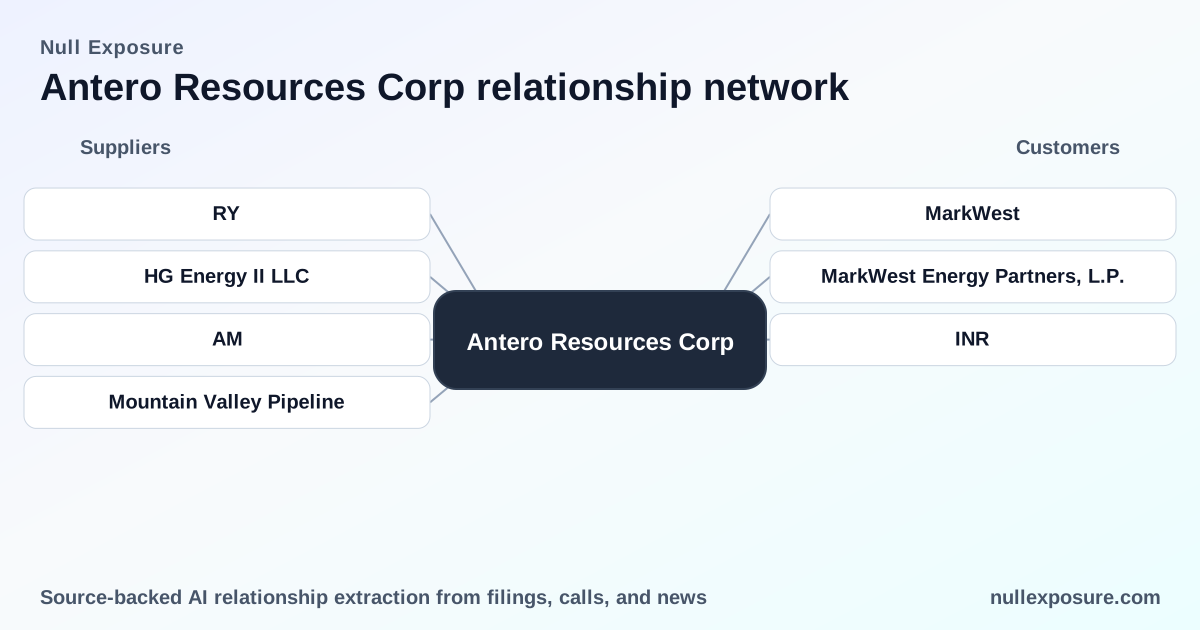
Antero Resources (AR): Counterparty Map and What It Means for Investors
Antero Resources is a U.S.-focused E&P that monetizes Appalachian natural gas, NGLs and oil through production sales and strategic midstream relationships, supplemented by selective asset monetizations. The company drives cash flow by selling hydrocarbons under a mix of firm and market-based arrangements, operating a material midstream footprint and using joint ventures and third‑party processors to convert and move product to market. For investors evaluating customer and counterparty exposure, tracking Antero’s processing partners, recent asset sales and the buyers of Utica assets is essential. Learn more about underlying relationship signals at https://nullexposure.com/.
How Antero makes money and why counterparties matter
Antero’s core revenue generation is straightforward: produce hydrocarbons in the Appalachian basins and sell them to industrial, midstream and trading counterparties. The company contracts cryogenic processing capacity with third parties to extract NGLs, operates midstream assets through Antero Midstream relationships and periodically repositions acreage and upstream assets via sales to raise capital and refine portfolio focus. These commercial linkages determine realized pricing, takeaway optionality and midstream profitability — all direct drivers of EBITDA and marginal free cash flow.
Counterparty rundown — who Antero sells to, processes with, or transacted with
Below I list every counterparty relationship surfaced in the public record provided and summarize the commercial relevance to Antero.
MarkWest
Antero contracts with MarkWest for cryogenic processing capacity for Appalachian production, a critical step to recover NGLs from gas prior to sale. This relationship is disclosed in Antero’s 2025 Form 10‑K. (Source: Antero 2025 10‑K filing)
MarkWest Energy Partners, L.P.
Antero references a 2017 joint venture (with Antero Midstream and MarkWest) to develop processing and fractionation assets in Appalachia, underscoring long-standing midstream cooperation and infrastructure co‑development. (Source: Antero 2025 10‑K filing)
Northern Oil and Gas, Inc. (NOG)
Northern Oil and Gas completed a 49% non‑operated stake acquisition in a Utica package alongside Infinity Natural Resources in a ~$1.2B deal, taking assets previously held by Antero entities; NOG is therefore a direct buyer and strategic regional partner in the Appalachian value chain. (Sources: MarketScreener March 2026; RigZone March 2026; Investing.com March–May 2026)
Natural Resources, Inc.
Press coverage identifies an affiliate of Natural Resources, Inc. as a counterparty in the sale of Utica oil and gas assets, positioning that group as a direct acquirer of Antero assets in Ohio. (Sources: Investing.com May 2026; ZA Investing May 2026)
Infinity Natural Resources, LLC / Infinity Natural Resources Inc (INR)
Infinity led a transformational acquisition of upstream and midstream Ohio assets from Antero for approximately $1.2 billion, completing the purchase in February 2026 and showing Antero’s willingness to divest non‑core positions to crystallize value. (Sources: RigZone March 2026; The Globe and Mail March 2026; CityBiz March 2026; Infinity press releases and April/May coverage 2026)
Infinity Natural Resources (ticker INR)
Analyst and press notes on INR confirm that Infinity completed the purchase of Antero’s Ohio assets, a transaction characterized publicly as transformational for the buyer and material to Antero’s portfolio reshaping. (Sources: The Globe and Mail March 2026; AI Journals May 2026)
Nvidia
Antero management referenced regionally announced power and data center projects that list Nvidia as a tenant, highlighting end‑user demand growth in West Virginia that supports local gas markets where Antero has scale. This is discussed during Antero’s Q1 2026 earnings call transcript. (Source: Benzinga transcript of Antero Q1 2026 earnings call)
Microsoft
Management specifically named Microsoft among customers tied to combined data center projects, indicating potential large‑scale, localized power demand that can lift gas pricing and long‑term off‑take opportunities in Antero’s core basins. (Source: Benzinga transcript of Antero Q1 2026 earnings call)
Antero cited a separate data center project tied to Google, further signaling incremental local demand from hyperscalers that reinforces regional pricing dynamics and midstream utilization. (Source: Benzinga transcript of Antero Q1 2026 earnings call)
What the company‑level constraint signals reveal about operating posture
Public evidence produces clear company‑level signals about how Antero contracts and competes:
- Long‑term contracting posture: Antero discloses firm sales commitments through 2030, indicating use of multi‑year firm contracts to secure offtake and price stability for a portion of production. (Evidence: excerpt referencing firm sales commitments through 2030)
- Market access and takeaway optionality: The company states it has firm takeaway capacity on major pipelines, enabling movement of production to domestic and international end markets and reducing single‑market dependence. (Evidence: excerpt on access to multiple end markets through long‑term firm takeaway capacity)
- U.S. revenue concentration with export channels: While Antero’s production and customers are predominantly U.S.-based, some sales are routed for export by counterparties — creating domestic operational focus with global market optionality. (Evidence: multiple excerpts noting substantially all production revenues are attributable to U.S. customers, yet some transported abroad)
- Seller profile and product concentration: Antero is principally a seller of natural gas, oil and NGLs and has entered firm sales contracts for delivery and sale of these products; hydrocarbons are the core product driving revenue. (Evidence: revenue and firm sales contract excerpts)
Together these signals describe an operator that uses a mix of long‑dated firm contracts and market sales, leverages pipeline options to diversify end markets, and reduces execution risk through midstream joint ventures and third‑party processing arrangements.
If you are profiling counterparty risk or midstream exposure, these company‑level traits matter because they define contract maturity, cash flow predictability and the sensitivity of pricing to local demand shocks.
Explore deeper counterparty analytics at NullExposure — our platform consolidates filings and media to map these relationships for investment due diligence.
Investment implications and short list of risks
- Positive: Firm sales commitments and midstream integration provide cash flow stability and support Antero’s attractive EV/EBITDA multiple relative to peers; recent asset monetizations show active capital recycling to strengthen the balance sheet.
- Structural risk: Revenue concentration in U.S. basins leaves the company exposed to regional pricing dislocations; local demand shocks or pipeline constraints would materially affect realized prices.
- Counterparty and execution risk: Reliance on third‑party processors and joint ventures (e.g., MarkWest JV arrangements) creates operational dependencies where downtime or capacity constraints could compress margins.
- Strategic clarity: The February 2026 Utica asset sale to Infinity/NOG/Natural Resources affiliates demonstrates deliberate portfolio optimization, improving capital allocation but reducing upstream scale in Ohio.
Bottom line
Antero operates as a vertically coordinated Appalachian gas producer that locks in a portion of production through firm contracts, outsources critical processing to established partners (MarkWest), and selectively monetizes assets to refine capital allocation. For investors, the most material counterparty exposures are processing and midstream JV partners and the buyers of divested assets — each directly influences pricing, takeaway optionality and near‑term free cash flow. For a counterparty map tied to filings and market coverage, visit https://nullexposure.com/ to view structured relationship evidence and primary sources.