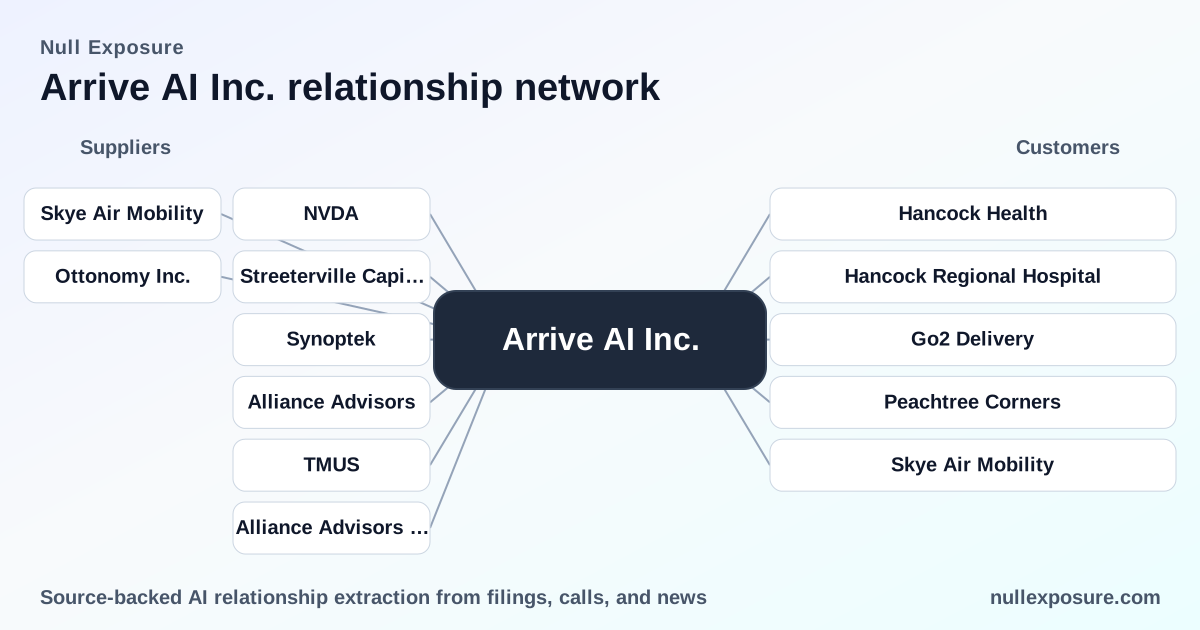
Arrive AI (ARAI): Customer relationships outline the commercialization path — and the concentration risk
Arrive AI operates a subscription-style Mailbox-as-a-Service branded as Arrive Points™, installed into customer environments to enable secure, asynchronous handoffs for autonomous deliveries. The company monetizes through deployments and commercial partnerships that combine hardware placement, software services and multi-year agreements; current public disclosures show revenue driven by a small number of pilots and partnership rollouts rather than broad recurring enterprise sales. For investors, the most important signals are early-stage commercial traction, revenue concentration in a single hospital deployment, and a partnership-led go-to-market that targets health systems, last-mile operators and smart-city platforms. Learn more on the company page at https://nullexposure.com/.
What the commercial footprint looks like today
Arrive AI is executing a classic hardware-plus-software commercialization playbook: install Arrive Points in controlled customer sites, validate operational benefits (reduced walking time, secure handoffs), then scale through multi-year partnerships and channel relationships. The company’s public disclosures and press activity show a blend of:
- hospital deployments used as operational proof points,
- regional delivery partners to extend service coverage, and
- city or mobility partnerships for geographic expansion.
Key operating model characteristics emerge from those facts: the contracting posture is partnership-driven and pilot-to-deal; commercial concentration is high; the product is positioned as operationally critical inside deployments (workflow-first claim); and commercial maturity is early — pilots and two-year deals rather than broad rollouts. No explicit contractual constraints are disclosed in the results reviewed, which is itself a company-level signal about limited public disclosure and early-stage deal terms.
Why concentration matters — a headline risk
Arrive AI reported only $113,250 in trailing twelve‑month revenue and disclosed that over 90% of a quarter’s revenue came from a single deployment at Hancock Health, highlighting acute concentration risk for valuation and cash flow stability. According to an earnings call transcript covering Q4 2025, the quarter’s revenue was $15,000 with over 90% derived from Hancock Health (earnings call transcript, Investing.com, May 2026). This concentration creates a binary commercial dependency: loss or non-renewal of that contract would materially alter cash generation.
Customer-by-customer review: what investors need to know
Hancock Health
Arrive AI launched a two-year partnership to support robotic medical deliveries at Hancock Health on May 19, 2025, and used that deployment as the primary proof point for asynchronous handoffs inside hospital workflows. According to the company white paper and press distribution, Arrive Points reduced walking time without adding extra steps for staff (press release coverage, Enterprisenews and LDNews, March–May 2026). An earnings-call transcript affirms that Hancock Health accounted for the bulk of very limited quarter revenue (Investing.com, Q4 2025 transcript, May 2026).
Hancock Regional Hospital
At Hancock Regional Hospital (Greenfield, Indiana) Arrive AI deployed what the company describes as the world's first fully asynchronous, autonomous medical delivery infrastructure, expanding from initial pilots into broader autonomous medical deliveries on October 28, 2025. The company presented this deployment as a field demonstration used to generate operational insights and validation for healthcare workflows (press release coverage, Finviz and multiple regional outlets, March–May 2026).
Go2 Delivery
Arrive AI executed a partnership with Go2 Delivery to advance secure medication delivery in Virginia, announced May 20, 2025; this relationship positions Go2 as a regional last‑mile operator integrating Arrive Points into medication logistics (press release distribution, LDNews and related outlets, March 2026). The Go2 tie shows the company’s strategy of selling into delivery operators for scaled service coverage beyond corporate-owned robot fleets.
Peachtree Corners
Peachtree Corners — a smart‑city environment — partnered with Arrive AI to launch secure automated delivery initiatives on June 4, 2025, reflecting a municipal/channel strategy to embed Arrive Points into city-managed corridors and testbeds (press release, LDNews/thenewsstar and other regional wires, March 2026). This relationship signals a route to citywide pilots and public-sector demonstrations rather than direct healthcare revenue.
Skye Air Mobility
Arrive AI announced an international expansion levered through a Skye Air Mobility partnership that established entry into India on June 24, 2025, indicating the company’s use of local mobility partners to accelerate geographic expansion (press release coverage, LDNews and other outlets, March 2026). The Skye alliance demonstrates a channel approach to reach markets that require local regulatory navigation and logistics partners.
What the relationships imply about the business model
These relationships collectively show a company focused on converting field demonstrations into multi-year arrangements. The operating posture is pilot-first, partner-scale-second: hospitals supply workflow validation, last‑mile operators extend operational reach, smart-city partners provide testbeds, and mobility partners open foreign markets. That structure produces meaningful benefits — credible proof points and partner distribution — but also creates acute financial concentration and dependency on successful conversion from pilot to recurring revenue.
Financial context that matters to operators and investors
Arrive AI’s trailing numbers underline the early stage: TTM revenue of $113,250, negative EBITDA, and a material mismatch between market capitalization and current sales scale (company financials, latest quarter March 31, 2026). With limited institutional ownership and a high insider share percentage, the equity story is driven by founder/insider conviction and execution on a narrow set of commercial wins. Given the reported quarter where >90% revenue derived from Hancock Health, investors must weigh the robustness and renewal terms of that hospital partnership above all else.
Final takeaways and next steps
- Proof-of-concept traction exists in healthcare and municipal pilots, anchored by Hancock Health / Hancock Regional Hospital as the operational showcase. (Press releases and white paper summaries, March–May 2026.)
- Revenue concentration is the dominant near-term risk: a single deployment supplied the bulk of quarter revenue, creating high sensitivity to contract renewal and scaling success (earnings call transcript, Investing.com, May 2026).
- Partnership-led geography expansion (Go2 Delivery, Peachtree Corners, Skye Air Mobility) provides a clear distribution model, but commercialization remains at the pilot/early contract stage (press release coverage, May–June 2025).
For investors evaluating Arrive AI’s commercial durability, the priority is transparent contract economics — renewal clauses, ARR conversion expectations from pilots, and timelines for customer diversification. For further research and a consolidated view of these customer relationships, visit https://nullexposure.com/ for the company dossier and linked primary sources.