Accuray (ARAY): Customer Relationships, Revenue Risks, and Strategic Footprint
Accuray designs, manufactures and sells precision radiosurgery and radiation therapy systems and captures revenue through capital equipment sales, installation and training services, and ongoing post‑warranty service contracts. The business model is dual‑track: high‑value, lumpy equipment sales drive headline revenue while recurring service and maintenance provide margin stability. For investors, the critical questions are concentration risk, geographic demand variability, and the extent to which joint ventures and channel partners convert installed base into recurring aftermarket revenue. For a structured map of customer relationships, visit https://nullexposure.com/.
Recent customer partnerships that matter to the commercial trajectory
Accuray disclosed two related commercial developments in March 2026 that signal deliberate expansion of its CyberKnife S7 footprint in Australia.
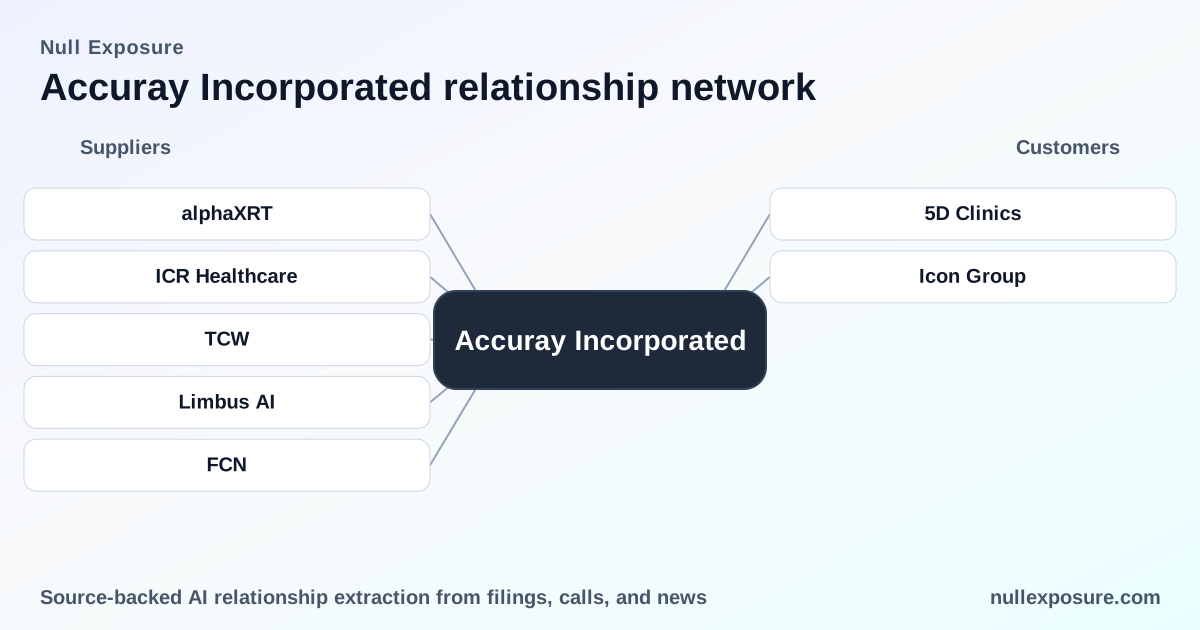
5D Clinics — first CyberKnife S7 treatments in Melbourne
5D Clinics treated the first patients in Melbourne using Accuray’s CyberKnife S7 System, demonstrating early clinical deployment and local uptake of the platform. According to a PR Newswire release (March 2026), this is an operational milestone for Accuray’s Australian roll‑out and serves as a nearer‑term proof point for adoption in that market.
Icon Group — joint venture partner for national rollout
Icon Group will serve as a joint venture partner with 5D Clinics to open and operate CyberKnife centers across Australia, with the explicit goal of expanding access to SBRT and SRS treatments closer to patients’ homes. The same PR Newswire release (March 2026) describes the JV arrangement and commercialization plan, reflecting Accuray’s go‑to‑market strategy of leveraging local operators and health networks to scale device placement and throughput.
How these relationships fit into Accuray’s operating and monetization model
Accuray’s go‑to‑market blends direct sales with distributor and partner-led expansion. Capital equipment sales remain the primary monetization event; partners and JVs are used to accelerate clinical throughput and reduce Accuray’s direct capital deployment. The Icon/5D JV arrangement exemplifies this hybrid approach: Accuray sells systems to operators and recognizes revenue on sales to JVs, while the JV structure aims to convert installations into patient volumes that support service and consumable sales over time.
-
Contracting posture: The company offers both short‑tenor service relationships and occasional extended payment terms. Company disclosures (FY2025 filing, June 30, 2025) note that service contracts are generally month‑to‑month, while extended payment terms longer than one year represented approximately 4% of accounts receivable as of June 30, 2025. These dynamics create a mix of predictable recurring cash from services and episodic credit exposure tied to large equipment orders.
-
Concentration and criticality: Accuray reports that one customer accounted for 10% or more of net revenue in both FY2024 and FY2025, a material concentration flagged in the FY2025 filing; this is a company‑level risk signal that elevates vendor concentration risk relative to peers. At the same time, Accuray’s systems are clinically critical to radiation oncology programs, which increases switching costs once a system is installed and serviced.
-
Geographic reach and demand variability: Accuray operates globally with primary offices in the United States, Switzerland, China, Hong Kong and Japan and sells via both direct and distributor channels. Disclosures indicate reduced budgets and longer installation timelines in the U.S. have negatively impacted net revenue since FY2024 and are expected to continue through FY2026, while China and other APAC markets represent material foreign demand (FY2025 filing). This geographic mix creates uneven capital cycle exposure and currency sensitivity.
-
Role dynamics: The company functions as both seller of equipment and provider of post‑contract services; its filings describe revenue recognition mechanics for sales to joint ventures, where Accuray recognizes revenue on control transfer and eliminates a portion of profit for unsold inventory held by the JV. This shows ARAY operating as a seller to intermediary JV partners while relying on those partners to drive end‑customer throughput.
Operational constraints and what they signal to investors
The company’s public disclosures and constraint excerpts yield a consistent set of operational characteristics that should factor into valuation and diligence.
- Short‑term service duration, longer payment tails for equipment. Services are structured month‑to‑month, limiting long‑term visibility on service revenue unless customers renew; conversely, extended payment terms on equipment create receivable duration risk (FY2025).
- Material customer concentration. One customer crossing the 10% revenue threshold in consecutive years is a clear concentration risk and increases earnings volatility if order patterns change (FY2025).
- Global distribution complexity. Direct sales dominate in the U.S. while distributors and agents cover parts of Europe, the Middle East, Africa and Latin America, adding complexity to channel economics and pricing, and exposing results to regional procurement cycles.
- Service segment as a stabilizer. Accuray explicitly sells post‑contract support, installation and training services; these services provide recurring margin and are strategically critical to preserve installed‑base economics.
- Revenue recognition complexity with JVs. Sales to joint ventures require elimination of intercompany profit for unsold goods at period‑end, which can mute reported margins when JVs hold inventory between sales and end‑customer delivery.
Each of these constraints is cited in Accuray’s FY2025 disclosures and recent corporate communications.
Investment implications and a clear set of next steps
For investors and operators evaluating ARAY customer relationships, the key takeaways are clear: the company’s path to revenue stability runs through scaling installed base utilization (patient throughput) and diversifying its top customers and geographies. The Icon/5D JV is a constructive example of accelerating utilization without requiring Accuray to be the clinic operator, but it does not eliminate concentration or regional budget risks.
Actionable points for investors:
- Monitor order book composition and the identity of the >10% customer disclosed in filings; a single large customer drives disproportionate revenue risk.
- Track U.S. installation timelines and hospital capital budgets because they materially affect near‑term equipment demand (disclosed impact through FY2026).
- Evaluate service revenue growth and renewals as the best buffer against lumpy equipment cycles; a rising services attach rate improves margin durability.
For advisors and corporate partners mapping contract exposure, prioritize counterparties that increase recurring utilization (large oncology groups, managed care partnerships, or high‑throughput JV operators).
Learn more about how customer relationships influence enterprise risk and valuation at https://nullexposure.com/.
Bottom line
Accuray’s commercial model is a classic medical‑device mix of lumpy equipment sales and steadier aftermarket services, executed through a combination of direct sales, distributors, and strategic JV partners. The Icon Group/5D Clinics JV demonstrates a pragmatic route to scale clinical throughput, but material customer concentration, regional budget softness in the U.S., and short‑term service contracts keep volatility elevated. Investors should weigh the stabilizing effect of services and JVs against concentration and timing risk when assessing ARAY’s risk‑adjusted equity case.