ARB IOT Group (ARBB) — customer wins that materially reshape the commercial risk profile
ARB IOT Group sells IoT hardware and system-integration services and monetizes through direct product sales (AI servers and ARB workstations), system integration contracts, and regional distribution agreements. Recent public announcements show ARB booking large project orders and channel exclusivity deals that convert technology into near-term revenue — a shift from recurring low-margin services toward high-ticket, project-driven hardware sales. For a concise briefing and related signals, visit https://nullexposure.com/.
How ARB actually makes money and why these customers matter
ARB’s revenue mix is anchored in three commercial levers: hardware sales (notably the ARB-222 AI server), system integration and support services, and channel distribution agreements that scale deployment in target markets. Public filings and market notices show a transition toward large, one-off supply agreements and exclusive reseller partnerships that accelerate top-line recognition but concentrate execution risk into a smaller number of counterparties.
Firm-level operating characteristics:
- Contracting posture: Project-based, milestone-driven contracts for hardware and integration dominate the announced activity; revenue recognition will follow deliveries and acceptance.
- Concentration: Large single orders are now material to trailing revenue, increasing counterparty concentration and revenue volatility.
- Criticality: Customers comprise both channel partners and direct data-centre buyers, so contracts are business-critical for counterparties and cash-critical for ARB.
- Maturity: ARB is in an early commercial expansion phase — the company reports meaningful trailing revenue but negative EBITDA and margins, so these contracts are strategic to reach scale and profitability.
Customer relationships that change the investment calculus
Below I cover each relationship disclosed in public reports. Each entry includes a plain-English summary and a source citation.
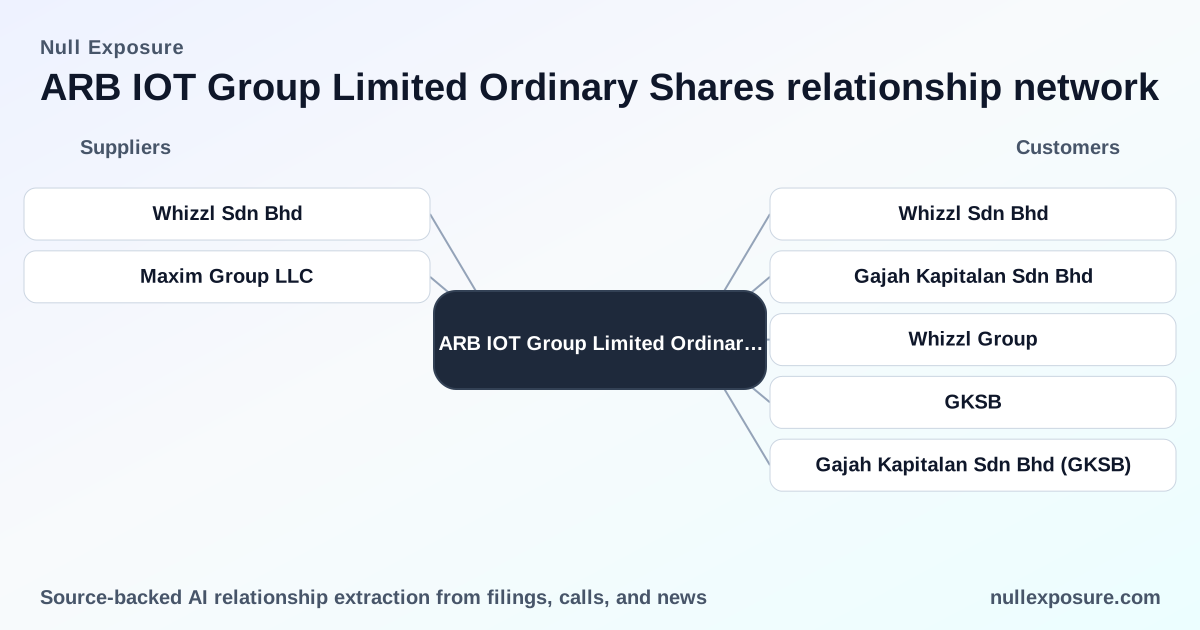
Gajah Kapitalan Sdn Bhd (GKSB)
- ARB signed an AI Products Supply Agreement to deliver 500 units of ARB-222 AI servers to GKSB in a contract valued at approximately US$45.0 million, supplying high-performance immersible servers for Malaysian enterprise and research customers. This order is large relative to ARB’s trailing revenue and will be a key execution and cash-flow event. (Source: Yahoo Finance announcement, March 2026 — https://finance.yahoo.com/news/arb-iot-group-limited-secures-210000358.html; additional coverage: Stocktwits/market reports, March 2026.)
Whizzl Sdn Bhd / Whizzl Group
- ARB appointed Whizzl as the exclusive wholesaler, sole distributor, and system integrator for its Smart IoT Palm Farming System in Sabah and Sarawak and has reported additional orders routed through Whizzl for AI server and data-centre solutions, positioning Whizzl as ARB’s primary channel partner in East Malaysia. That exclusivity creates a regional go-to-market lever but centralizes distribution risk in one partner. (Source: FinancialContent market release, March 2026 — https://markets.financialcontent.com/stocks/article/gnwcq-2025-3-11-arb-iot-group-limited-appointed-exclusive-wholesaler-distributor-and-system-integrator-for-its-smart-iot-palm-farming-solutions-to-gain-market-access-in-sabah-and-sarawak-regions?Language=spanish; supplemental: StockstoTrade coverage, April 2026.)
Potboy Group
- ARB supplies Pick-N-Go technologies while Potboy assumes machine ownership and operations, a commercial arrangement where ARB provides the technology stack and Potboy handles ownership and deployment, shifting operational risk off ARB and creating a services/solution revenue stream rather than a capital-intensive asset holding. (Source: Malaysiakini announcement, FY2023 filing/notice — https://www.malaysiakini.com/announcement/670055.)
What these relationships imply for revenue, margins and risk
- Materiality: The US$45M GKSB contract represents a material portion of ARB’s trailing revenue (trailing revenue USD 197.32M), so successful delivery and payment will meaningfully alter near-term cash flow and investor perception.
- Execution risk: Large hardware deliveries and data-centre integrations require supply-chain coordination, acceptance testing, and after-sales support; any delay risks revenue deferral and concentrated counterparty exposure.
- Channel leverage vs. concentration: Exclusive distribution through Whizzl accelerates market penetration in Sabah/Sarawak but concentrates go-to-market execution in one partner; that is efficient for scaling but raises single-point-of-failure concerns.
- Capital and margin dynamics: Moving from low-margin services to high-ticket hardware can expand gross profit if ARB controls component costs and pricing; however, current public data show negative EBITDA and operating margins, so margin improvement depends on disciplined execution and favorable product economics.
Operational checklist investors should monitor next
- Delivery schedules and acceptance milestones for the GKSB ARB‑222 shipments (dates and receipts will drive revenue recognition).
- Payment terms and receivable aging for large contracts; evidence of upfront deposits or escrow arrangements reduces counterparty credit risk.
- Inventory and supply-chain disclosures in quarterly filings — component shortages or concentration of suppliers would be a key risk.
- Performance and renewal metrics with Whizzl in Sabah/Sarawak; additional channel wins would signal scalability, while exclusivity disputes or underperformance would be a red flag.
Valuation context and governance signals
Public market metrics show market capitalization around USD 10.15M while trailing revenue is USD 197.32M and EBITDA is negative, which points to a highly volatile valuation that trades on execution news rather than steady earnings. Insider ownership is significant (about 35%), and institutional ownership is negligible, indicating a tightly held equity base where insider actions and dilution patterns will materially affect minority investors.
Bottom line: catalysts and downside
- Catalysts: Successful delivery and collection on the GKSB US$45M order, further channel expansion through Whizzl, and evidence of margin improvement will re-rate ARB from a small-services firm into a hardware-driven growth story.
- Downside: Execution or payment failure on large orders, supply-chain disruptions, or channel concentration problems would lead to abrupt revenue reversals given the project-driven model.
For a concise, investor-focused feed of customer signals and contract-level coverage, consult our research hub at https://nullexposure.com/.
Key takeaway: ARB’s recent customer agreements are transformative for near-term revenue but amplify execution and concentration risk; investors should trade the stock based on verified delivery milestones and payment outcomes rather than headline order announcements.