Argo Blockchain (ARBK): Customer relationship signal — the Helios sale and what it means for investors
Argo Blockchain operates and monetizes primarily as a renewable-powered digital-asset miner and strategic holder of blockchain investments, generating revenue by mining and selling cryptocurrencies and by selectively restructuring its asset base through disposals and strategic partnerships. Investors should view Argo as a capital-intensive, operationally focused miner that extracts cash flow from mined coins while selectively monetizing infrastructure assets to manage capital and liquidity. For a concise overview of customer and counterparty signals tied to Argo’s asset disposals, visit https://nullexposure.com/.
A clear business thesis: how mining converts to shareholder value
Argo runs large-scale mining facilities and derives revenue by converting mined digital assets into fiat or held crypto positions; the business model mixes operational mining economics with balance-sheet management through asset sales and strategic investments. Financials show Revenue TTM $15.5M and Gross Profit $2.89M, while operating metrics reflect the sector’s volatility: EBITDA is negative (‑$10.25M) even as some accounting metrics report positive profit margin—an item investors must reconcile in filings. The company’s emphasis on renewable-powered operations is a structural differentiator that reduces energy cost volatility and supports modular asset deployment and disposition.
Why the Helios divestiture matters for ARBK investors
The sale of the Helios facility is an example of Argo actively cropping capital from fixed assets and reallocating balance-sheet exposure. Disposing of a mining facility to a strategic counterparty changes both operating leverage and cash flow timing: it reduces future mining capacity (and related revenue potential) but also converts illiquid infrastructure into immediate capital or strategic partnership value. Asset monetization is therefore a deliberate lever Argo uses to manage liquidity and operational concentration.
Press coverage and the explicit relationships in the record
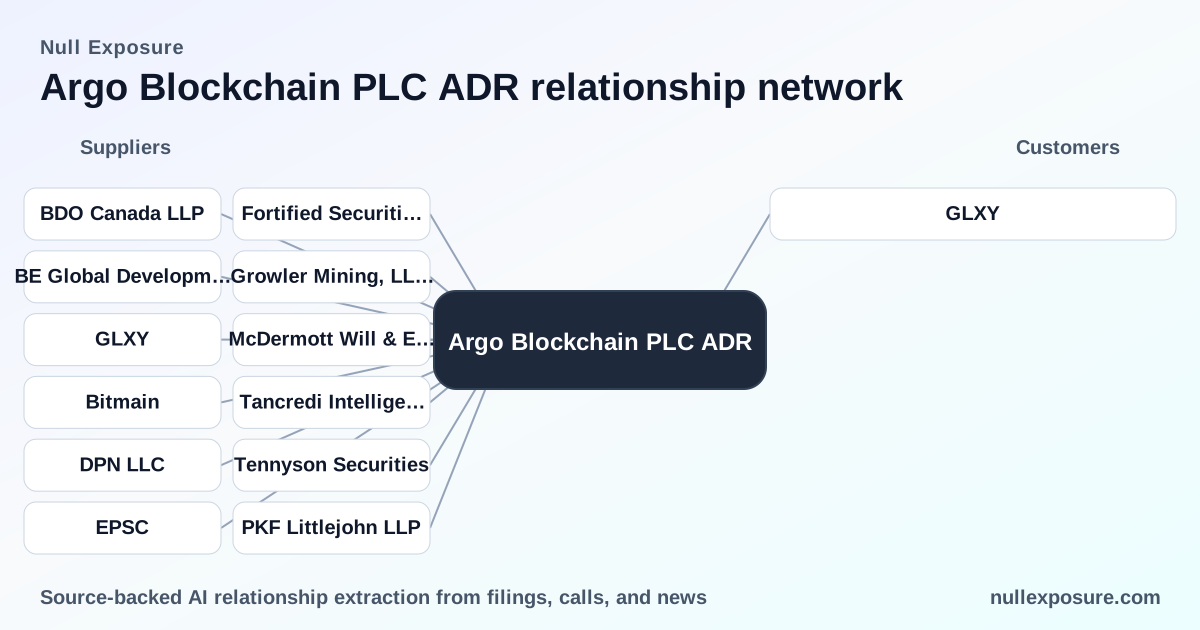
The public signal set in the relationship results centers on one counterparty: Galaxy Digital Holdings Ltd (GLXY). Both items in the results reference the same press report; I list each recorded relationship entry below exactly as surfaced.
-
Galaxy Digital Holdings Ltd — Following the successful completion of the sale of Argo’s Helios facility to Galaxy Digital, Argo’s CFO Alex Appleton resigned from his executive roles to pursue other opportunities. According to an FXNewsGroup report dated March 9, 2026, the Helios sale was the triggering event referenced in Argo’s announcement.
Source: FXNewsGroup (news report, March 9, 2026). -
Galaxy Digital Holdings Ltd (duplicate mention) — The dataset contains a second, identical news mention: the same FXNewsGroup article reiterates that the Helios facility was sold to Galaxy Digital and that Alex Appleton resigned post-transaction. This duplicate press signal confirms the transaction and the related corporate change were widely circulated in March 2026.
Source: FXNewsGroup (news report, March 9, 2026).
For readers tracking counterparty exposure: the only named customer/counterparty in the available relationship results is Galaxy Digital, and the public narrative links Galaxy to a completed facility purchase that directly influenced Argo’s executive changes.
You can explore deeper customer-relationship flags and the supporting documents at https://nullexposure.com/.
Operating-model constraints and company-level signals investors should internalize
While no formal constraint excerpts are attached to these relationship records, the company-level financial and event signals provide clear operating-model constraints:
- Contracting posture: Active asset recycling is part of Argo’s posture — the Helios sale is an explicit example of monetizing capacity rather than always expanding via capex. That posture reduces immediate capex requirements but trades off future mining throughput.
- Concentration and counterparty concentration: Argo’s revenue base is limited and mining is inherently concentrated by facility; the reliance on discrete facilities elevates the impact of individual asset sales on near-term production. Institutional ownership is limited (~13%), which constrains access to patient capital through major institutional investors.
- Criticality of assets: Individual facilities are material to production economics; divestiture of a named facility like Helios is a structurally important event for operational output and forecasting.
- Business maturity: The company operates in a sector with early-stage volatility—capital intensity is high, operating volatility is high, and EBITDA can be negative even when headline accounting metrics suggest profitability. Investors must reconcile income-statement items and cash-flow profiles in filings to understand sustainable economics.
These constraints are company-level signals and should drive how investors model cash flow timing, capex needs, and counterparty risk. Do not treat the Helios sale as a one-off without considering the implications for future capital allocation and production guidance.
Tactical implications for owners and analysts
- Short-term liquidity boost vs long-term throughput trade-off: The Helios sale provides cash or risk transfer to Galaxy Digital while reducing Argo’s in-place hashing capacity; models must adjust mined-coin production curves accordingly.
- Executive turnover as governance signal: The resignation of a CFO immediately following a material disposal is a governance and succession event that investors should interrogate through filings and calls.
- Reconciling reported profitability: Use the latest quarterly filing (latest quarter in the data: 2025‑06‑30) to reconcile the negative EBITDA with reported profit-margin metrics; the differences can arise from non-cash items, one-time gains from disposals, or accounting timing.
- Counterparty concentration monitoring: With Galaxy Digital as a disclosed buyer of a meaningful facility, track subsequent commercial arrangements (hosting agreements, power contracts, offtake) that will alter Argo’s revenue profile.
Quick investor checklist: what to do next
- Review the company’s most recent SEC/market filing for the Helios transaction terms and any related sale-and-leaseback, hosting, or service agreements. Confirm whether proceeds were used to pay debt, reinvest, or shore up liquidity.
- Re-model production forecasts assuming the Helios facility is out of Argo’s future hashing capacity unless filings show a hosting/operational arrangement retained under contract.
- Monitor corporate governance updates and CFO replacement details to assess near-term execution risk.
- Track Galaxy Digital’s disclosures for operational plans at Helios; the buyer’s strategy will affect regional hash price and hosting dynamics.
Bottom line
The public relationship signals for ARBK in this set are narrowly concentrated: Galaxy Digital is the counterparty tied to a material asset sale (Helios), and that same event coincided with executive turnover. For investors, that combination is a classic liquidity-management trade-off — immediate capital or risk transfer in exchange for a reduced asset footprint and altered production profile. Reconcile the company’s accounting metrics in the latest filings and incorporate the Helios disposition into any near-term production and cash-flow forecasts.
For ongoing, transaction-level monitoring of Argo and similar names, see the coverage at https://nullexposure.com/ — the hub for tracking customer and counterparty moves that change operating leverage and investor outcomes.