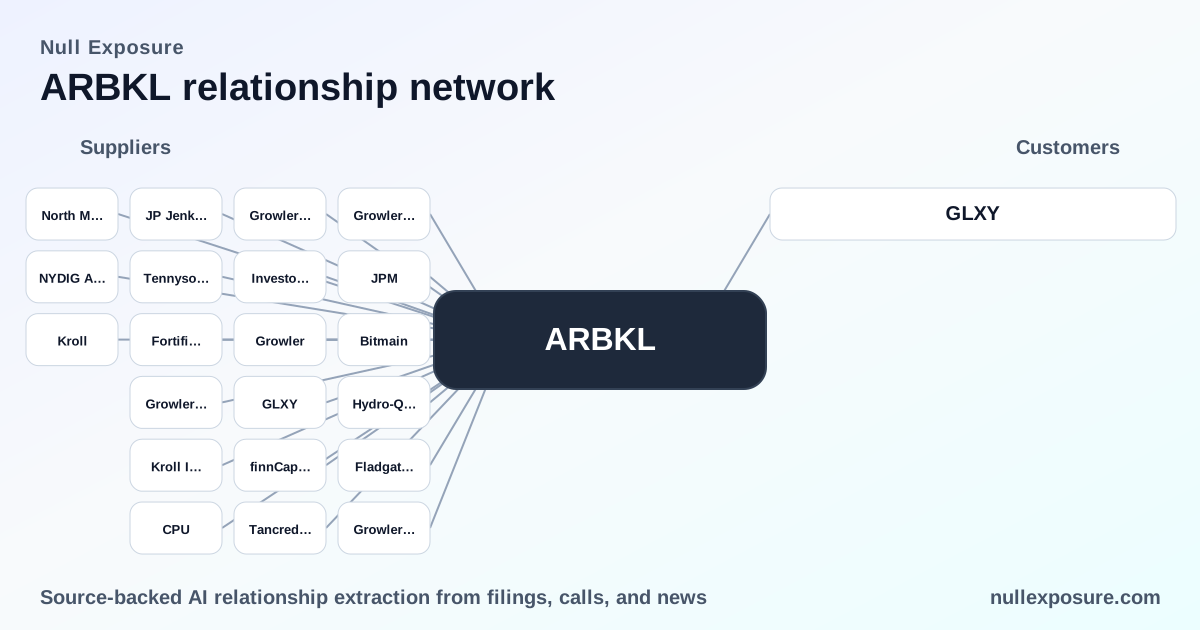
ARBKL Customer Relationships: How asset sales and creditor settlements reshape credit exposure
Argo Blockchain operates as a digital-asset miner that monetizes through mining revenue, strategic asset dispositions, and structured financings; holders of the ARBKL 8.75% Senior Notes due 2026 are therefore exposed not only to bitcoin price and hash-rate dynamics but also to the company’s active balance-sheet engineering and counterparty arrangements. Recent customer and counterparty transactions show Argo extracting liquidity through asset transfers and equity commitments while de-risking legacy secured claims, which has direct implications for recovery dynamics ahead of the 2026 note maturity. For more on counterparty intelligence and deal-flow signals for fixed income and structured investors, visit https://nullexposure.com/.
Why these relationships matter to noteholders
Argo’s commercial interactions with a small set of strategic counterparties function less like recurring commercial customers and more like liquidity partners and exit buyers. The company’s approach is transactional: sell or transfer mining assets, settle secured claims through equity issuances, and secure committed equity subscriptions to fund operations or retire liabilities. That posture converts operational exposure into counterparty and transaction risk — concentration in counterparties and timing of cash flows become primary drivers of recovery value for ARBKL paper.
- Contracting posture: Argo negotiates bilateral settlement and purchase agreements rather than long-term, volume-based contracts.
- Concentration: Activity centers on a few large counterparties capable of acquiring mining facilities or accepting secured-claim settlements.
- Criticality: Asset disposals like the Helios sale materially change the company’s production base and therefore the economic profile of the notes.
- Maturity of relationships: Transactions span multiple years (FY2022–FY2026), showing an active restructuring timeline rather than a one-off sale.
Detailed counterparty briefs (all relationships covered)
Growler Mining Tuscaloosa, LLC — equity issuance in exchange for secured-claim release and asset transfer (FY2025)
Argo issued shares to Growler in return for Growler’s release of approximately $7.7 million in secured loan claims, the transfer of cryptocurrency mining assets valued at $23.8 million, and a $3.5 million cash contribution, effectively converting secured creditor exposure into equity and asset consolidation on Argo’s books. This arrangement was reported in May 2026 by Investing.com summarizing Argo’s restructuring disclosures (Investing.com, May 2026).
Growler Mining Tuscaloosa, LLC — committed equity subscription up to $5.0 million (FY2026)
A separate agreement sets terms under which a subscriber (Growler or an affiliate) committed to purchase up to $5.0 million of Argo ordinary shares during a defined commitment period, with funding to occur via drawdown notices as tranches are requested by Argo. This subscription framework surfaced in an EDGAR-related notice reported by ADVFN in May 2026 and signals an ongoing capital relationship intended to supply incremental equity liquidity (ADVFN/EDGAR notice, May 2026).
Galaxy Digital Holdings Ltd (GLXY) — sale of Texas Helios facility (FY2022)
Argo sold its Texas-based Helios mining facility to Galaxy Digital, a transaction that triggered a dramatic market reaction — Argo’s London-listed stock spiked over 70% on the announcement — and represents a precedent for monetizing large-scale mining assets via third-party acquisitions. Forkast reported the Helios sale and the attendant price movement in March 2026, documenting Galaxy Digital’s role as a strategic buyer in Argo’s asset-disposition program (Forkast, March 2026).
What these counterparty moves imply for creditors and investors
The relationships above reveal a clear strategic playbook: convert secured claims into equity, monetize physical mining assets, and secure committed equity subscriptions to shore up liquidity and reduce secured-lender pressure. For holders of the ARBKL senior notes due 2026, this translates into several actionable implications:
- Recovery dynamics shift to counterparty execution. Recovery on the notes will depend on the realized proceeds from asset sales and the effectiveness of claim-for-equity settlements, not just ongoing mining economics.
- Counterparty credit quality matters materially. The ability of counterparties like Galaxy or Growler to fund acquisitions, provide cash contributions, or honor subscription commitments directly affects Argo’s liquidity runway.
- Event timing concentrates near note maturity. Transactions reported across FY2022–FY2026 indicate active restructuring; the sequence and success of remaining disposals or equity draws will determine cash available at or before the 2026 maturity.
- Equity issuances dilute upstream recovery for unsecured stakeholders, but can improve secured creditor outcomes when used to settle claims. The conversion of secured loan claims into equity reduces a secured creditor’s direct claim on assets while potentially stabilizing the company’s balance sheet.
Constraints and company-level signals
There are no explicit contractual constraints or covenants surfaced in the reviewed reporting that tie Argo’s customer contracts to specific lock-ups, escrow arrangements, or operational performance triggers. The absence of listed constraints in the available relationship reporting functions as a company-level signal: Argo’s restructuring and liquidity measures are executed through negotiated bilateral agreements rather than standardized, publicly disclosed constraint frameworks, which increases reliance on counterparty negotiation outcomes and private settlement mechanics for recovery determinations.
How investors should read these developments
- Prioritize counterparty diligence. Evaluate the financial wherewithal of counterparties like Galaxy and Growler and the enforceability of subscription/settlement commitments.
- Monitor tranche and drawdown schedules. For the Growler subscription, the timing and uptake of drawdowns will reveal whether equity commitments translate into usable cash.
- Track remaining asset-sale opportunities. Additional disposals will materially affect the asset base available to meet senior-note obligations ahead of 2026.
For deeper counterparty intelligence and ongoing monitoring of Argo’s restructuring outcomes, visit https://nullexposure.com/ to see how these flows intersect with credit recovery scenarios.
Bottom line
Argo’s counterparty activity is a purposeful liquidity and restructuring program: asset sales, secured-claim-for-equity conversions, and committed equity subscriptions are the levers management is using to manage through to the 2026 note maturity. For holders or underwriters of ARBKL paper, the central risk is execution risk with a few counterparties rather than diversified operational exposure — and that execution will determine ultimate recovery.